
(Due to a calamitous computer meltdown, these mini reviews are the missing posts.)
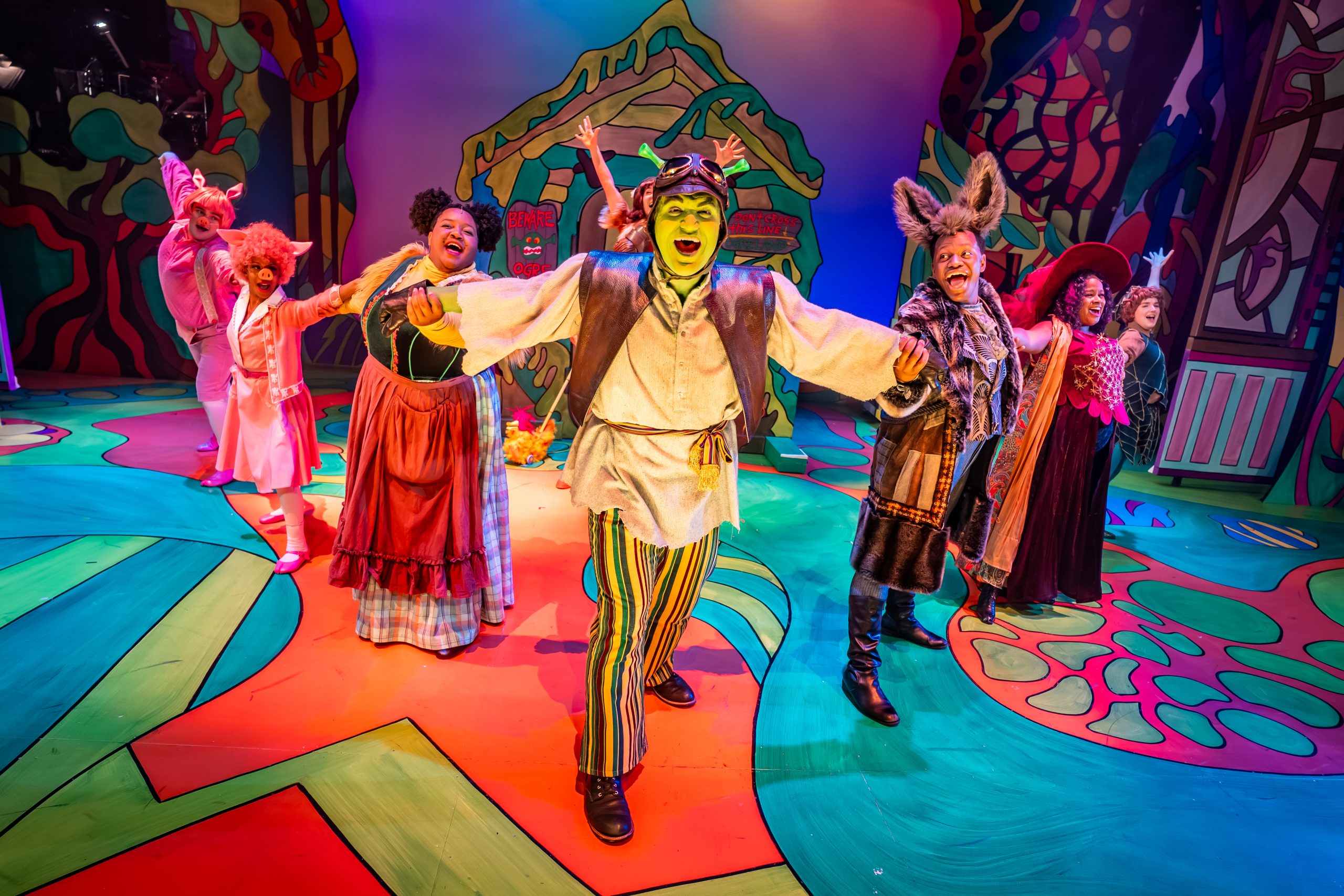
Shrek The Musical
Photo: Dahlia Katz
Young People’s Theatre/Shrek The Musical, based on the DreamWorks Animation Motion Picture and the book by William Steig, book and lyrics by David Lindsay-Abaire, music by Jeanine Tesori, directed by Herbie Barnes, musical direction and arrangements by Jeannie Wyse, choreographed by Monica Dottor, Young People’s Theatre, closes December 30.
In a word, Shrek the Musical is adorable.
Before seeing the show, I knew nothing about the Shrek universe, but the performance I attended was filled with schoolchildren, and the first question the YPT educator asked in the Q&A was, “What did Shrek learn?” The answers were wonderful. He learned not to be alone. He learned about love. He learned that it was acceptable to be different. All the teaching points were there because the message of acceptance is at the heart of the musical. The schoolchildren absorbed that completely, and nothing could have made their teachers happier. I asked an usher whether the musical followed the storyline of the film and apparently it does so the outsider message is there in the original book which is a good thing indeed.
I know Jeanine Tesori from the opera world, so I suppose it was a bit snobbish of me to be surprised that she had composed Shrek The Musical. Nonetheless, the songs are tuneful and varied, David Lindsay-Abaire’s lyrics clever, Monica Dottor’s choreography delightful, and Herbie Barnes’ direction over all extremely clever.
It is a talented cast of thirteen with everyone but Shrek (Trevor Patt), Princess Fiona (Ellen Denny), and Donkey (Joema Frith) playing multiple roles.
I did not know that Shrek is a Scottish ogre , nor as played by Patt, that he has an even, placid presence. Denny can certainly sing and dance up a storm but Frith at times just speaks too quickly as Donkey although he certainly nails the fast talking hustling character. Michael Therriault is extremely funny as the tiny Lord Farquaad, seated as he is to create his three-foot height. Jeff Madden gives good support as the formidable Thelonious, the major domo of the kingdom (among other roles). The cast of fairytale characters banished to the swamp is uniformly strong.
William Layton’s set is fanciful and his dragon is wonderfully constructed, while Joyce Padua’s costumes are truly imaginative. Everything about this production feels like a big musical, even though the orchestra is just two pianos and percussion. Even the vulgar humour, such as Fiona and Shrek trying to outdo each other with farts, which sent the children into gales of laughter, fits the style of the piece.
I thoroughly enjoyed Shrek The Musical, musically, visually, and thematically. Long may it run.

Paquin Exhibitions & Theatricals/The Unauthorized Hallmark(ish) Parody Musical, book by Bonnie Milligan and Tim Drucker, lyrics by Bonnie Milligan, Tim Drucker and Joel Waggoner, music by Joel Waggoner, directed by Tim Drucker, music direction by Joel Waggoner, choreography by Brooke & Tiffany Engen, Royal Theatre, closes Jan. 4.
The world premiere of The Unauthorized Hallmark(Ish) Parody Musical is a promising idea, and the creative team certainly has great creds behind it. One of the book and lyric writers, Bonnie Milligan, has a Tony Award for Kimberly Akimbo, and there are other substantial Off‑Broadway and Broadway experiences shaping the material.
However, you have to be careful with parody because it can easily slip into the wrong kind of silliness, as, unfortunately, TUHPM does.
The show begins cleverly enough, with witty lyrics and a cute setup.
Holly (Alexandra Clementi), who works for Big Bank in Big City and who has just completed a Big Merger, learns that her mother Merry (Emily Richardson) is having heart trouble. Holly leaves everything in the hands of her ambitious assistant, Martha (Luke Witt), a drag role, and returns home to Small Town to help her mother run the twelve businesses she owns. Once there, Holly discovers her former love Mark (Sean Meldrum), now the town sheriff, and uncovers a scandal involving the local baking contest instigated by Cookie (Heidi Michelle Thomas) and her evil henchthingy Cody (also Witt), not to mention a runaway moose as a plot enhancer.
The lyrics remain clever and the original songs are bouncy, but they begin to sound the same, and the razor‑thin storyline cannot sustain the early promise no matter how many Hallmark (ish) spoofs are thrown in, What starts as sharp parody gradually loses steam because the narrative foundation is so slight despite the ending, hinging on whether Holly will follow the Hallmark rule and stay in Small Town, or whether she will break the mould and choose differently.
The ex-movie house Royal Theatre is usually for events so it has a postage-size stage but director Drucker and his two choreographers do what they can with movement but they are limited in scope. Sadly, Chris Osborn’s scenic design augmented by Taylor Edelle Stuart ‘s video projections (with Drucker listed as scenic consultant) looks barely high school level although this may be intended. As well, the usually reliable Ming Wong did not do much in terms of costumes. Sadly, the show looks on the cheap not to mention that you need a crane to haul you out of the low lying theatre seats.
Luckily, there is a lively cast to offset the inherent weakness of the show. They seem to be able to laugh at themselves which is a blessing.

Robin Hood, A very Merry Family Musical
Photo: Dahlia Katz
Canadian Stage in association with the Elgin & Winter Garden Theatres/Robin Hood, A Very Merry Family Musical, written by Matt Murray, directed by Mary Francis Moore, musical direction by Mark Camilleri, choreographed by Jennifer Mote, Winter Garden Theatre, closes Jan. 4.
This is the second year that Canadian Stage has taken over the Ross Petty pantomimes, and everything is exactly as it should be: a total delight for both children and adults. Children get the story and the visual exuberance, while adults get the steady stream of double entendres and topical jokes.
Written once again by Matt Murray, Robin Hood: A Very Merry Family Musical offers a clever contemporary premise in which Robin (the terrific Julia Pulo) is a small-business hoodie maker taking on Glamazon, the corporate behemoth run by the villainous Prince John (Damien Atkins), There is an interesting twist to Robin’s character. She is such a control freak that she keeps losing stuff.
Meanwhile, Prince John has seized power while King Richard (also Atkins) is off in Turkey getting a hair transplant. Atkins is gloriously unscrupulous, refusing to pander to the children while clearly reveling in every moment of villainy. He is absolutely brilliant.
Set in Roncesvallesshire, with a wealth of west-end Toronto references, the plot hinges on Glamazon’s plan to cannonade High Park for a fulfilment centre, giving the show a sharp local bite. Children from the audience are always included in the plot line and writer Murray has created a very interesting scenario for them (although I still think they should get a small gift for their participation).
There is romance for Robin in the form of Prince John’s seemingly double-dealing handsome nephew Marion (Praneet Akilla), game-playing with the comic duo of Friar Tuck (Eddie Glen) and Little John (Julius Sermonia) and a proper panto dame in Daniel Williston’s Sparkle Bum, Robin’s nursemaid who has long outstayed her usefulness (but who has also the best laugh lines for the adults), alongside a score of found pop songs under the lively direction of Mark Camilleri, sassy choreography by Jennifer Mote, and brisk, high-energy direction by Mary Francis Moore. Brandon Kleiman’s colourful, slightly gothic set design adds to the festive spectacle along with Ming Wong’s’ fascinating medieval/modern costume mélange.
I do miss the sponsor parody commercials that used to punctuate the Ross Petty shows, but that is a small quibble in an evening that is bright, funny, smartly performed, and deeply satisfying. Canadian Stage has happily rescued a beloved Toronto holiday tradition.

Narnia
Photo: Dahlia Katz
Bad Hat’s Theatre with Soulpepper and CROW’S/Narnia, based on The Lion, The Witch and The Wardrobe by C.S Lewis, adapted, directed and co-choreographed by Fiona Sauder, music and lyrics by Landon Doak, associate direction and dramaturgy by Matt Pilipiak, creative producer Victor Pokinko, music director, orchestrator and arranger Jonathan Corkal-Astorga, co-choreographed by Rohan Dhupar, Young Centre for the Arts, closes Jan. 4.
Bad Hat’s Theatre’s holiday adaptation of The Lion, The Witch, and The Wardrobe should, by all accounts, be a slam-dunk: the production is a hit, it has been extended, and it boasts enormous talent. But for me, it was a show of accumulating irritations.
Adapted, directed, and co-choreographed by Fiona Sauder, the piece departs from C. S. Lewis’ novel by reimagining the four Pevensie siblings – Peter (Matthew Novary Joseph), Susan (Sierra Haynes), Edmund (Landon Doak), and Lucy (Belinda Corpuz) – as unrelated orphans, underscoring the idea that family does not require blood ties, a point further underlined by the portrayal of Mr. and Mrs. Beaver as a same-sex couple – Beaver (Jonathan Tan) and Mr. B (Matt Philipiak). In fact, Mr. B. makes that very point – that you can create your own family. The idea does come with loose ends, however, including a teasing reference by the now-female Professor to a woman in a portrait that goes nowhere. Thus, irritation number one,
Framing the action, the Professor, beautifully played by veteran actor Astrid Van Wieren, narrates the transitions between scenes in rhyme so strained and awkward the lines became a source of genuine annoyance.
There is much to admire: Landon Doak’s original songs are strong, (despite some weak diction), the multi-talented cast play instruments, and Amaka Umeh delivers a thrilling, full-throttle performance of the character now simply called Witch. While everyone else gets to appear on stage as some character or other, Jonathan Corkal-Astorga is toiling away on a partially hidden piano as a one-man band even though he is joined by various instruments on the songs, which, in a way, breaks character whenever someone becomes a musician.
Shannon Lea Doyle’s restless set, with staircases constantly reconfiguring, proves visually exhausting, and the climactic battle is staged so quickly and indistinctly that I could not tell how the Witch was defeated or Edmund wounded.
The biggest laughs in the show come from two Sauder inventions, both played to great effect by actor James Daly. Sauder has borrowed two characters from Prince Caspian – Trumpkins and Reepicheep – and stripped them of their nobility.
In this adaptation, Trumpkins is the Witch’s majordomo who speaks in a hilariously pompous but mangled misaligned English, while Reepicheep is a little mouse on wheels that Daly pulls on a stick while speaking in a totally indecipherable high squeaky voice. There is a double laugh here because the mouse-puller is called incongruously Kevin.
Finally, I admit I am clearly the outlier here, but despite the fine performances and musicality, this very successful production in the eyes of others, simply did not come together for me.

Wing Chun Dance Drama
Photo: Courtesy Shenzhen Opera and Dance Theatre
TO Live, ADEM Company Inc. & Canada China Cultural Development Association/ Shenzhen Opera and Dance Theatre’s Wing Chun Dance Drama, co-choreographed by Han Zen and Zhou Liya, Meridian Hall, closes Jan. 4.
The North American premiere of Wing Chun Dance Drama, presented by the Shenzhen Opera and Dance Theatre, is an ambitious and exhilarating work that operates on two parallel levels.
On one, it traces the life of Ip Man (Chang Hongji), a grandmaster of the Wing Chun branch of Chinese martial arts and mentor to Bruce Lee, as he establishes his academy in Hong Kong; on the other, it follows a young lighting technician, Da Chun (Feng Haoran), whose dream of mastering Wing Chun unfolds alongside a film crew making a movie about Ip Man’s life. Thus, we see two timelines – Ip Man in the 1950s and Da Chun in the 1990s.
Created by choreographers Han Zhen and Zhou Liya in 2022, the spectacular piece moves fluidly between lyrical ballet, expressive contemporary dance and electrifying demonstrations of the four core elements of Wing Chun, the latter executed with dazzling precision. The martial arts demonstration forms the central section of the piece and is performed with great formality as Ip Man takes on four great fighters, one a woman (the same dancer as the woman film director), in thrilling combat and is clearly the emotional heart of the dance drama.
One of the most striking sequences of the production depicts Ip Man’s arrival in Hong Kong, where crowded streets spring to life through idiomatic choreography that conjures up fishmongers, mahjong players, and brothels with extraordinary clarity. On the other hand, the film crew choreography is also strikingly original with the female director (Wang Yuanlin) expressing her angst through angular contortions of her body while her lighting, sound and script people all have signature moves around their equipment or devices. The detail is astonishing, whether the crowded street or the small group of filmmakers.
Chang Hongji is phenomenal as Ip Man, anchoring the work with quiet authority. Two ravishing duets with his wife Wing Sing (Xu Tianhui) provide moments of shimmering beauty contrasting sharply with the force and dignity he projects as a Wing Chun grandmaster. As Ip Man gradually loses his powers with age and illness, Chang Hongji’s performance is hear0breaking as he graphically details his body’s decline. In total contrast, of course, is young Da Chun, who grows with force and vigour throughout the work.
The production values are lavish: a constantly shifting set of modular boxes creates vivid spaces, the sophisticated lighting effects are superb, and a sweeping symphonic score by composer Yang Fan gives the evening its emotional lift, not to mention a literal avalanche of costumes as worn by the huge cast.
Although the narrative occasionally feels overstuffed and leaves gaps, not to mention a plethora of false endings, the sheer scale and choreographic imagination are overwhelming. Wing Chun Dance Drama is unapologetically oversized right contemporary Chinese dance theatre at its most expansive, and I found it utterly enthralling.