
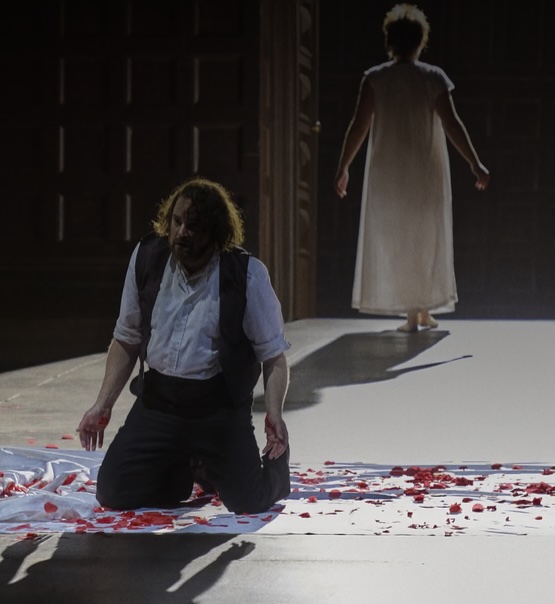
Rigoletto
Photo: Michael Cooper
Canadian Opera Company/Rigoletto by Giuseppe Verdi, libretto by Francesco Maria Piave, directed by Christopher Alden, conducted by Johannes Debus, Four Seasons Centre, closes Feb. 14.
I am very glad that the Canadian Opera Company has remounted this production of Rigoletto, because only by seeing it again can one really get a handle on American director Christopher Alden’s take on this Verdi opera.
Alden is an auteur: a director with an unmistakable stamp, known — along with his brother David — for radical, often ultra-creative and provocative reimaginings of canonical works. When he is good, he is very, very good. When he is bad, he can be very irritating indeed.
When I first encountered this Rigoletto in 2018 — a co-production with English National Opera, with sets and costumes by Canadian designer Michael Levine — my reaction was blunt: this was one of the busiest productions I had ever seen, and somewhere inside all that activity was Verdi’s Rigoletto. Seeing it again however, I understand that the busyness is not gratuitous. It has purpose, coherence, and cumulative force. This second viewing makes the production not merely intelligible, but compelling. For me, it becomes an absolute must-see.
The singing in this production is, across the board, wonderful, and the orchestra is superb. Anyone who follows my writing on the COC knows that Johannes Debus, the company’s music director, can seemingly do no wrong — and he certainly does not here. The orchestral playing is electric, driven, and finely detailed, with Debus urging Verdi’s score forward with total conviction. But as impressive as the musical side is, what ultimately distinguishes this Rigoletto is what Alden places around the singers — the relentless stage business that illuminates the libretto by Francesco Maria Piave.
That libretto, of course, is based on Victor Hugo’s incendiary play Le roi s’amuse (The King Amuses Himself), a work that caused outrage in France and ran headlong into censorship. Verdi was warned it would face the same resistance in Italy. At its centre is an unrepentant libertine — here the Duke of Mantua (American tenor Ben Bliss)— who uses and destroys women with impunity. Alden embraces that scandal head-on.
The opera opens in what Alden/Levine make a male-only smoking room: cigars, port, newspapers, and power. Women are excluded — except for two. One is the shattered, ruined daughter of Monterone, (Canadian actor Brooklyn Marshall) whom Alden introduces as a silent onstage presence. She is disheveled, visibly destroyed, and her very existence indicts the Duke before a note is sung. The other woman is later Giovanna (Canadian mezzo-soprano Simona Genga), Gilda’s nurse, who becomes one of the most chilling figures in the production. She caters to the Duke, facilitates his access to Gilda under the guise of a “poor student,” ministers cruelly to Monterone’s daughter, and moves through the opera as an eminence grise. It is devastating to watch a woman aiding the destruction of other women.
The men — the all-male chorus — are everywhere. There is no female chorus in Rigoletto, and Alden makes that absence speak volumes. The courtiers encircle the action, complicit, amused, enjoying the Duke’s conquests. Rape is not euphemized here. When Gilda (Canadian soprano Sarah Dufresne) is abducted, the staging makes clear what is happening, with the crowd closing in as violence occurs. It is horrifying, and it is meant to be.
At the centre of this moral nightmare stands American baritone Quinn Kelsey’s Rigoletto, a performance of total immersion. Kelsey does not merely sing the role; he inhabits it. As the court jester, despised by the men he mocks, he feels the curse of Monterone (Canadian baritone Gregory Dahl) — “Maledizione” — in his bones. That curse becomes destiny. His daughter sacrifices herself to save the Duke who has ruined her, and the curse is fulfilled with cruel inevitability.
Dufresne’s lyric coloratura is exquisite. Her ornamentation is secure and expressive, her “Caro nome” beautifully shaped, and her vocalism suggests a major career ahead. In short, Dufresne’s Gilda is deeply affecting. (I am familiar with soprano Andriana Chuchman who takes over the final three performances as Gilda, and audiences will be in capable hands.)
Bliss, as the Duke, is handsome, tall, and utterly convincing as a cad. He does not soften the character, and Alden gives him a startling piece of business during “La donna è mobile” that exposes his moral emptiness with brutal clarity. More to the point, Bliss makes all his money notes with effortless ease.
American mezzo-soprano Zoie Reams brings warmth and presence to Maddalena, and the quartet — one of opera’s great ensembles — is thrillingly delivered. Chinese bass Peixin Chen’s Sparafucile is dark-voiced and ominous, his presence underscored visually as Alden keeps both him and Maddalena visible onstage long after their initial appearance.
One of Alden’s most striking strategies is his use of the times between scene changes. Curtains are pulled, furniture shifts behind as storm sounds rumble and thunder rolls while Rigoletto remains onstage. He waits, haunted, first alongside Monterone’s ravaged daughter, later alongside his own. In other scenes, the chorus sits around the stage, watching, complicit, observing the fate of Rigoletto, the constant witness to his ultimate suffering.
Only in the final scene does Alden strip the stage bare. No furniture. No chorus. No courtiers. Just Rigoletto and Gilda. And then comes the production’s most radical choice. Instead of dying in her father’s arms, Gilda rises and walks away toward an empty doorway, leaving Rigoletto utterly alone. It is a devastating image — one that reframes the opera’s conclusion entirely. As Debus drives the orchestra through Verdi’s wrenching final chords, Rigoletto is abandoned, cursed, and stripped of everything.
This is a Victorian melodrama set firmly in Verdi’s own time — a world of misogyny, silence, and sanctioned cruelty. By placing Monterone’s daughter onstage as a silent victim, Alden creates a grim through-line: one ruined woman leading another to her death. It is not comfortable. It is not decorative. But it works.
In this case, Christopher Alden gets it right. The busyness, the density, the visual overload — all of it serves the drama. Michael Levine’s designs support the concept rather than smothering it. The result is a Rigoletto that deepens with repetition. I am certain that seeing it yet again would reveal still more.
This is a must-see production — unsettling, intelligent, and finally devastating in its clarity.