
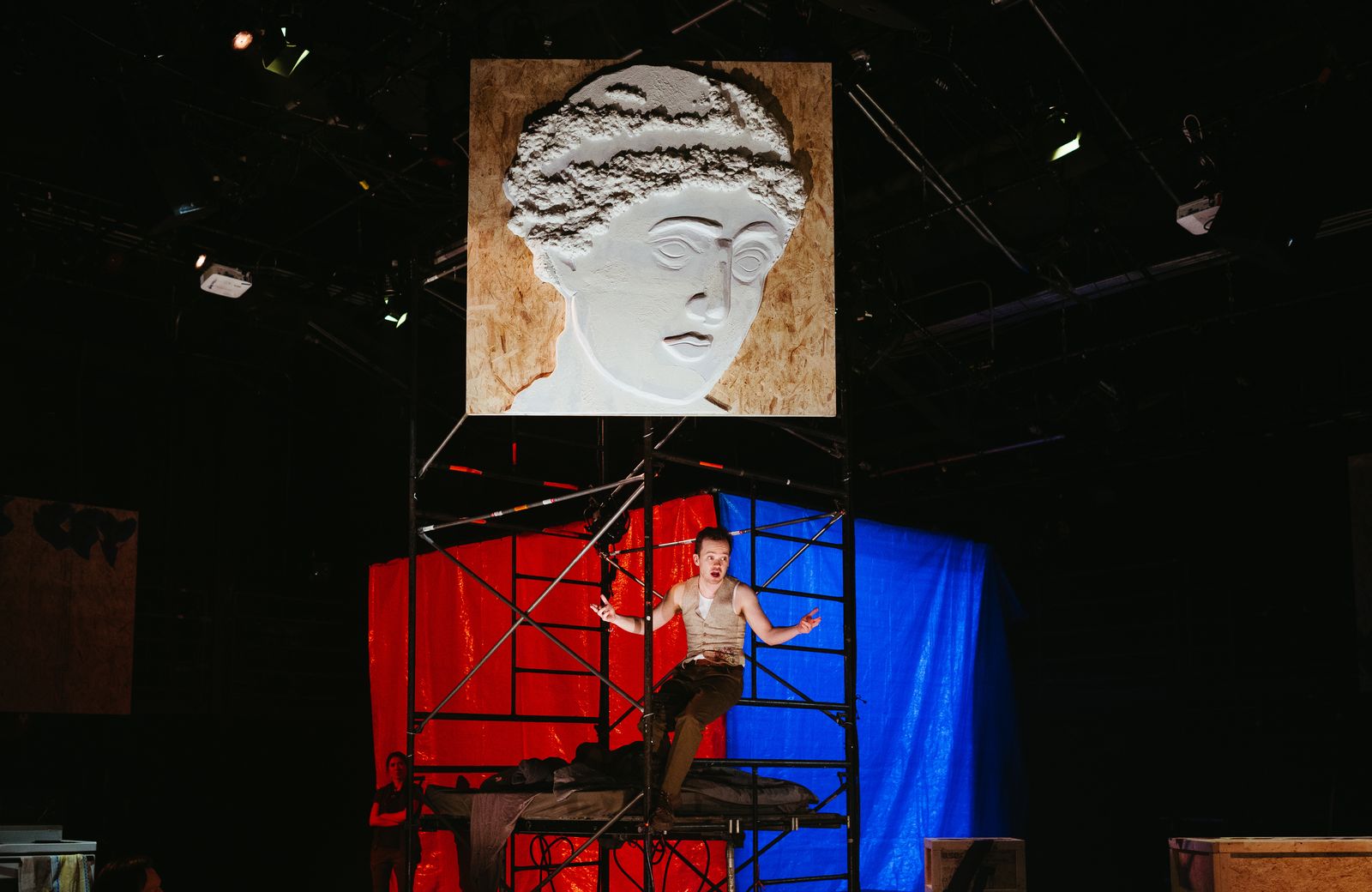
R in the upper scaffolding
Take Rimbaud
Photo by Wade Muir
The Howland Company with Buddies in Bad Times Theatre/Take Rimbaud by Susanna Fournier, directed by ted witzel, Buddies in Bad Times Theatre, closes May 23.
“Once, if I remember well, my life was a feast where all hearts opened and all wines flowed.
One evening, I sat Beauty on my knees. And I found her bitter. And I reviled her.
I armed myself against justice.
I fled.
O witches, O misery, O hatred, to you my treasure was entrusted!”
And so begins “A Season in Hell” (1873) by French poet Arthur Rimbaud, a prose poem that is a wild, fractured, intensely personal work written after the collapse of Rimbaud’s catastrophic relationship with fellow poet Paul Verlaine.
“A Season in Hell” is not a narrative in the ordinary sense. It’s more like a confession, a hallucination, a self-analysis, a rebellion, a spiritual crisis, a poetic manifestation all fused together. It’s a rejection of conventional morality and religion. It’s a fascination with sin, degradation and corruption, self-mockery and self-condemnation, attempts to reinvent consciousness, consciousness through suffering and excess, rage against bourgeois society, erotic and emotional turmoil, disillusionment with the idea of the poet as seer.
And all this is what inspired playwright Susanna Fournier to be the wellspring of a work that would express the fucked up world that she felt existed 12 years ago. And it has taken her 12 years to create the play Take Rimbaud that expresses that fucked up world that is even more fucked up today.
It’s important to understand Susanna Fournier as a playwright. She is substantive. She is a playwright of ideas. She is a playwright as a thinker. She is a playwright who wants her audience to come to grips with the ideas that she puts before you and be overwhelmed by them. For her, coming to a play is not to sit and be entertained, but to be consumed by what she presents. And in conversation with director ted witzel,in the program notes, she bemoans that in these intervening 12 years, capitalism has become an increasingly destructive assault, desensitizing us and sending us even further into isolation.
Even more, that the cause of theatre has become harder to justify, that we have to keep on explaining the value of art to people in order to get the money we need to make it. But art still is important because it’s almost the only arena left for us to think and to feel, and to express how to cope with this fucked up world that we live in. But it’s the only place left where something is being born, where an idea can lead to revolution, and where we’re always moving towards something, and where we can see an idea being born.
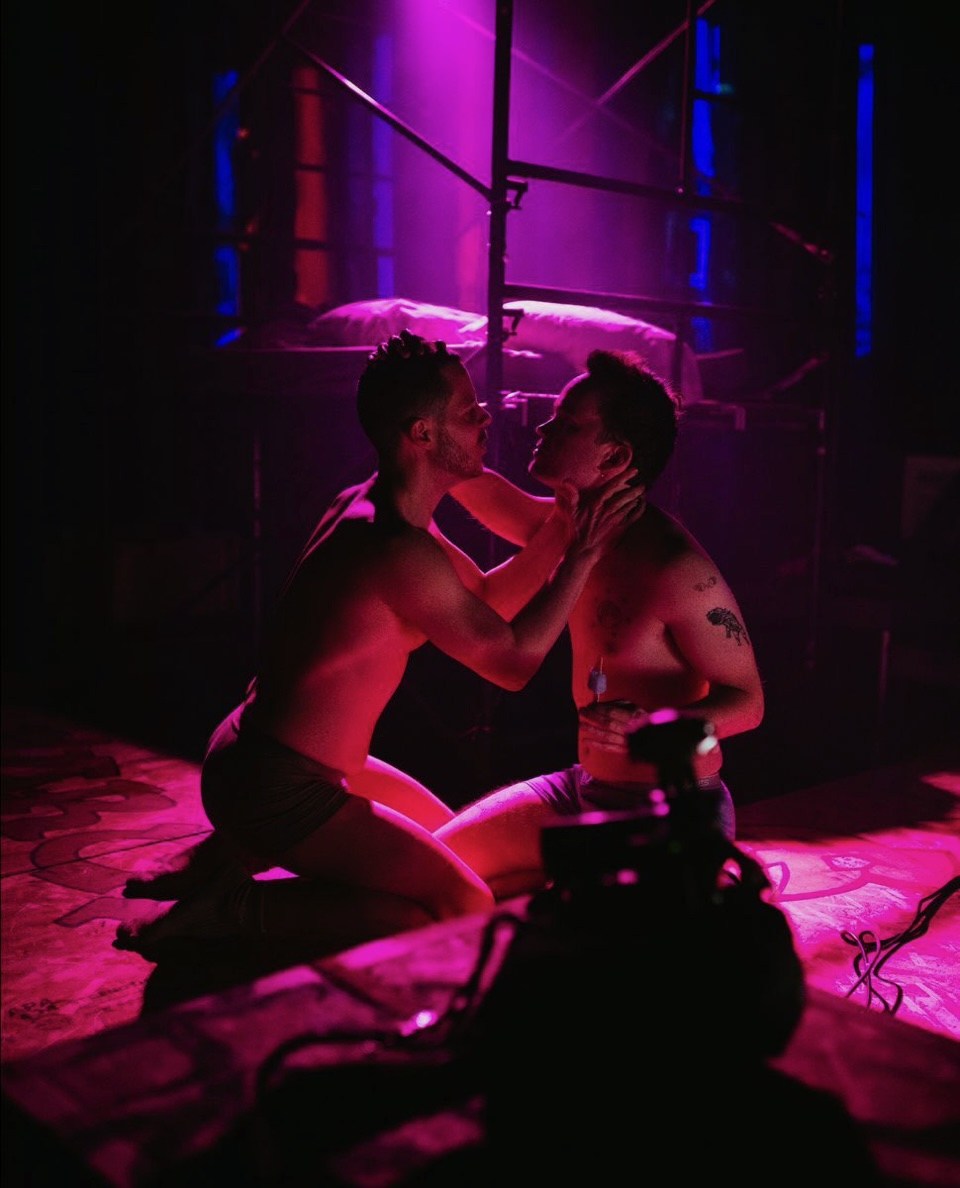
R and Paul
Take Rimbaud
Photo by Wade Muir
And that is what Fournier hopes – that with this new play that took 12 years to come to fruition, that here at least the actors and the audience are feeling seen, that we’re out of isolation, and between what is happening on stage and what we are feeling in the audience, that together, we are being seen.
The play is an hour and 45 minutes without an intermission, and I have no idea where that time went, because I sat there transfixed by what was taking place before me.
How Fournier constructed this play is brilliant. She took four poets and put them in Toronto in 2014 – Arthur Rimbaud, Paul Verlaine, Sylvia Plath, and Sappho from ancient Greece – and that these four characters would meet each other, separately at first, the two women and the two men, and then the four of them would somehow be involved with the making of an art film which would be exposing the fucked up world of today, without any of the manifestations of fake artistry, portraying the truth of today. That would be their goal. Finally, someone would be telling the truth.
The structure of the play has eight actors. The central four are R (Thomas Mitchell Barnet), Paul (Julian De Zotti), Sylv (Ruth Goodwin), and Sapph (Rose Tuong). The characters called 1 (Breton Lalama), 2 (Hallie Seline). 3 (Courtney Ch’ng Lancaster), and 4 (Cameron Laurie) are other characters as needed. They’re also scene changers,.projectionists, cameramen, narrators, commentators, and a Greek chorus. In fact, they’re anywhere they’re needed, but we’re very conscious of their comings and goings which adds to the restless energy of the play.
R and Paul meet very much like the real Rimbaud and Verlaine met in real life. R sent an admiring letter to Paul as Rimbaud sent to Verlaine admiring his poetry who then invited him to come to Paris, and here a similar thing has happened. In this case, Paul has sent R a train ticket to come to Toronto. They form a homosexual relationship and agree to create this art film together that’s going to be artistic truth, Paul being the producer and moneyman, and R being the director and actor. which becomes the source of friction in their very tempestuous relationship.
On the distaff side, the women seem to be at a retreat where emerging writers have come to interface with masters, with Sapph as a master. She first sees Sylv with her head in the oven, and that is their first meeting with Sapph gently reminding Sylv that you cannot kill yourself in an electric oven. It has to be gas. And that is how the two women first get together.
Sylv has absolutely no courage in her own convictions or confidence in her own talent. Sapph keeps telling her that she does have talent, but Sylv remains a blushing violet, painfully uncertain of herself. The two women gradually develop a homoerotic relationship, but you can see that Sapph is very much enamoured of her, while Sylv remains emotionally reticent.
In a way, this echoes the historical story of Sappho, who was lionized in her own day as a great lyric poet. After all, the word “lesbian” comes from the island of Lesbos where she was born, and “sapphic” love derives from her name. Whether Sylvia Plath truly hid her light under a bushel, I am not entirely sure. Was she really a weak link or was she made that way by the forces around her? What is certainly known is that she did kill herself by putting her head in a gas oven.
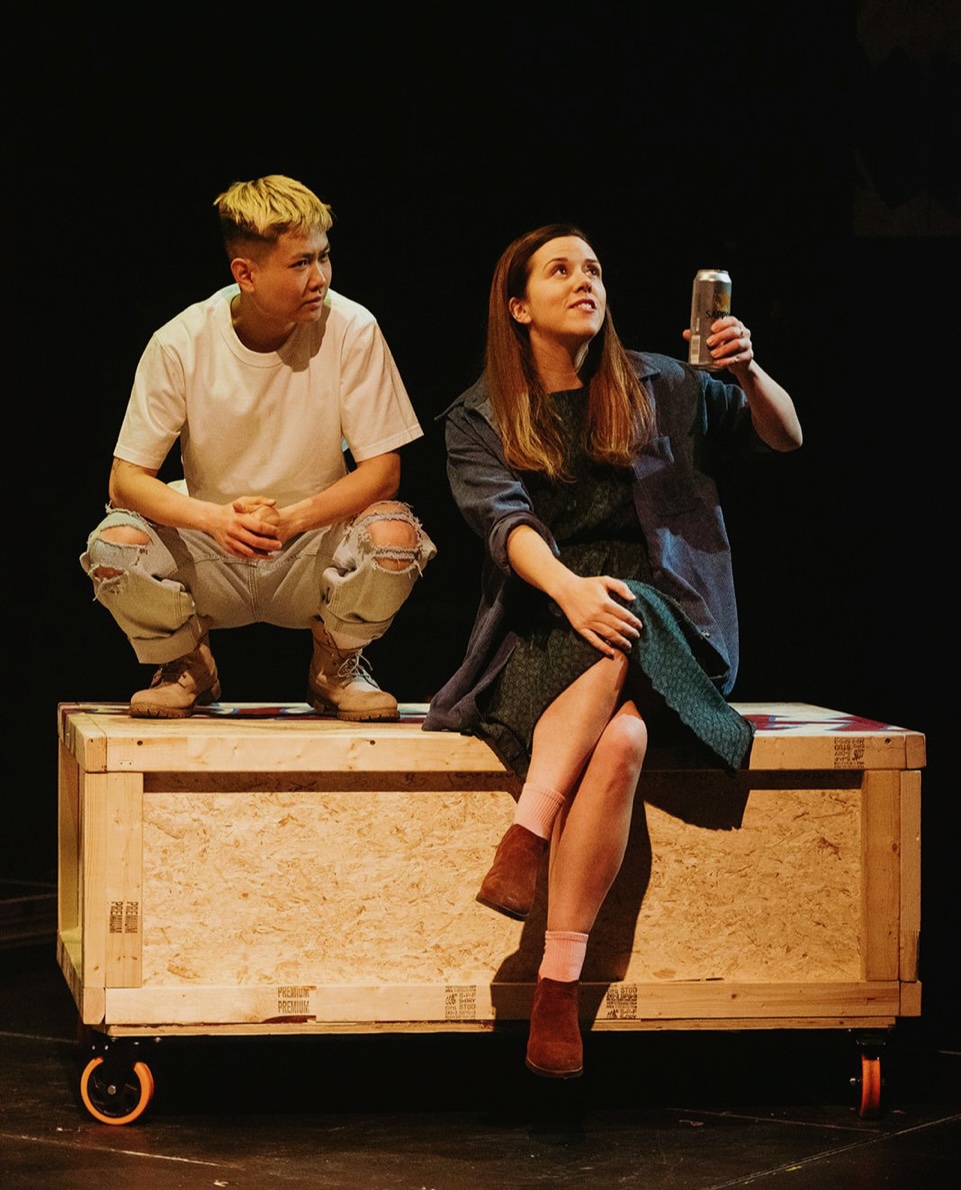
Sapph and Sylv
Take Rimbaud
Photo by Wade Muir
How the two stories intersect is absolutely fascinating. At a wild party where the crowd honours the people who died ridiculously young by intent or an overdose like Amy Winehouse, Heath Ledger, John Candy et.all. by shouting their names as those on the balcony above pour vodka onto the open mouths of the people below – Paul begins to flirt with Sylv and they begin to form a romantic relationship, much to the disgust of both R and Sapph. Sylv confesses to Sapph that she really wants marriage and children, and when Sapph says, but Paul’s a homosexual, that doesn’t matter to Sylv. In fact marriage and children were very important to Plath.
One could say there are other echoes of reality. R just storms out. out of the movie and off the stage. Is that a reference to Rimbaud throwing over poetry in his early 20s, never picking up the pen again? He became a merchant and a traveler, as a matter of fact, he was one of the early coffee merchants.
The Sappho figure literally ends up tied up with masking tape and put in a casket. Is this a reference to her being exiled to Sicily because her family turned out to be on the wrong side of politics when an enemy faction came to power on the island of Lesbos? Sapph claims that she was cancelled, that her poetry fell into disfavour. Is this referring to the Romans not wanting her to be known as a lesbian because that was improper, created an ending for her where she jumped off a cliff in Sicily out of unrequited love for a sailor, which gave her a heterosexual romance, thus making her poetry respectable because the more conservative Romans didn’t like the idea of her being a lesbian. They wanted to give her a proper history because everybody loved her poetry so much.
These characters and storyline, however, are just the bare bones of Take Rimbaud.
Layered over this skeleton are arguments about art and civilization and poetry and literature. There’s even a scene that takes place in the Paris Commune in 1871 which raises questions about politics and history. There are just so many ideas coursing through this play, I can’t even begin to deal with them all because this is a Susanna Fournier play, and the story is just the main thread that the cloth is woven from as illustrated in the thoughts on philosophy and human behaviour stemming from the commentary of 1, 2, 3, and 4.
Also very important are the visual effects that are part of director witzel’s master plan. At one point Sapph is actually cleaning the stove, which is a radical image unto itself. Or, there is a locked crate, and at one point, it is unlocked to reveal a pistol on a purple cushion. And of course, with that pistol, Paul takes a shot at R, mirroring the shot that Verlaine took at Rimbaud, which landed Verlaine two years in prison. Paul in the play does wound R, mirroring again the true story.
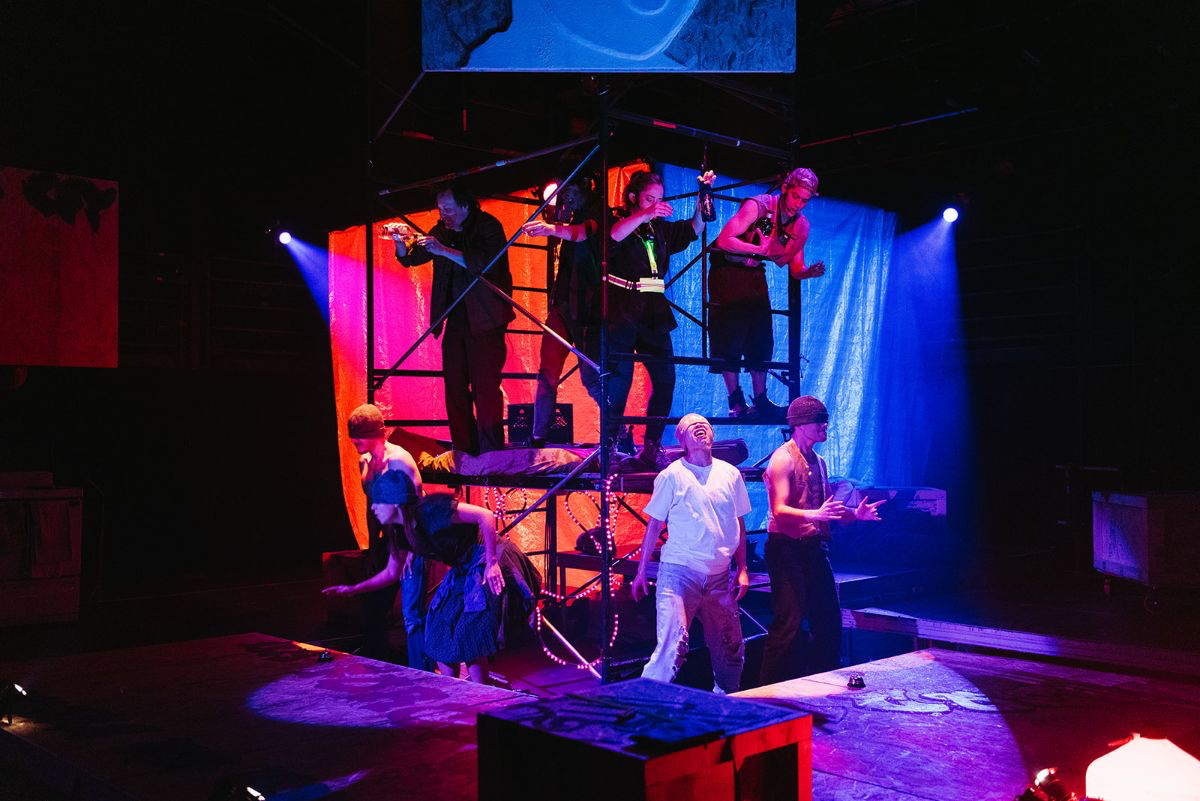
The Party
Take Rimbaud
Photo by Wade Muir
It is hard to put into words the shock of that locked crate that’s been in front of us throughout most of the play, and the revelation of the pistol on the velvet cushion. In fact, all the visual images in this play are just outstanding, with crates being opened and the many projections that keep flashing on the stage and the walls.
And that brings us to witzel’s direction and set designer Ting – Huan 挺歡 Christine Urquhart and the lighting of Darren Shaen and the projections of Nicole Eun-Ju Bell and the sound design of Dasha Plett because they must be taken together as one unified whole. It is a cluttered, messy set, and it seems that the lighting and projections are out of control but there’s much logic in it all which makes the visual aspect of Take Rimbaud so completely compelling.
When you first walk into the theatre, the audience sits in half of a square, so the set is in the triangular middle. Numbers 1 through 4 are cleaning the stage like janitorial staff. In fact Urquhart has costumed them in uniforms with glowing red lights on their chests as if they were some kind of bot. There is a huge plaster cast of a Greek woman dominating the top of the stage. Beneath is a big sheet of plastic hanging over a construction in the middle, and when it’s released, a steel scaffold. is revealed.
This turns out to be Paul’s bedroom in the middle, but it’s also a scaffold that you can climb with a second story where the party takes place. You can leap and crawl all over it, and in fact, they do.
On the surrounding risers where Sapph and Sylv’s story takes place are crates of varying sizes, which throughout the play, will become opened and things will be revealed. So it’s a very mysterious-looking place. They also use the upper gallery at Buddies to great effect, climbing up and down it. It’s a really busy set, all told.. And of course, there’s the famous stove that Sylv puts her head in. It’s the only real object that we can identify.
witzel has the cast move up and down and through the set like monkeys. With the able participation of the lighting designer, people magically appear and disappear in different parts of the set which is all part of witzel’s grand design. Shaen’s lighting is all kinds of garish colours but he has real fun with red, It’s hard to tell where lighting begins and projections end and vice versa. It’s just a wild configuration of action and lights and projections and crates scattered all over the stage and wild movement everywhere. It’s a busy set for a play that’s teeming with ideas.
At this point, the theatre critic, well, this theatre critic in particular, always feels that I’ve never done a Susanna Fournier play adequate justice, because it’s always been such an overwhelming experience. And all I can say is that I’ve done my best to try and convey the depth and the length and the breadth of what she as a playwright has tried to do in Take Rimbaud, and that is to show what a fucked up world we live in.
And, with the art fim in tatters, is it the stillbirth of creativity? Remember that I said the visual images were so very important in this play? There just may be a kernel of hope.
I, however, am left with a lingering question. Fournier does that to me. Why these particular four poets?
Lai Im Lancaster says:
The play should have been filmed. Fast moving performance, from your description, would have made it a very good movie.
pcitron says:
Interesting thought.
P.