
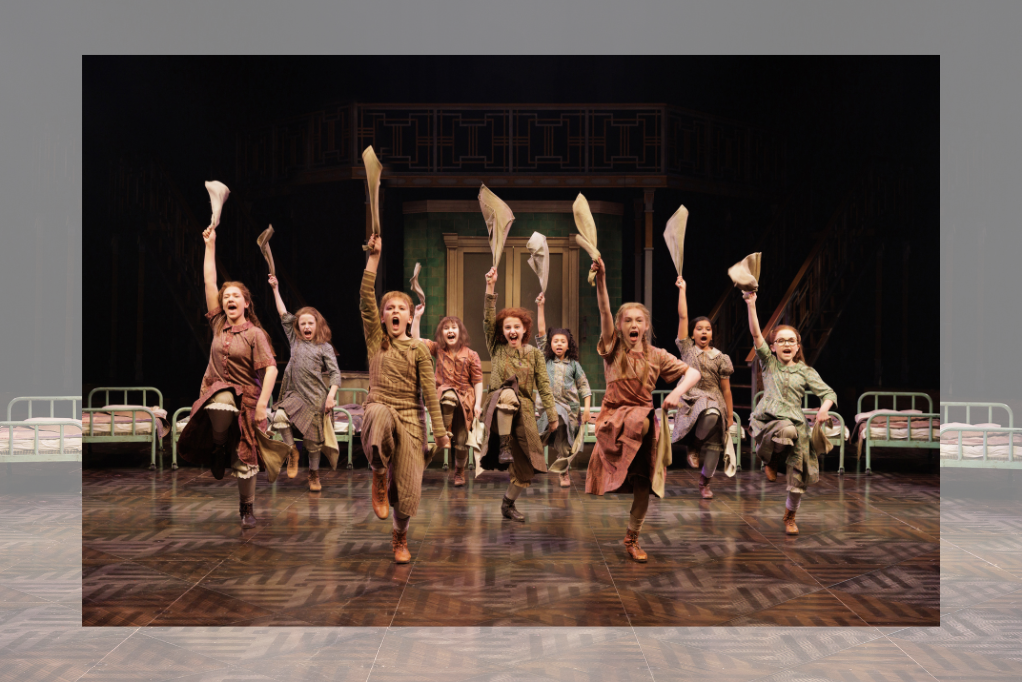
Stratford Festival 2025/Annie, book by Thomas Meehan, music by Charles Strouse, lyrics by Martin Charnin, based on “Little Orphan Annie”, directed and choreographed by Donna Feore, music direction by Laura Burton, Festival Theatre, closes December14.
The Orphans of Annie
Photo: David Hou
There are shows that live or die on spectacle, and there are shows that live or die on performance. Stratford’s Annie manages to do both, and it does so largely on the backs of the children – Annie (Harper Rae Asch) and her eight orphan companions – who populate the stage with astonishing confidence, stamina, and joy. This is a production that never underestimates what young performers can do, and the result is a stage picture alive with movement, precision, and sheer theatrical energy.
From the opening moments, the children are asked to do everything. They sing with clarity and power, they dance with attack and polish, and they tumble, flip, and vault through choreography that demands athleticism as much as charm. These young performers are not treated as decorative figures or sentimental props. They are working artists, and the production respects that. Their commitment gives the show momentum and credibility, ensuring that Annie never sinks into sugary nostalgia.
At the centre of the children’s adult world stands Laura Condlln’s Miss Hannigan who heads the orphanage, a performance that understands the character’s desperation as well as her cruelty. Condlln avoids caricature. Her Hannigan is sharp, bitter, and often funny, but she also suggests a woman who has lost any sense of possibility in her own life. The comedy lands because it is grounded in frustration and exhaustion rather than cartoon villainy, and that balance gives the performance bite.
The other adults in the cast also give life to otherwise stereotype.
Dan Chameroy’s Oliver Warbucks conveys a rich gruff businessman with heart while Jennifer Rider-Shaw is his charming and efficient secretary Grace Farrell who understands how to manipulate her boss. At the down market scale of things, Mark Uhre gives good account as Rooster Hannigan, the no good brother, while Amanda Lundgren is hilarious as the equally no good girlfriend Llly St. Regis. The rest of the large cast, be they the denizens of New York, Warbucks’ mansion, the radio station, or even the White House, are just terrific. And lest we forget, Sandy the dog is adorable, performed as he is by two darlings, Clue and Uno.
Donna Feore’s hand as choreographer and director is unmistakable. Feore has long favoured strong, highly trained dancers, particularly men, and that preference is on full display here. Nowhere is this clearer than in the staging of Daddy Warbucks’s household staff. These men are not passive servants drifting through the background. They are dynamic, muscular dancers who attack the choreography with precision and authority, transforming ensemble numbers into displays of physical power and rhythmic control. The dancing does not merely decorate the score; it drives it forward.
Feore’s choreography across the production is smartly structured, giving each number a clear shape and purpose. Group scenes are staged with clarity, and transitions are fluid, allowing the show to move briskly without feeling rushed. The physical storytelling supports the emotional arc, particularly in scenes where Annie’s resilience and optimism are tested by the adult world around her.
The title role, as performed by the astonishingly talented Asch, benefits from being placed within this environment of excellence. Annie emerges not as a manufactured symbol of pluck, but as a child shaped by hardship who nevertheless insists on hope. Asch’s performance is buoyed by the strength of the ensemble around her, making her journey feel communal rather than isolating.
What ultimately distinguishes this Annie is its refusal to condescend to either its young performers or its audience. The production trusts the material, trusts the cast, and allows the show’s enduring appeal to emerge organically. It is lively, polished, and emotionally generous, anchored by outstanding work from the children and a clear choreographic vision.
Michael Gianfrancesco’s sets work marvelously on the thrust stage of the Festival Theatre because they mostly are backdrops such as skylines of New York or interior walls with just enough set pieces to indicate time and place. His clever costume are right out of the comic strip. The atmospheric scenic design is aided by Kimberly Purtell’s lighting and Sean Nieuwenhuis’ projections. Design-wise, this production is a class act.
In a season crowded with large-scale productions, Annie stands out not because it is familiar, but because it is so confidently executed. It reminds us that when a musical is built on discipline, imagination, and respect for its performers, it can still feel fresh. This is Annie as it should be: exuberant, demanding, and full of life.