
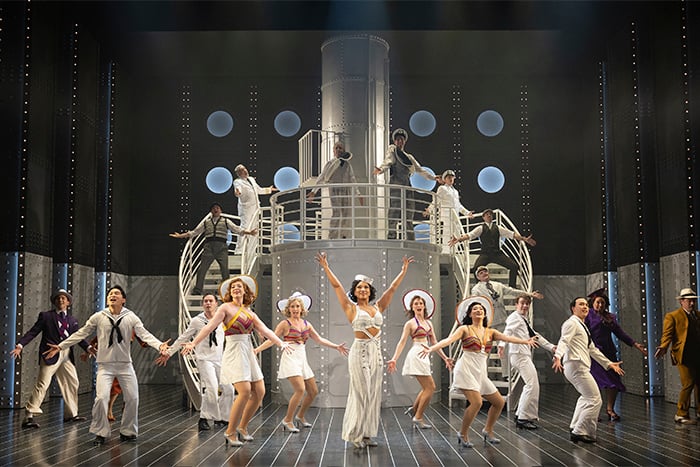
Anything Goes
Shaw Festival 2025
Photo: David Cooper
Shaw Festival 2025/Anything Goes, music and lyrics by Cole Porter, original book by P. G Wodehouse & Guy Bolton and Howard Lindsay & Russell Crouse, new book by Timothy Crouse & John Weidman, music direction by Paul Sportelli, choreographed and directed by Kimberley Rampersad, Festival Theatre, closes Oct. 4.
It isn’t often I say this, but the Shaw Festival’s Anything Goes is perfect. Truly perfect.
From the casting to the choreography, from the orchestra to the costumes, there isn’t a single false note. If I had to find a quibble — and it really is the smallest of quibbles — it would be that Mary Antonini, in the lead role of Reno Sweeney, has a vocal habit of letting the end of her singing line float up before dropping off. But if that’s all I can find to complain about, that should tell you everything.
This show is a triumph, and Kimberly Rampersad, who directed and choreographed the production, is absolutely covered in glory. Her vision is tight, bold, joyful, and relentless in its energy. I sat at the end of the performance and simply said to myself: That was perfect.
As for the excellent cast, let’s start with Antonini, whose Reno Sweeney carries the show. The lady can sing, the lady can dance, and the lady can act. Her performance is phenomenal, and her tap dancing is nothing short of dazzling. I must mention the jaw-dropping six-minute tap sequence, led by Antonini, that ends the first act — an ensemble blowout that brought the house down.
Allan Louis gives a refreshingly different take on Lord Evelyn Oakleigh. Instead of the stock upper class English twit, he plays the character as a charming eccentric with just a touch of brain — a welcome surprise and a smart choice. Michael Therriault as Moonface Martin brings a layer of class to the gangster role, while Kristi Frank, playing his gun moll Erma Latour, got to shine in the sly song “Buddy Beware”, asserting herself as far more than just a comic sidekick. She gave the character real agency and presence.
The romantic couple — Jeff Irving as Billy Crocker and Celeste Catena as Hope Harcourt —are equally well cast. Irving brought the necessary hapless charm to the lovelorn Wall Street guy, while Catena’s Hope carried the emotional balancing act of a woman torn between love and family duty. And of course, Sharry Flett, as Hope’s social-climbing mother, was deliciously formidable.
This is Anything Goes, so of course we had the iconic grand staircase of the cruise ship — you can’t have this show without it. And Rampersad gave the ensemble, particularly the sailors, a whole lot to do. The choreography is exuberant, and the men’s numbers in particular are full-throttle, joyful explosions.
The costumes and sets by Cory Sincennes are a dream: 1930s period perfection, with sleek suits, dazzling dresses, and a visual palette that transports us right onto the deck of an Art Deco fantasy liner. Mikael Kangas’ lighting is bright and cheerful, matching the tone of the production beat for beat.
And then there’s Paul Sportelli, whose music direction brings out the crispness and clever wit of Cole Porter’s score. The brass was punchy, the rhythms sparkled, and every one of Porter’s clever lyrics landed with clarity. The score – what a lineup: “Blow, Gabriel, Blow”, “You’re the Top”, “It’s De-Lovely”, “Anything Goes” — hit after hit, all delivered with snap and polish. Porter’s blend of sophistication and silliness has rarely felt more alive.
It’s worth noting that this is the third iteration of Anything Goes. The original 1934 book by P.G. Wodehouse and Guy Bolton was first updated by Howard Lindsay and Russel Crouse, and most recently reworked by Timothy Crouse and John Weidman, giving the women more agency while retaining the farce, the mistaken identities, and the shipboard high jinks that make the show such a pleasure. The changes are subtle but effective — the show still feels vintage, but in the best, most modernized way.
And a final word. This is musical theatre as it should be — stylish, joyful, dazzling, and perfectly calibrated. I floated out of the theatre on a wave of satisfaction.