
An Interview with Bryony Lavery

(Note: The first part of this interview is Lavery talking about her life and times. The second part is our conversation about her play Stockholm, where we are joined by choreographer Susie Burpee.)

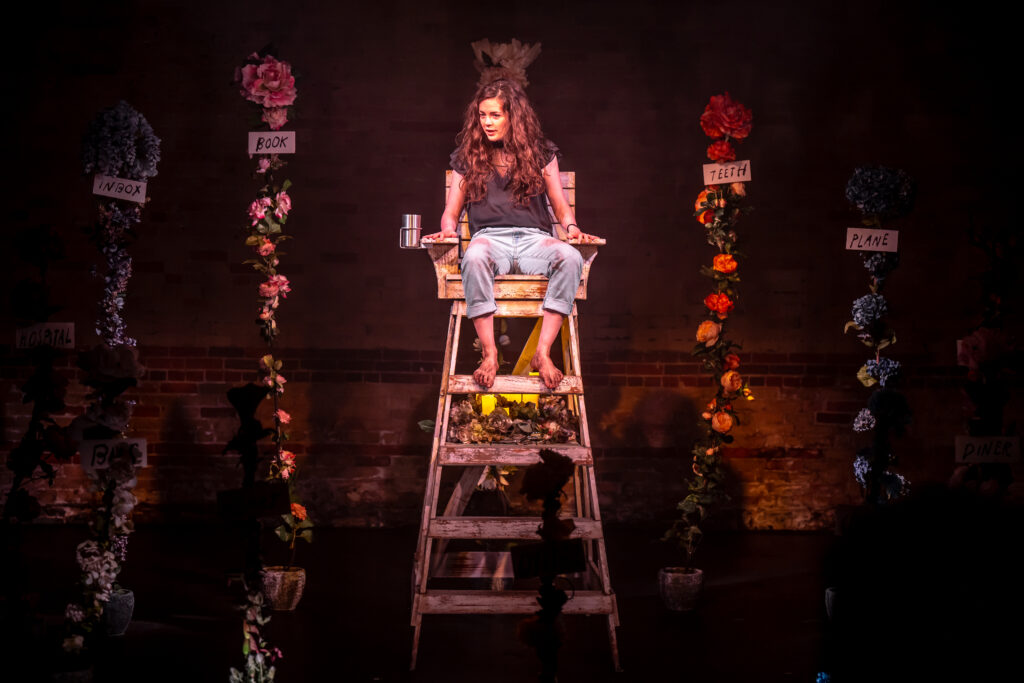
Acclaimed English playwright Bryony Lavery came to town to see the North American premiere of her blockbuster play Stockholm. Produced by Seventh Stage Theatre in association with Nightwood Theatre, the play runs at the Tarragon Extra Space until Jun. 3.

The prolific playwright, 65, is known for her hard-hitting themes, poetic language and many theatrical challenges. Although Lavery is a lesbian and a feminist, her plays are anchored in universal themes.

She was born a Shepherd; Lavery is her married name. In person, she is a charmer. Her intelligence and droll wit shine through. She’s a fun interview, even though we touched on dark matters.

As Lavery said in a 2002 interview with the Observer: “I’m good on grief, death, sex and anger – they are my specialist subjects. I really get them – a piece of good luck, that.”

Note: Lavery and I didn’t really touch on the controversy about her 1998 award-winning play Frozen, and the accusation of plagiarism. As she said briefly:  “It’s a dull story. It was an awful experience. I didn’t look after other people’s work.” (Here are two links for those interested in reading more about this literary scandal. The interview with the Guardian (http://bit.ly/JKPfJ5). The article from the New Yorker (http://bit.ly/L1kiyW).

———————————————————————–

INTERVIEW WITH BRYONY LAVERY

In my research, I found there was little information on you other than you were born in Yorkshire, so why don’t we start there.

I was born near Wakefield, but I grew up in Dewsbury. It was an industrial mill town, a centre for the mungo and shoddy industries that produced heavy woollens. We were four children, two sisters and two younger brothers. I was the second oldest.

What about your parents?

My father was principal of a nurse training college. He was a clever working class boy. He spent the war in the army medical corps and then he went to university. He never spoke about the long march to Burma. He brought back a blanket that wasn’t made of wool, and that was the only thing that came home with him after the war. My mother was a stay-at-home mom.

Did the arts play a role in your family?

We were a Bohemian family. My sister played the violin before she switched to science. One brother spent time back stage in the West End, and my youngest brother was an actor and comedian, known for his impressions of famous British fish. I was the only one to make a career of it.

I know you were married before you came out.

I’m a late learner. Although I identified with the gay struggle, I never disliked sleeping with men. Paul and I met in college when I was 21. He was a teacher. We were married for ten years. I came out when I was hit by the twin torpedo heads of theatre and feminism.

I understand Paul committed suicide.

By that point he had married again. He had one child and another on the way. He was never great with money. He must have been in a terrible state. He was the last person on earth you’d think would commit suicide. It made you think about family and the decisions you make in life. About two or three years ago, I got an email from his eldest son. He wanted to meet with me so he could hear about his father.

You were an actor before you became a writer. What theatre school did you go to?

I never went to theatre school. I did an external London degree in English language and literature.

What’s an external London degree?

I was part of the baby bulge, so there were fewer university places available. I didn’t have the marks to get me into a London university, so I went to the Hendon College of Technology which is now Middlesex University. I was desperate to get away from Tewksbury.

Did you go straight into theatre?

I taught for five years. You could become a teacher with a university degree and no teacher training. I was put in front of a group of 8-year-olds and I made it up as I went along. And then my head changed and I got a job in the theatre fringe. That was when theatre truly put its icy claws into me. I switched to teaching half time, three days a week. The plan was to write on the other two days.

I read somewhere that you played Tinkerbell in Peter Pan.

I did do Tinkerbell. I wasn’t a good actor, but I wasn’t a bad clown. I started clowning with a Brazilian called de Castro who taught “how to be stupid”. I left live performance and moved into theatre administration where I’d take out a tour of six actors on £750, sleeping on people’s floors.

When did you start writing plays?

I was in my late 20s. I had written three plays at college. My first professional play was when two actors asked me to write something for them. In those days, you could actually live on what you made as a playwright – a very small living if you had low standards. I certainly didn’t know that it would become my career.

(Note: The play was Sharing, about two roommates in a derelict flat.)

What was your break-out play?

It depends. I’ve been discovered a lot.

Okay. What was the break-out play when you stayed discovered?

I’d have to say Goliath in 1997. It was my response to Beatrix Campbell’s book where she dissects the 1991 riots that happened on the housing estates all over Britain. I realized it was okay to write seriously – that I should do serious stuff. It was a one-woman show where the actor played many parts with many different accents.

(Note: Goliath: Britain’s Dangerous Places.)

I’m not familiar with her name.

Beatrix Campbell is an icon – a hard-hitting feminist lesbian journalist.  She wrote the controversial book on Princess Di. She was very generous with the Goliath material that I used verbatim in the play. In light of Frozen, it taught me, erroneously, that it was okay to use things that people write. Unfortunate in hindsight.

(Note: Diana, Princess of Wales: How Sexual Politics Shook the Monarchy.)

Why do you write on the dark side with plays about serial killers, race riots, cannibalism, Alzheimer’s Disease, fatal car crashes, and war-torn countries?

To fire a play, you need a strong flame to keep it going. I explore things that frighten us. I write about what’s the worst that can happen. I suspect that a large percentage of all the plays written are on the dark side.

You seem to have become a theatre adventurer of late.

I’m more and more interested with working with new ideas, leaving behind what I’ve learned, and opening up my head to the possibilities of what theatre can be.

Can you give me an example?

The production Kursk that I did with the sound/theatre company Sound&Fury. I got so excited about how sound works, and the wonderful army of sounds that you can create. Sound drives the production.

(Note: In 2000, the Russian submarine Kursk exploded and was trapped on the seabed. The 2009 production Kursk places the audience on an imaginary British submarine that is spying on the Russian sub. The cutting edge soundtrack recreates a virtual submarine.)

What about another example of your new directions

 I’m also working with Australian director Chris Drummond. The production has an actor voicing the internal thoughts of a character, played by another actor. I’m interested in mixing the fluids, so to speak, of finding new ways of making theatre, as opposed to making plays.

Where would you say you are in your career?

I’ve had a play on Broadway, and one at the National Theatre. That’s the pinnacle. Now I can do what I like.

————————————————————-

IN CONVERSATION WITH PLAYWRIGHT BRYONY LAVERY AND CHOREOGRAPHER SUSIE BURPEE ABOUT THE PLAY STOCKHOLM.

Let’s get to Stockholm, a play you developed with the physical theatre company Frantic Assembly in 2007.

Co-directors Scott Graham and Steven Hoggett – I call them The Boys and they call me Ma – commissioned the play and chose the title and the main theme – the Stockholm Syndrome. I’m a fiction writer. I can’t push reality. I had to have a reason for the title, so the couple in the play have a trip planned to Stockholm.

The play has a perfect modern couple living a perfect modern life. It’s Todd’s birthday and he and Kali are planning to have a romantic dinner at home. The next day is their get-away to Stockholm. During the course of this dinner, everything starts to unravel. Isn’t the Stockholm Syndrome about a victim who forms a bond with the oppressor?  In other words, joins with the enemy? How does this figure in the play?

It’s about love and possession. In an ordinary domestic relationship, usually it’s the man who is more possessive of the woman. I flipped it. I didn’t want either one to be stronger. Each one is suffering from Stockholm Syndrome.

How do you see the play as a whole?

The Boys think it’s a love story. I think it’s a horror story.

(At this point we are joined by choreographer Susie Burpee.)

The script is very poetic. Is this your usual mode of writing?

BL: I’ve been accused of being too poetic, but to me it’s cutting down language to the nuts and bolts. I’m interested in the way people use words. There’s a lot of ugly swearing in the script. The actors should have a beautiful structure to offset the raw dialogue. Elevated language allows them to better articulate these hurtful words.

SB: Language and rhythm are important in Bryony’s work. By adding movement, it gives the poetry of her writing its due.

Much of the text is in the third person.

BL: I used third person once before in a radio play. It was about a woman trapped in the ice. It sounded weird in the third person, implying she wasn’t there when she was. In Stockholm, Kali and Todd are presenting themselves to us. The third person voice feels shiny. It gives them a quiet confidence.

And then there’s the “Us” factor.

BL: In the first two weeks of rehearsals for the original production, there were four actors, two men and two women. I thought I was writing for four people. Then there were two, and Kali and Todd had to speak as “Us”, as well as their own individual characters. It’s the “Us” that is destroying them. It’s the airless perfection that they’re trying to achieve.  It’s the monster in the room. I put “Us” dialogue in because it felt right.  It’s a very contentious issue. A director has to find a style that works to present “Us”.

SB: In a way, “Us” is the centre of the play.

Even though the script is shocking, there is still a lot of humour.

BL: Absolutely. I want the play to get laughs. The audience has to have a steam valve, and in my case, it’s laughter. I laugh through my own pain. It’s a family trait. We’re a funny family.

There’s a strong physical theatre component in Stockholm.

BL: I know how actors use their bodies in rehearsals, but you never see that part on stage. I spent two weeks watching the Frantic Assembly actors experiment with physicality and text. It was fantastic. There’s a sweeping physical swath at the centre of the play. As The Boys said: “We’re going to choreograph the fuck out of it.”

What’s the genesis of the physicality?

SB: The way Bryony lays out the script, or makes suggestions in the stage directions, really helps me to come up with movement ideas. It’s the couple’s domestic space and they know it well. It’s physicality in response to their world. When the curtain opens, the audience is going to wonder what world they’re in, and they will get drawn into that world by the rhythm of the words.

Bryony, the stage directions you put in are very pointed.

BL: I do interfere if there is a space, and if I think that something should happen. For example, make the audience laugh. I suggest things when the bits of my mind haven’t completed the thought. I think I do it to scare the director. In Stockholm, I also included directions that Scott and Steve had worked out in order to acknowledge their contribution.

SB: The stage directions remind me of the composer Satie whose music can be played in so many different ways. Bryony’s stage directions are full of possibilities. You’re not bound to one thing. For example, the suggestion that a beautiful terrible fight should take place. Is it a fight? A dance” There are different ways it could be done. Or she makes a suggestion about unpacking groceries.

Susie, how does the continuous movement of the actors affect the direction of the play?

SB: Director Kelly Straughan and I are collaborating. It’s a happy place to be inside her point of view. I bring my vision to suit hers. It’s an interesting process. As she shapes her rhythm to the rhythm of the play, we discover more information. That means we have to go back and revisit movement to make it more sympathetic. Kelly and I made a pact. We wanted the movement sequences to fill in when words weren’t there. The spaces that Bryony talks about. The movement is saying something above or below the words. It’s the physical manifestations of a head trip. It’s aggressive  physicality punctuated by awkward pauses, or a pause for reflection. There are so many colours to their relationship. It’s a wild ride and a jammed packed hour. Happily, both actors, Melissa-Jane Shaw and Jonathon Young, are natural movers.

The set is important to Stockholm.

BL: In the original production, the designer had created a shiny desk with a lap top on it. It was really water, so when Kali’s head crashes into the desk, it looked like it was going through the wood. That’s just one example. The Swedish production was a black box.

SL: Lindsay Walker’s set is very domestic. It’s the couple’s house. There are different levels which are needed for specific movement. Movement animates the set, and animates their interior thoughts. Inanimate objects come alive. Surfaces become spaces to travel on. The movement highlights the depth of what is going on in the text. The set has a veneer. It’s not an everyday kitchen. There’s something not quite right. It has the oddity of a show home. We had to have the set in the studio right from the start so we could create on it.

BL: Kelly asked me how she should approach the play, and in retrospect, I gave her the wrong advice. I said think about the set. What I should have said was, do it how you think best.

What’s your view of the play in hindsight?

BL: I see Stockholm on a rolling run, being performed by two men, or two women, as well as a heterosexual couple. The gender doesn’t matter because it is a relationship with no air.

(Stockholm runs at the Tarragon Extra Space until Jun. 3.)

Theatre Review – Stewart Lemoine’s The Exquisite Hour

This play is a charmer. It is also poignant and sentimental, yet laugh-out-loud funny. Sometimes we need gentle humour in our lives, and Lemoine, based in Edmonton, is not afraid to write plays that could be considered retro. All the more power to him.

It’s understandable why Ted Dykstra took on the role of Zachary Teale. It is absolutely against type. This outstanding actor/director is known for his outgoing, in-your-face personality. Zachary Teale is a bespectacled middle-aged nebbish, a confirmed bachelor who is a merchandise supervisor at Abernathy’s department store. The play is set in 1962, which is a more innocent age. This is not a play that could take place today. The Exquisite Hour is like watching a much-beloved old film on Turner Classic Movies.

When we first meet Zachary, he is in his backyard enjoying lemonade laced with bourbon. There he is – his trousers pulled up high above his waist, his chequered shirt covering an old-fashioned undervest that our fathers and grandfathers wore.

Into this serenity comes Mrs. Darimont. Actor Daniela Vlaskalic is wearing a big brimmed straw had with flowers on top, a shirtwaist dress widened by a ton of crinolines, super flat shoes, a large purse, and the de rigueur white globes. Congratulations to designer Marzena Cegys for both the period costumes and the lovely set – a fence with flowers spilling out over the top, and the sweet out door garden chairs and table.

It turns out that Mrs. Darimont has come to sell Mr. Teale the 1959 version of a set of encyclopaedias. She has brought “H” along to show Mr. Teale how the encyclopaedias can be used to create conversations, which is an excellent way to get to know people if you are shy – a perfect fit for Mr. Teale.

This is where director Ron Pederson comes into play big time. The vignettes with random “H” selections gerrymandered into a conversation that Zachery and Mrs. Darimont act out are absolutely hilarious. Imagine conversation starters that include the Belgian St. Hubert, the Hohenstaufen noble family, and while Hannibal is the third selection, they don’t quite get to converse about the famous conqueror of the Alps, because other things are happening between them.

Pederson’s direction is belly laugh funny, but he is also aware of the changing relationship between the two, and to give away the ending would be grounds for murder, so I’ll keep silent. Suffice it to say, that Pederson understands the dramatic arc of the play, and under his sympathetic direction, his excellent actors convey every subtle nuance of their encounter.

This play is a run-don’t-walk. It’s a most satisfying, old-fashioned theatre experience.

Stewart Lemoine’s The Exquisite Hour, The Theatre Department, (starring Ted Dykstra and Daniela Vlaskalic, directed by Ron Pederson), Factory Studio Theatre, Apr. 18 to 29, 2012

Factory Theatre/Artistic Fraud – Robert Chafe’s Oil and Water

Artistic fraud of St. John’s, Newfoundland, is one of Canada’s most imaginative companies, both in staging and subject matter. Oil and Water, which is part of Factory Theatre’s Performance Spring Festival, is the latest show from the fertile minds of writer Robert Chafe and director Jillian Keiley.

First, mention must be made of Shawn Kerwin’s remarkable set. The main image is a triangular scaffold structure – a tower set on a rocking horse base that can convey the movement of the waves, as well as being a ladder that can evoke a steep cliff. On either side are tables made up of pails and metal washing bowels set on planks of wood. Tall ladders are at the back. In other words, we get the image of the sea, the rough hewn landscape of coastal Newfoundland, and the starkness of rural poverty, all at the same time.

The inspiration for the play is the American sailor Lanier Phillips. In 1942, his convoy ship, USS Truxtun, floundered on the rocks near the village of St. Lawrence. Phillips was one of only 46 men who made it to shore, covered in oil from the leaking bilges. He was also the only black sailor to survive. The most touching part of the show is when Violent Pike tries to wash his skin clean of oil, and only after scrubbing intensely, does she realize that the sailor is a black man, the first she has ever seen. The kindness and equality shown to Phillips by the Newfoundlanders changed his life forever.

Chafe has three different storylines in his play. In the first act, we see Lanier, the young man (Jeremiah Sparks) on board his ship, interacting with his black messmate Langston (Mike Payette), and the white sailor Bergeron (Clint Butler). Blacks in the navy could not rise above being mess attendants or deck swabbers. There is also the ghost of his slave grandmother Adeline (Neema Bickersteth), always counselling him to be wary of white people. The second story is about the much older Phillips (Ryan Allen) in 1974, and the horrors encountered by his daughter Vonzia (Starr Domingue) as Boston tries to integrate its schools. The third is the life of the Newfoundland Pike family, Violet (Petrina Bromley), her husband John (Jody Richardson), her nephew Levi (Mark Power), and her friend Ena (Alison Woolridge) who is obsessed with taking pictures.

While the older Phillips watches all the stories, we see that John is constantly coughing as a result of dust from the mine that is killing him. That Phillips’ daughter Vonzia is traumatized by the stones and rocks thrown at her school bus. That shipboard life has just as much racism as on land. The crucible of the play comes with the second act, and the rescue of the men. Lanier throws himself in the sea against the advice of his grandmother who warns him about the white people on shore. The scene of Lanier in the sea is absolutely dramatic and brilliantly conceived, with pails of water being thrown on him as he struggles on the ropes of the rocking triangle. His rescue and interface with the Pike family is absolutely poignant.

Vonzia holds her father to account which her tormented question, “What are you going to do?” That is when Phillips tells her about the Pike family and their kindness, and in that tale there is hope. Chafe chose to end his play there, but there is a curious dissatisfaction, and I, for example, wanted to know what he did do. The program notes tell us that Phillips became a civil rights activist with Martin Luther King, but maybe we needed to see this. The play does seem to end abruptly.

On the other hand, the characters are absolutely believable and the Chafe/Keiley team scores another winner with the presentation of the raw truth. How the town of St. Lawrence rose to heroic stature, despite their poverty, whether on the sea or in the mines. How Phillips always remembered his encounter with them as a life-altering experience.

Once again, the very talented Andrew Craig has composed a soundscape that his hummed and sung by the acting ensemble, made up of both Newfoundland folk melodies and black gospel tunes. There is always music in the background of Oil and Water that captures the cinematic nature of the story.

Artistic Fraud of Newfoundland never disappoints. The large cast is a powerhouse of acting skills, particularly Bromley’s Violet. The set is a visual canvas of many images. The contrast between the stories evokes many disturbing themes. In short, the cleverly titled Oil and Water is a total theatrical experience that is not to be missed.

Robert Chafe’s Oil and Water, Artistic Fraud, Factory Theatre’s Performance Spring Festival, (starring Ryan Allen, Neema Bickersteth, Petrina Bromley, Clint Butler, Starr Domingue, Mike Payette, Mark Power, Jody Richardson, Jeremiah Sparks and Alison Woolridge, directed by Jillian Keiley), choral score by Andrew Craig, April 18 to May 6, 2012.

For The Record – Olivier Choiniere’s Bliss

About: Four Wal-Mart employees, obsessed with celebrity, breathlessly recount minute details of Céline Dion’s life. What begins with a rapturous account of Dion’s farewell Montreal concert before taking to her bed to have her child, disintegrates into lascivious tabloid speculation. At the same time, these menial workers also savour every horrific fact about the sad life of Isabelle Cote, a real life young woman from Sherbrooke, sexually brutalized by her father and brothers.

Strengths: An intriguing, if disturbing premise, solid acting, directing and theatrical values. A fascinating exploration of voyeurism and schadenfreude as the stories begin to twist around each other.

Weaknesses: The script does tend to bog down into obscure surrealism at the end. The role of the Oracle, the one Wal-Mart employee who tries to keep a reality check on the musings of her colleagues, could have been beefed up.

Other: This production introduced an excellent new playwright from Quebec. It also showed the immense importance of SummerWorks, where the production first saw the light of day in English Canada. Kudos to BIBT artistic director Brendan Healy for programming Bliss.

Bliss by Olivier Choinière, (Translated by Caryl Churchill), Candles Are For Burning/Buddies in Bad Times Theatre, (starring Delphine Bienvenu, Jean Robert Bourdage, Trent Pardy and France Roland, directed by Steven McCarthy), Mar. 27 to Apr. 8, 2012


For The Record – Reviews

I’m starting a new category called For The Record.

Because of vicissitudes with my website reclamation, as well as a death of a close friend, I fell behind on my website reviews. As a form of catch-up, I’m going to use what we call in the trade, Alternate Story Format or ASF. At least I can cite my opinion in a public forum, for the record, and backdate the posts. (These are all shows that have closed, or were one night concerts.)