Musical Review – Dancer: A Musical in Ten Furlongs (Oh What a Ride! Productions Inc. in association with Crow’s Theatre and The Toronto Stage Company)

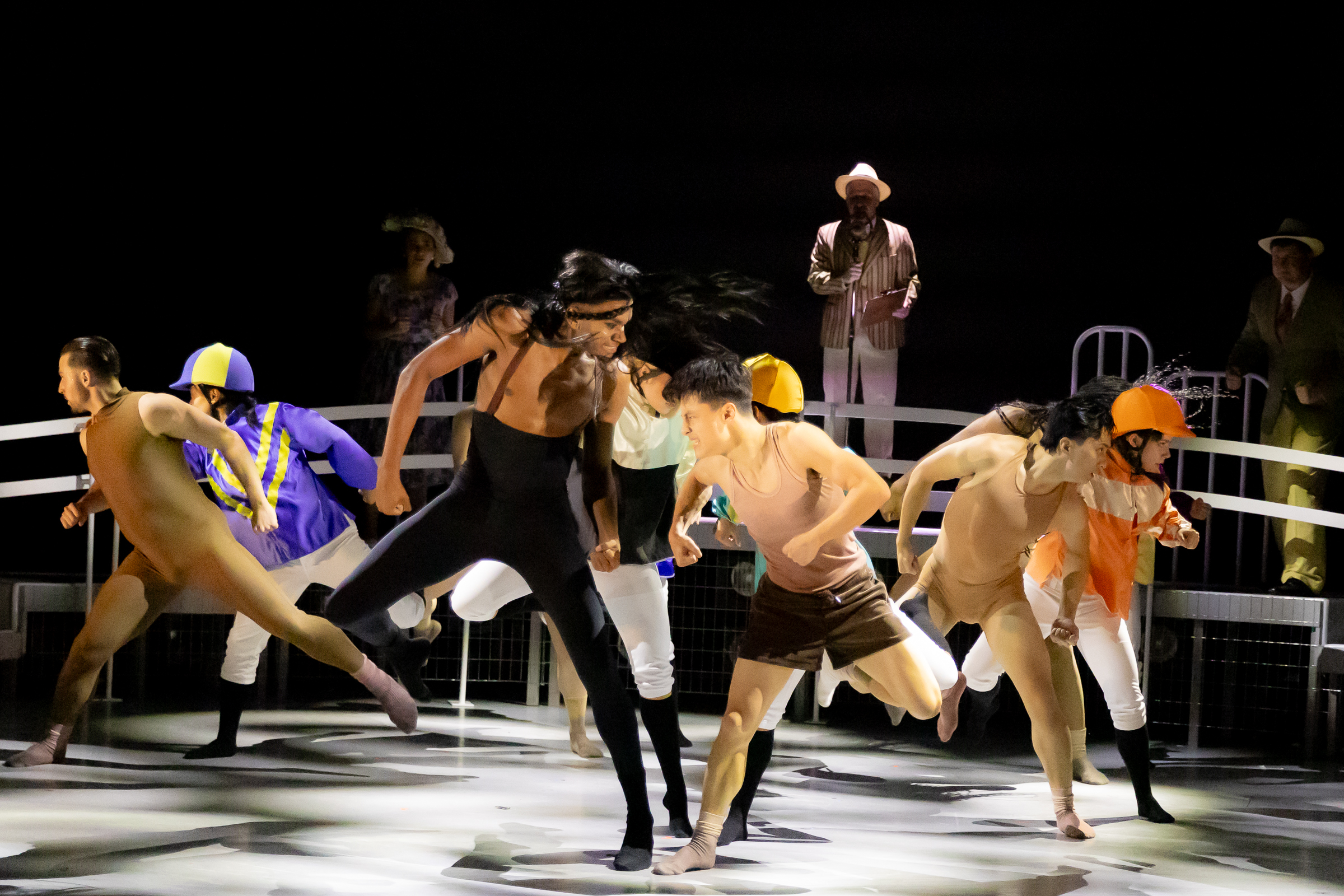
The race ror the Kentucky Derby, Northern Dancer battles it out with Hill Rise, other horses surround, track announcer at back

Dancer: A Musical in Ten Furlongs
Photo by Racheal McCaig

Oh What a Ride! Productions Inc. in association with Crow’s Theatre and The Toronto Stage Company/Dancer: A Musical in Ten Furlongs, book and lyrics by Jim Betts, music by Marek Norman, directed and choreographed by Stacey Tookey, Terminal Theatre, closes Nov. 1.   

Dancer: A Musical in Ten Furlongs is guaranteed to put a smile on your face and make your Canadian heart swell with pride. And yes, it is about a horse, namely Northern Dancer, who became the first Canadian-bred horse to win the Kentucky Derby in 1964. 

The eyes of an entire nation were fixed on Churchill Downs in Kentucky, and even Prime Minister Lester B. Pearson got caught up in the excitement, sending an extraordinarily long telegram to Northern Dancer’s owner, E. P. Taylor, declaring that Canadians were waiting with bated breath and that his horse was running for the honour of the country. 

And did you know that Northern Dancer became the first non-human to be named Canadian Athlete of the Year? Or that he was presented with the keys to the City of Toronto in the form of a carved carrot, which, I might add, he promptly ate?

But did you also know that Northern Dancer was the runt of the litter? When Windfields Farm, where he was born in 1961, held its yearling sale, nobody wanted him. While his fellow colts went off to new owners, Northern Dancer was left behind. Small, stubborn, temperamental and seemingly untrainable, he was hardly anyone’s idea of a champion. 

Yet everybody loves an underdog story, and therein lies much of the musical’s irresistible appeal. We watch this unlikely hero defy every expectation, transforming himself from an unwanted little colt into a racing legend, ultimately claiming the most coveted prize in North American horse racing, the blanket of roses awarded to the winner of the Kentucky Derby.

Of course, there is more to a successful musical than a good story. Enter what I affectionately call the old guard of Canadian musical theatre, book writer and lyricist Jim Betts and composer Marek Norman. 
Dancer: A Musical in Ten Furlongs
Photo by Racheal McCaig

These two veterans have been such an integral part of the Canadian musical theatre landscape, and have given us so much pleasure over the years, that they seem almost inseparable from its history. We are certainly not dealing with a couple of young whippersnappers, but with two seasoned theatre artists whose decades of experience have given them an instinctive understanding of how to construct a musical. Surprisingly, Dancer marks their first collaboration. In short, the creative backbone of this musical is in the hands of the A-Team.

According to Betts and Norman, they have deliberately fashioned a score that captures the popular musical sounds of the early 1960s, the era in which Northern Dancer became a national hero. There are echoes of the Beatles and the British Invasion, the folk-inflected melodies of Gordon Lightfoot, and the lush orchestral sophistication of Henry Mancini. Yet the music never becomes a mere exercise in nostalgia. Instead, these diverse influences are woven into a rich and varied score, with the racing sequences given their own distinctive orchestral character. The result is music that not only evokes the period but also helps propel the story forward.

But you are probably wondering, what about the horse? And here is the catch. Dancer is a dance show, an honest-to-God dance show. 

Enter Canadian-born Stacey Tookey, now based in New Jersey, whose career has unfolded largely in the United States, including three Emmy nominations. 

Boy, can this lady ever command a stage! Tookey, who is both director and choreographer, has ten dancers portraying the horses, and the show opens with an exhilarating explosion of movement. Gorgeous bodies sweep across the stage in breathtaking lines and extensions, gymnastic feats, tours en l’air and majestic leaps, creating a dazzling display of physical virtuosity. 

What is so remarkable is that the dancers are not literally imitating horses. Instead, through the grace, lyricism and sheer magnificence of their movements, they evoke the power, beauty and nobility of these extraordinary animals. It is not imitation but the very essence of the horse that Tookey captures through dance.

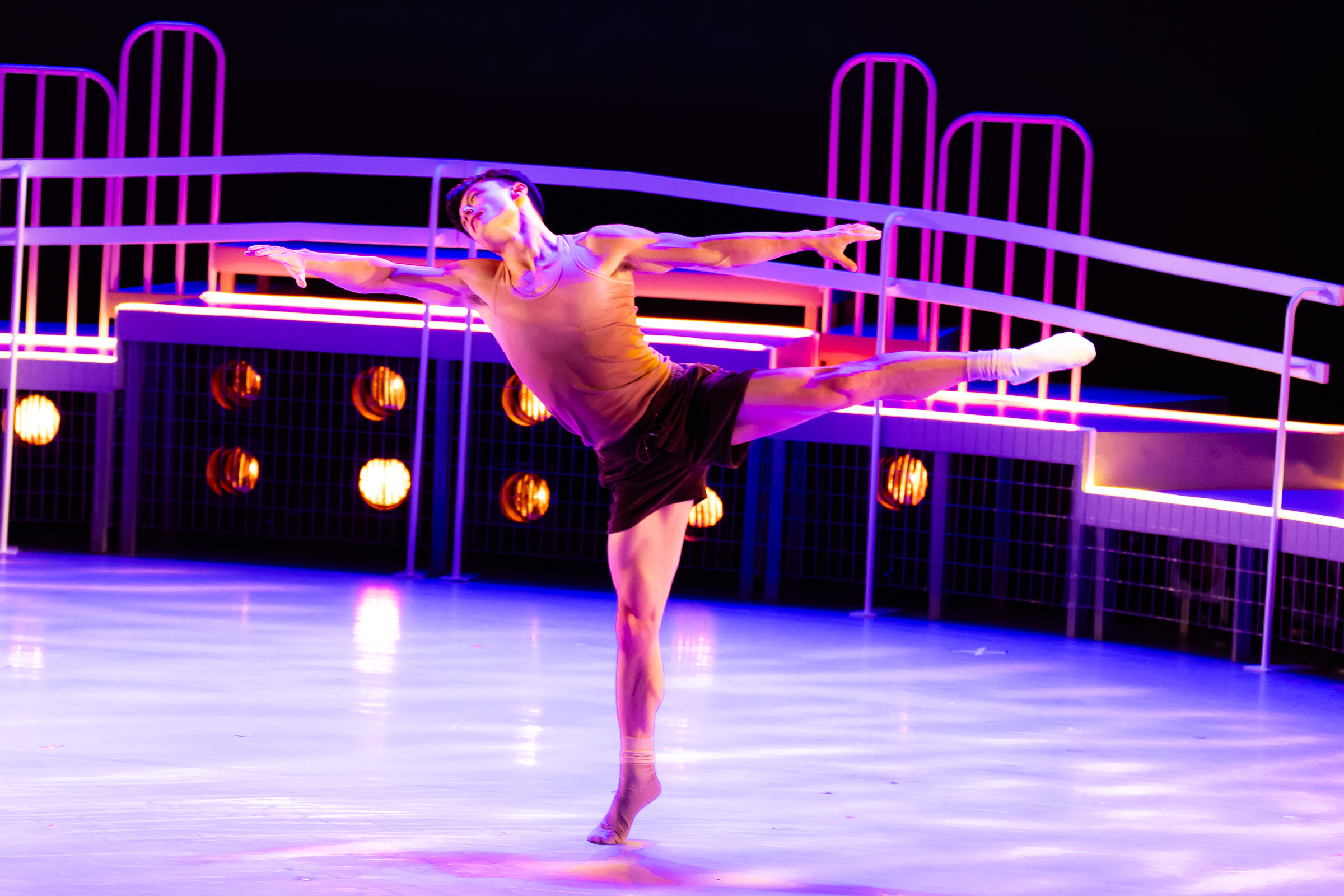
Everyone, that is, except Northern Dancer, portrayed by the diminutive Keanu Uchida, who transforms his body into that of a whiny little brat throwing a monumental temper tantrum. Stubborn, petulant, irritating, perpetually pouting and seemingly untrainable, this is one thoroughly exasperating little horse. 

Uchida’s physical characterization is a marvel, his movements compressed and ungainly, in hilarious contrast to the majestic grace of the other dancers. Yet beneath all that obstinacy lies a champion. When Northern Dancer finally decides to run, there is simply no stopping him. This little runt can fly, or, as his devoted groom so aptly puts it, “put a hole in the wind.”
Dancer: A Musical in Ten Furlongs
Photo by Racheal McCaig

Betts and Norman first presented Dancer at the 2023 Toronto Fringe Festival, where it became an overnight sensation. By the second performance, the entire run had sold out, and the show went on to win the award for Best New Musical. Those fortunate enough to have seen it clamoured for a return engagement, while those who had missed out were desperate for another chance. 

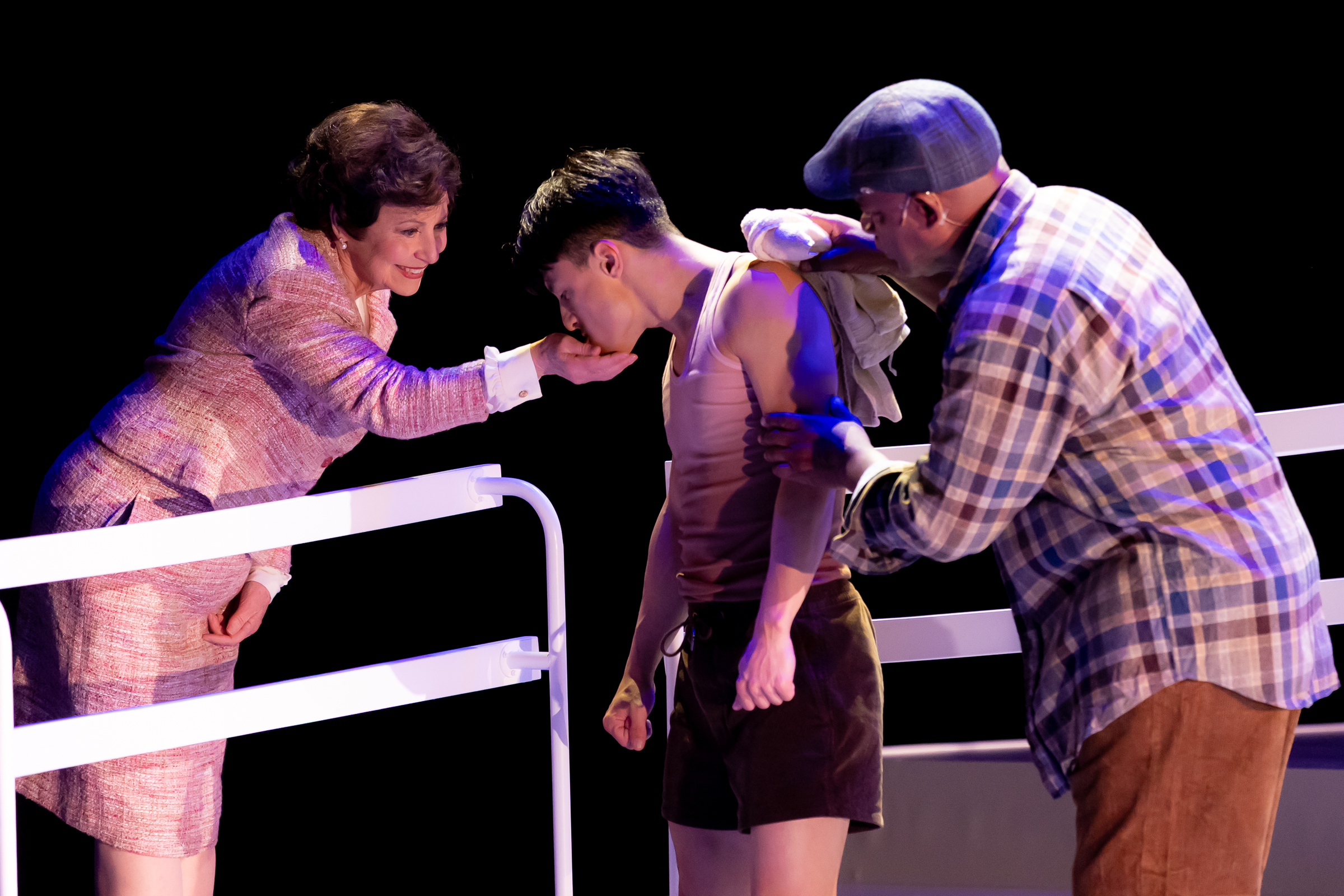
Now that wish has been granted. The original 90-minute production has been expanded to 100 minutes, still without an intermission, and among the most significant changes is the fuller development of the two people closest to Northern Dancer. There is his devoted groom, Bill Brevard (Sterling Jarvis), who recognizes the little horse’s potential when everyone else has given up on him, and Mrs. E. P. Taylor
“Winnie” (Barbara Barsky), who affectionately calls him her “little giant.” Together with Northern Dancer, they form an endearing trio whose mutual affection and unwavering loyalty provide the musical with its emotional heart.

There is a particularly charming scene in which Winnie and Bill set about finding a name for the little colt. Bill recalls that the legendary ballet dancer Vaslav Nijinsky once expressed a wish to be reincarnated as a horse. Winnie then points out that the colt’s sire was Native Dancer, and suddenly the name Northern Dancer is born. It is a delightful exchange, revealing the tenderness these two characters feel for their troublesome little charge, while forging an unexpected connection between the seemingly disparate worlds of ballet and horse racing. And Betts and Norman take that connection one imaginative step further, actually bringing Nijinsky and Northern Dancer together in a scene later in the musical.

Tyler Murree portrays E. P. Taylor, whose relationship with his wife, Winnie, is one of the musical’s quieter pleasures. Taylor is crusty, perpetually busy and occasionally snappish, yet beneath the gruff exterior lies a genuine sweetness and affection that makes their scenes together particularly endearing. 

Book writer Betts even manages to slip a little feminism into the proceedings, with Winnie railing against the restrictions imposed on women in the 1960s, including her inability to open a bank account or obtain an Eaton’s credit card in her own name. It is a telling reminder of the era, delivered with a welcome touch of humour. Barsky is just lovely as Winnie. The part is extremely well-written – a wife of a powerful man who knows how to handle him, who seems to take an active part in the business, and yet is every inch a society matron.

Then there is Jarvis as Bill Brevard, a role he has inhabited since the musical’s early development. Jarvis brings enormous warmth and humanity to the devoted groom, whose unwavering faith in Northern Dancer makes him one of the most sympathetic figures in the show. Betts also touches on the anti-Black prejudice Brevard encounters in the American South, giving his character a social dimension beyond his relationship with the horse. 
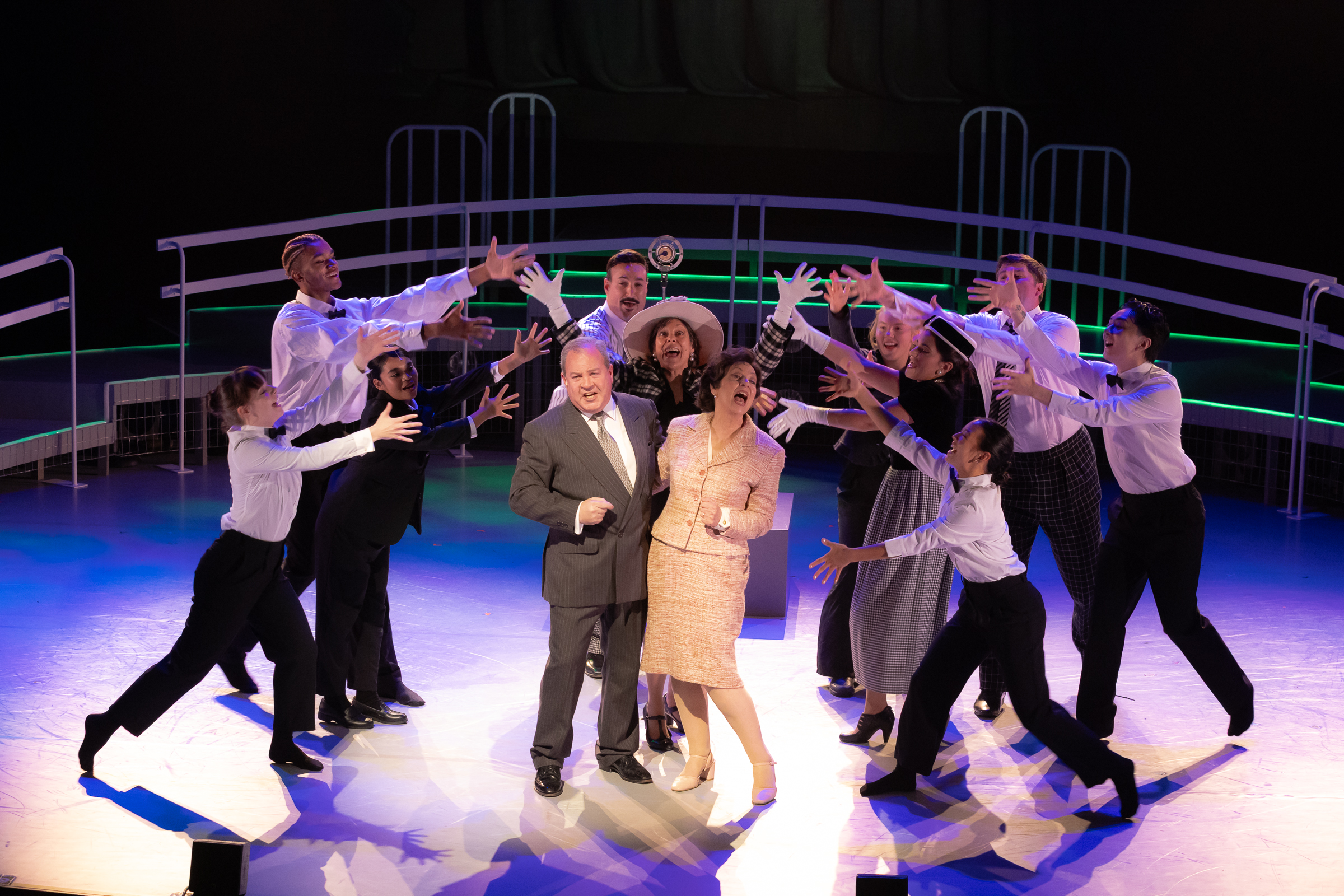
Dancer: A Musical in Ten Furlongs
Photo by Racheal McCaig

Another valuable presence in the musical is Sam Rosenthal as Daryl, the track announcer, who functions as a kind of semi-narrator, as well as calling the races and keeping the story moving at a lively clip. He also has some great one liners which he delivers with just the right ironic touch.

Of course, every good musical needs a villain of sorts, and that dubious distinction falls to Kent Sheridan as Horatio Luro, the Argentinian trainer, a role he plays with positively luscious glee. Referring to himself as le grand señor, Luro is oily, pompous, officious and insufferably self-important, lavishing upon Winnie Taylor an exaggerated, almost cloying display of Latin macho gallantry. A consummate know-it-all, he boasts of breakfasting with Bing Crosby and hobnobbing with the rich and famous of the horsey set. 

Yet beneath all this swagger and self-proclaimed expertise lies a man who simply does not understand Northern Dancer. Worse still, he resorts to the whip, the one thing the little horse absolutely cannot abide. Their encounters erupt into fierce battles of will, with Northern Dancer expressing his fury and defiance through explosive, almost violent movement. Uchida attacks these confrontations with extraordinary ferocity, transforming the horse’s stubborn resistance into a thrilling display of physical theatre.

The chorus of singers is called the Hoofbeats, a rather peculiar name, to say the least. Yet these versatile performers do considerably more than provide vocal accompaniment. From their ranks emerges a colourful parade of supporting characters, including pushy auctioneer Harry Green (Danny Cannis), the “experimental” veterinarian Doc Bane (Daniel Williston), hilarious Prime Minister Lester B. Pearson (Lara Angela Roda), and the thoroughly narcissistic jockey Willie Shoemaker (JJ Gerber). These cameos, some of whom get their own song, inject an extra dose of humour into the proceedings, always a welcome diversion when they’re clever, which these for the most part are.

 At the heart of Dancer, however, are the dance sequences, most of which unfold during the races, although there are several dream sequences as well. What is absolutely phenomenal is that no two races look alike. Norman has composed edgy orchestral music for the eight-piece band, and just as each race has its own musical identity, Tookey gives it a distinctive choreographic vocabulary. The balletic movement is breathtaking, with the other dancers never surrendering their grace and Uchida never quite acquiring his, although he keeps winning. 

In the final two races, dancers also portray the jockeys, adding yet another dimension to an already intricate choreographic landscape. Sometimes they ride on the backs of their horses; at other times, they move beside or behind them, creating a fascinating double choreography in which jockey and mount must remain in constant physical dialogue. It is an extraordinary feat of imagination, using the language of ballet to conjure the excitement, speed and competitive fury of horse racing without resorting to literal imitation. And we believe absolutely in what we are seeing.

The Kentucky Derby sequence is particularly spectacular. Tookey has devised an utterly original movement vocabulary for Northern Dancer, whose physicality remains stunted, compressed and ungainly, yet who can unleash lightning-fast turns and jumps from within those very limitations. His chief rival is the favourite, Hill Rise, portrayed by Jude Richardson, a tall, stately and magnificent dancer whose effortless elegance provides a striking contrast to the diminutive Uchida. 

As the race progresses, however, something fascinating happens. Richardson gradually loses his composure as Hill Rise falls behind, his once-majestic movement becoming increasingly strained and disjointed. By the time he loses by a nose, that glorious elegance has all but deserted him. It is a brilliant piece of choreographic storytelling, revealing the outcome of the race through the very bodies of the dancers. Quite simply, Tookey’s choreography is a triumph.
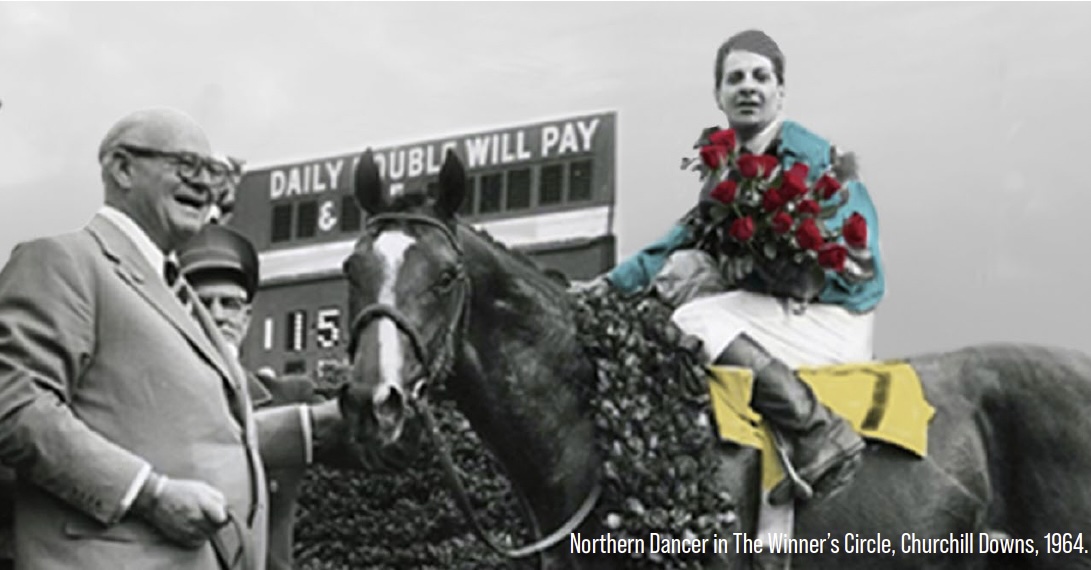
Winner’s Circle, Kentucky Derby 1964
Northern Dancer, owner E.P. Taylor, jockey Bill Hartack

Even the title, Dancer: A Musical in Ten Furlongs, contains a clever piece of theatrical ingenuity. The show unfolds in ten scenes, each designated a furlong, bookended by a prologue and an epilogue. For the uninitiated, a furlong is one-eighth of a mile, which means that ten furlongs equal a mile and a quarter, precisely the distance of the Kentucky Derby at Churchill Downs. Thus, the musical’s very structure becomes a metaphor for Northern Dancer’s greatest triumph, taking us furlong by furlong towards the finish line. 

Set designer Julia Kim has provided the attractive back ramps, clever movable paddock fences and narrative videos, while Alessia Urbani has returned to the Sixties to costume the humans. The horses are in various shades of brown unitards (with Hill Rise in black and the jockeys in racing colours). Northern Dancer is in brown shorts and a tank top, setting his clunky look apart from the tight fit of the other horses. Chris Malkowki’s lighting follows the action, particularly zooming in on Northern Dancer in the races, thus directing the eye of the audience.

All is not perfect, however, and I have one serious complaint. 

Mark Camilleri, the supervising music director and orchestrator, who also serves as conductor and keyboard player, is an enormously talented musician. However, Mark, I hope you’re listening, because your band is simply TOO LOUD. 

At times, the eight musicians overwhelm the singers, particularly Sterling Jarvis, and that is unforgivable in a musical blessed with lyrics as clever as those Jim Betts has written. I wanted to hear every word, and I could not. 

There are few things that make me angrier in musical theatre than having lyrics swallowed up by an overzealous orchestra. What is the point of such wonderful writing if the audience cannot hear it? I sincerely hope the balance between singers and musicians is corrected, because audiences will undoubtedly flock to Dancer, and they deserve to hear every word of this delightful score.

Dancer: A Musical in Ten Furlongs is an absolute delight. The wonderfully tuneful score and breathtaking choreography combine to transform a remarkable chapter of Canadian sporting history into a joyous theatrical celebration. It is a feast for the eyes, a pleasure for the ears, and a heartwarming tribute to a little horse who captured the imagination of an entire nation. 

Quite simply, Dancer is a show not to be missed.
Theatre Review – Booty Candy (Buddies in Bad Times Theatre & Obsidian Theatre)

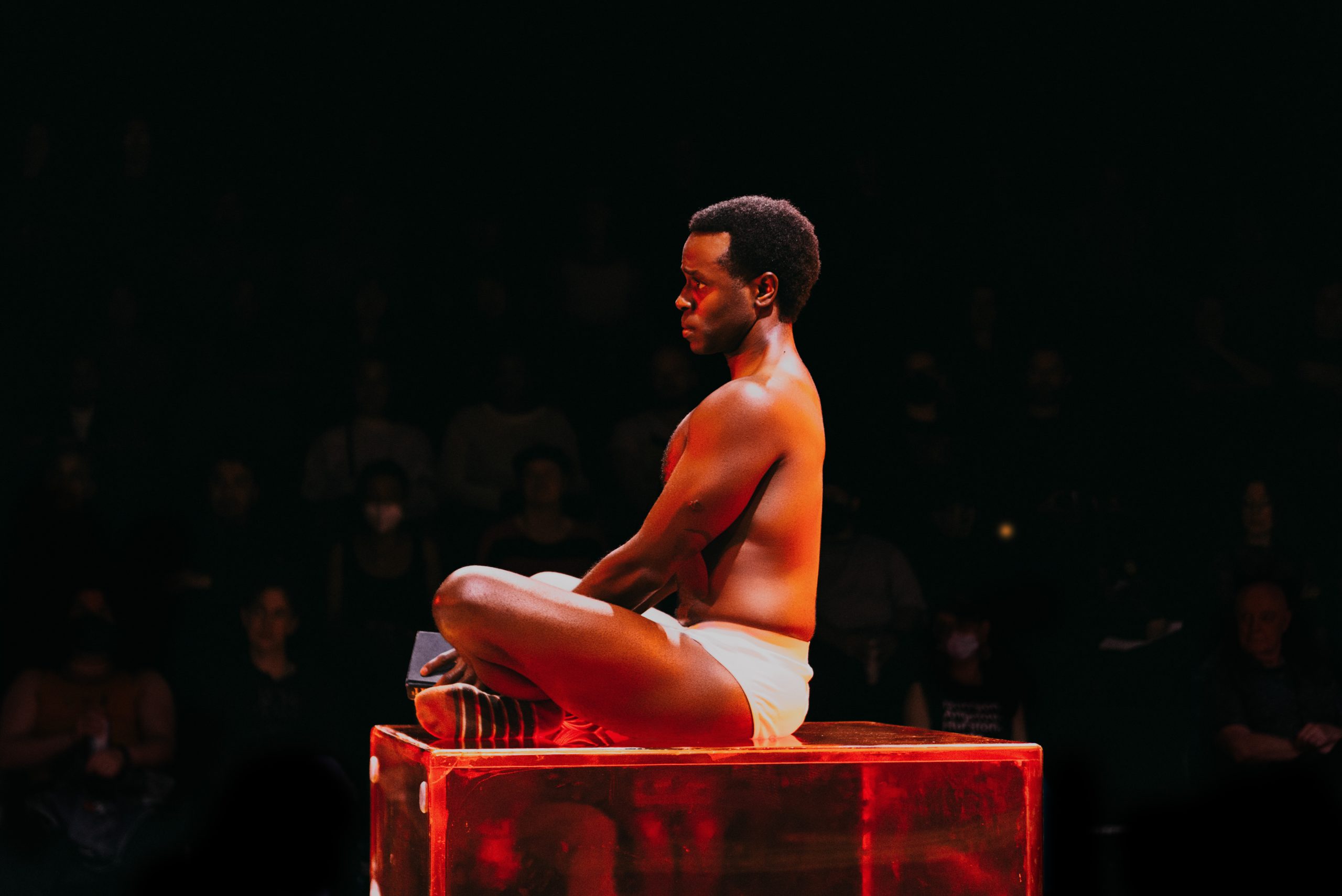
Kyle Brown as baby Sutter sitting cross-legged, facing sideways, wearing just briefs

Booty Candy
Photo by Roya DelSol

Buddies in Bad Times Theatre & Obsidian Theatre/Booty Candy, written by Robert O’Hara, directed by Jay Northcott, Buddies in Bad Times Theatre, closes Oct. 17.

Booty Candy is an extraordinary, must-see play.

The structure is absolutely breathtaking. It begins with a series of seemingly unrelated scenes in the first act, which are brought together at the end of the act in the most unexpected way. The second act continues these scenes at a later point in time, finding new ways to connect them. In other words, the intersectionality as a whole is most surprising and ingenious.

Booty Candy was written by American playwright and director Robert O’Hara, known for his provocative, often outrageous theatrical works that explore race, sexuality, identity and social hypocrisy through biting satire and dark comedy. Born in Cincinnati, Ohio, in 1970, O’Hara made his professional breakthrough with Insurrection: Holding History in 1996. His plays, including Booty Candy, are distinguished by their unconventional structures, audacious humour and willingness to confront uncomfortable truths. 

At the heart of Booty Candy is the experience of growing up Black and gay in America. O’Hara examines the complicated relationships between family, religion and community, exposing the prejudices, hypocrisies and contradictions that shape individual lives. He is particularly interested in the tension between public morality and private behaviour, as well as the pressures of conforming to society’s expectations.

Booty Candy
Photo by Roya DelSol

O’Hara has said that Booty Candy is semi-autobiographical, and among the various scenes, one recurring character is Sutter (Kyle Brown), a young Black gay man whom we see as a child, an adolescent and finally an adult. 

However, Booty Candy is not simply Sutter’s story. In fact, the five performers are listed in the program by number rather than by character, with Kyle Brown, who plays Sutter, designated as Actor Two. This is because the other actors, all of whom play multiple roles, are equally important to O’Hara’s examination of society. 

For example, Christopher Allen (Actor 4) portrays a reverend who hilariously castigates members of his congregation for their disapproval of gay worshippers. Helen Belay (Actor 1) and Meghan Swaby (Actor 3) appear in an equally hilarious scene as a lesbian couple undergoing an “uncoupling,” the opposite of a marriage ceremony. Then there is Dan Mousseau (Actor 5), who portrays a series of troubled white men. All five performers are given equal weight as O’Hara spreads his broad canvas, examining the many contradictions, prejudices and complexities of contemporary society.

One moment in Booty Candy, you are absolutely convulsed with laughter, as in the scene with the reverend, or the hilarious telephone conversation between Belay and Swaby, who play four different women complaining about a relative and the name she has chosen for her unborn baby. The two actresses keep disappearing for lightning-fast costume changes. Then, in the very next scene, O’Hara can turn to something deeply poignant, such as the agonizing encounter between Sutter (Brown) and Clint (Mousseau), the latter who claims to be straight but is struggling with his attraction to Sutter.

Booty Candy
Photo by Roya DelSol

Thus, O’Hara takes us through an extraordinary range of emotions, moving from the satiric to the poignant, from the ironic to the downright funny, and even to the pathetic. He is a playwright of many moods, and the sheer unpredictability of his writing is one of the great strengths of Booty Candy, making for a thoroughly compelling evening of theatre.

The acting in Booty Candy is absolutely phenomenal, with all five performers delivering brilliant performances in their multiple roles. The direction is particularly tight, with Jay Northcott finding the perfect pacing, never allowing the action to lag for a moment, while striking just the right balance between scenes of satiric humour and genuine poignancy.

Nick Blais’ set design, however, is something of a mystery. A large wooden structure dominates the stage, with a long central piece that serves as a table or counter, but also as a walkway on which the actors can stand. Beside it is a plastic table for sitting inside or on top. Above it, to the side, is a raised platform, with various pieces suspended in the air. Is the large piece supposed to suggest a phallus? What is certain is that the oversized central structure tends to dwarf the actors, and I am not convinced of what Blais is trying to achieve. 

Booty Candy
Photo by Roya DelSol

On the other hand, costume designer Arianna Moodie has struck gold. Her costumes are absolutely brilliant, and given the constant shifts in scenes and characters, this is no small achievement. Whether it is the four gossipy women played by the two actresses, the young gay men out on the town for a drink, the mother and father at home, or Sutter at various stages of his life, from childhood through adolescence to adulthood, every character looks exactly as they should. The costumes are a triumph. 

Darren Shaen’s lighting design and David Ariza’s original music and sound design also contribute to the production’s striking theatricality, helping to define the constantly shifting moods and scenes.

Before concluding, a word about the title. Booty Candy was apparently the expression O’Hara’s grandmother used to refer to his penis when he was a child, a euphemism that he found amusing and later recognized as having theatrical possibilities. In fact, the play opens with young Sutter questioning his mother about his “booty candy,” sending her through hoops as she struggles to explain what it means. Given the many scenes involving sex and sexuality throughout the play, the title becomes an apt umbrella for the entire work.

If I had to find one word to describe Booty Candy, which premiered in Washington, D.C., in 2011 and made its Off-Broadway debut in 2014, it would be –  extraordinary. Extraordinary for its vision, its many themes, but most of all for its brilliant structure and sheer overall inventiveness. It is not just what O’Hara has to say, but how he says it that makes this play so remarkable. 

Robert O’Hara, I am a fan.

Opera Review /Cosi fan tutte by Wolfgang Amadeus Mozart (Canadian Opera Company)

The sisters and their suitors in disguide huddled together, a don Alphonso and Despina *in disguise) look on,

Così fan tutte
Photo by Michael Cooper

Canadian Opera Company/Così fan tutte, music by Wolfgang Amadeus Mozart, libretto by Lorenzo Da Ponte, conducted by Johannes Debus, directed by Atom Egoyan, Four Seasons Centre, closes Oct. 18.

Canadian film and stage director Atom Egoyan’s unconventional production of Mozart’s Così fan tutte entered the Canadian Opera Company’s repertoire in 2014, and this is now its second revival. In other words, this is the third time I have seen it, and each encounter has presented me with a puzzle. This time, however, I think I may finally have worked it through. 

Egoyan takes the opera’s subtitle, The School for Lovers, literally and sets the action in an actual school. Egoyan adds a further twist by suggesting that the two sisters are in on the wager from the beginning. 

In Da Ponte’s libretto, Don Alfonso sets out to teach the hopelessly romantic Ferrando and Guglielmo that their fiancées are not as steadfast as they believe—hence “Così fan tutte”, roughly translates as “All women are like that.” He persuades the young soldiers to pretend that they have been called away to war, then return in disguise and woo each other’s beloved in order to test the women’s fidelity.

In Egoyan’s interpretation, Fiordiligi and Dorabella know that the departure and disguises are part of an elaborate plot. This has always troubled me. If the sisters know what is going on, why does the opera continue to unfold as written? They never acknowledge the wager again after their charade with Don Alfonso during the overture. The wager literally disappears from the opera.

On this third viewing, I think I may finally have found the answer. 

What if the women, fully aware that the disguised strangers are actually each other’s fiancés, genuinely fall in love with them. In Egoyan’s version, they know their identities all along and fall for them nonetheless. Although the original couples reunite at the end, the women are left with powerful feelings for the men they must relinquish. If that is what Egoyan is suggesting, his conceit does not weaken the emotional stakes; it makes them more painful, placing an even sharper edge on Mozart’s music and Da Ponte’s libretto.

Two further motifs reinforce Egoyan’s concept.

The first is the butterfly, which can fly freely but can also be captured in a net and pinned down. Butterfly nets appear throughout the production, and at the end of Act I the chorus advances carrying enormous pins. The image reflects the mounting pressure on Fiordiligi and Dorabella to surrender to the apparent strangers who are courting them: like the butterflies, the sisters are being pursued, captured and pinned down.

The second motif is Frida Kahlo’s famous double self-portrait The Two Fridas, which becomes a visual representation of the sisters. The women in the painting sit side by side with their exposed hearts connected by a blood vessel. One holds a miniature portrait of Diego Rivera, while the other uses a hemostat in an attempt to stop the blood flowing from a severed artery. The image evokes divided identities, emotional vulnerability and the wounds inflicted by love—all central to what Fiordiligi and Dorabella experience.

Egoyan also turns a number of the opera’s arias into classroom lectures on the nature of love. Members of the chorus sit attentively as Don Alfonso, Despina and Guglielmo dispense their various theories and advice, because this is, after all, a school for lovers. 

Così fan tutte
Photo by Michael Cooper

On this third encounter, these once-disparate elements—the sisters’ secret knowledge, the butterflies, The Two Fridas and the lectures—finally began to form a coherent whole. What had previously seemed to me a contradiction in Egoyan’s concept now appears to be its most provocative idea: the school is not merely testing fidelity, but exposing how unruly, divided and painful love can become even when everyone knows the rules of the game.

Before turning to the main event—the music—credit must be given to the Canadian design team. Debra Hanson’s school uniforms are splendid, while her whimsical schoolroom set is filled with desks, chairs and display cases of butterflies. Suspended butterflies also descend from above, while glowing lights transform the stage for the romantic scenes. Michael Walton’s atmospheric lighting further enhances Egoyan’s concept and contributes immeasurably to the production’s beauty.

This is a bold and original interpretation, provided one is willing to accept its central premise: the sisters know who the disguised men are, yet fall in love with each other’s fiancé nonetheless. That is the conceptual leap the production demands. I must add, however, that I remain unhappy with Egoyan’s ending—but I will return to that at the conclusion of this review.

Così fan tutte
Photo by Michael Cooper

Così fan tutte was Mozart’s third and final collaboration with the brilliant librettist Lorenzo Da Ponte. Premiered less than two years before Mozart’s death, it is the work of a composer at the height of his mature powers, and the music simply sparkles. Each of the six principal characters receives a generous share of the score.

The two acts also offer an intriguing musical contrast. Act I is dominated by ensembles in which the characters sing collectively about the increasingly complicated situation, while Act II turns inward, giving greater prominence to arias in which they express their individual feelings.

In the pit was COC Music Director Johannes Debus, who can do no wrong as far as I am concerned. Così fan tutte is a long opera, but Debus never allowed it to feel self-indulgent. He drove the quick passages at a blazing pace—the singers seemed to be running for their lives—while giving the deeply felt passages the spaciousness they required. That contrast between sparkling momentum and emotional reflection is essential to Mozart, and Debus got it absolutely right.

Because so much of Così fan tutte is written for ensembles, the production requires voices that blend seamlessly, and for the most part they did. 

For me, the standout was English tenor Laurence Kilsby, making his COC debut as Ferrando. He possesses the ideal Mozart voice: a light, pure and elegant lyric tenor that soars effortlessly, yet remains sweet and divinely luscious to the ear. His singing was quite simply angelic. Kilsby is a real find.

Also making her COC debut is Canadian mezzo-soprano Martina Myskohlid as Dorabella, whose growing career has already taken her to Europe. She possesses a beautifully mellow lyric mezzo-soprano—smooth, even from top to bottom and ideally suited to Mozart. By mellow, I mean a warm, rounded tone that is utterly pleasing to the ear, particularly in the middle register. It is wonderful to welcome a Canadian singer of this calibre to the COC stage.

Australian soprano Lauren Fagan, returning to the COC as Fiordiligi, does not possess the most conventionally beautiful voice, but it certainly commands the ear. We have previously seen her as the Countess in The Marriage of Figaro and Tatyana in Eugene Onegin, and once again she proved herself to be a sensational singing actress. Fagan embraces the text, and her voice seems instinctively to understand the emotional language of the music. Her “Come scoglio”, one of the score’s great arias, was superb. Hers may not be a showy instrument, but when it comes to conveying emotion, thought and dramatic conversation through music, it is remarkably effective. That is what makes her performances so rewarding.

Canadian bass-baritone Joel Allison, who has previously appeared in supporting roles with the COC, now takes on the prominent role of Guglielmo. He possesses a wonderfully full and powerful instrument, with ringing tones that immediately command attention. At times, however, the voice was a little too penetrating for the ensembles, standing out when it needed to blend more seamlessly with the others. Nevertheless, this is a bass-baritone of tremendous promise, strength and authority. Allison already has an impressive career underway, and it will be fascinating to hear where this formidable voice takes him as his artistry continues to develop.

As Don Alfonso, seasoned Canadian bass-baritone Daniel Okulitch is a consummate singing actor who knows his way around a stage. His attractive, even voice is extraordinarily responsive: mellow when required, yet strong and authoritative when the character takes control. Most importantly, he uses it to communicate every nuance of the text and situation. Okulitch brings to the role all the assurance one expects from a performer with extensive stage experience, and he has never disappointed in any performance I have seen.

Così fan tutte
Photo by Michael Cooper

Last but certainly not least, Despina brings us that diminutive Canadian fireball coloratura soprano Tracy Dahl, who at 64 can still light up a stage. There is now an occasional trace of strain and widening vibrato in her highest notes, but Dahl can still sing up a storm. Her lilting coloratura, rapid runs and sparkling trills remain remarkably secure, while her sheer energy threatens to outstrip everyone around her. She holds her own effortlessly against a much younger cast and dominates the stage through personality, wit and vitality. What a delight—and a genuine thrill—to see this iconic Canadian singer performing with such undiminished theatrical fire.

Now back to the ending,

One element of Egoyan’s production continues to disappoint me: the ending. The two couples simply stand motionless, like four statues, when the drama cries out for some sign of what has happened between them. They might hesitate over where to stand, exchange uncertain glances or even begin to move towards their newly discovered partners. Some interaction is needed to acknowledge the emotional confusion that Egoyan’s own interpretation has created. After offering such a bold and psychologically provocative reading of Così fan tutte, he gives us a final image that says almost nothing. It is a limp conclusion, a distinct comedown and, ultimately, deeply unsatisfying.

Despite its disappointing final tableau, there is much to recommend in Egoyan’s approach to Così fan tutte. On this third viewing, the production’s many ideas finally came together for me, revealing a staging that is intellectually provocative, visually imaginative and musically superb. It may stumble at the final moment, but taken as a whole, this is a noteworthy production of Mozart’s masterpiece.

Opera Review – La Traviata (Canadian Opera Company)

Violetta and Alfredo
La Traviata
Photo by Michael Cooper

Canadian Opera Company / La Traviata, composed by Giuseppe Verdi, libretto by Francesco Maria Piave, after a play adapted from Alexandre Dumas fils’ novel La Dame aux camélias, conducted by Paolo Carignani, directed by Arin Arbus, Four Seasons Centre, closes Oct. 17.

The Canadian Opera Company’s revival of La Traviata is a musical triumph, due in large part to the conducting of Italian maestro Paolo Carignani. 

Carignani is a storyteller. People forget that the composer was inspired by the libretto. Verdi composed his music based on the words of Francesco Maria Piave, and Carignani, in turn, based his conducting on those words. In other productions of La Traviata that I have seen, there has been a wall of music, as conductors have been swept up in Verdi’s lush melodies. Carignani, on the other hand, embraced the story.

There are thoughtful pauses as a person reflects, or as actual conversations unfold between the characters. The conducting follows thought and emotion. There are breaks in the music that allow the drama to breathe. For the first time, I was actually touched by Act One and the first scene of Act Two, whereas with other conductors I am usually simply hearing the rapturous music. In other words, for the first time I am hearing La Traviata the way one listens to Puccini, as odd as that may sound.

Oddly, in other productions of La Traviata, where I am mostly hearing that wall of music, Act Two, Scene Two, in which Alfredo confronts Violetta at Flora’s salon and humiliates her in front of the guests, is usually the one scene that genuinely touches me. In this production, however, it was the one directorial miscue on the part of American Arin Arbus. It simply did not work. Violetta is left lying on the floor, yet surely someone would go to her. The doctor is there, Gastone is there, the Baron is there, Flora is there. Even if Violetta waved them away, some chivalrous soul would at least attempt to help her to her feet.

Alfredo summons the crowd, although they are already there. Père Germont enters and condemns his son for his treatment of Violetta, although he arrives too late to have witnessed what Alfredo has done. Nothing about the staging of the scene worked and, as a result, it was both disappointing and surprising. Musically, Carignani was doing all the right things, but visually the drama simply was not happening, in complete contrast to the other acts where it was. That was the great directorial disappointment of this production.

Nonetheless, Carignani, the storyteller, was aided immeasurably by American soprano Kathryn Lewek, who gave him everything he wanted because she is a singing actress nonpareil who lived her role. You felt that she was Violetta incarnate, and she matched Carignani’s thoughtful approach to the words. She was telling the story with the conductor, and that is what made this production of La Traviata so very different from others one sees. She has the coloratura to rip through “Sempre libera,” but also the beautiful singing required for the cavatina that precedes it. Hers is a sweet voice that has power when she needs it, with a ringing top but no shrillness, and beautiful, sweet notes beneath that still have heft. 

Violetta and Giorgio Germont
La Traviata
Photo by Michael Cooper

Looking over her repertoire, she seems almost to be following in the footsteps of the great Kiri Te Kanawa, with Mozart and the lighter lyric soprano roles. She does have a Queen of the Night under her belt, however. Does she have the strength to move into pure bel canto? One does not know yet. She may find her natural home among the lighter Verdi heroines and Mozart. At the moment, however, it is a beautiful voice infused with sweetness. And what more could one ask? It is a voice she can taper and shape in the service of being an actress.

The Alfredo of the evening, Chinese tenor Long Long, does not possess the ringing high notes one usually associates with the role, although he can certainly make his money note. What he does have is a very warm, empathetic sound in his middle register. If he does not give you a voice of excitement, he gives you a voice of compassion, earnestness and empathy, which in some ways is almost better when you are telling a story. I suppose with tenors people want the excitement of a ringing top rather than settling for a top that simply makes it. Yet Long Long’s warmth suited the dramatic approach of this production, and I found his acting more than adequate.

Giorgio Germont was played by Canadian baritone Russell Braun. Braun has never been the strongest actor, and he began with a full-throated performance that felt as if he were singing at a concert rather than participating in a drama. His voice did settle down, however, and once he got into the extended duet with Lewek, he began to find his acting chops. By the time his duet with Long Long arrived, he had found a simpatico relationship with his colleagues. There is no getting around the fact that Braun has a wonderfully strong, hearty, fulsome baritone, but he did initially have to rein it in from recital mode and bring it into relationship with the other singers. It took him a while to find that balance, but once he did, it was a fine performance. 

This lavish production entered the COC’s repertoire in 2015 and is still gorgeous to look at. Set in the 1850s, when the opera was actually written, the American creative team included all the trappings of that very opulent era in France. There are Riccardo Hernandez’s magnificent sets, and Cait O’Connor’s sumptuous gowns for the women and formal dress for the men. The many comprimario roles are handled by a fine array of Canadian singers.

I do, however, have one problem with Marcus Doshi’s lighting. There is the octet in Act Two, Scene Two, and the quintet in the final act, yet Doshi lights only the three principals — Violetta, Alfredo and Giorgio Germont. Why did Verdi write an octet and a quintet if all eight and all five singers are not meant to be seen? I found it genuinely bothersome that the other singers are left in darkness.

Flora’s Salon, The Ballet
La Traviata
Photo by Michael Cooper

On the other hand, choreographer Austin McCormick’s very decadent ballet in Act Two, Scene Two works brilliantly. The men are dressed as women, the women as men, and there are O’Connor’s ghastly skeletal bulls in the Spanish-themed entertainment. Since Flora’s party is built around the gypsy women and Spanish matadors, the ballet’s mockery of both fits perfectly into the excessiveness of the occasion. 

This beautiful production has held up remarkably well after more than ten years, and now, with a wonderful storytelling maestro at the helm, it has acquired an added dimension to Arin Arbus’ original realistic direction.

Theatre Review – Getting to Normal (World on Fire Theatre Collective)

Michael talking to his psychiatrist, both sitting in chairs.

Getting to Normal
Photo by Marianne Sawchuk

World on Fire Theatre Collective/Getting to Normal, written and directed by George Walker, Red Sandcastle Theatre, closes Sept. 18.

The World on Fire Theatre Collective is a company devoted to the works of George F. Walker, one of Canada’s preeminent and most prolific playwrights. This time, they have brought us a new play called Getting to Normal, which has to be one of the most ironic titles Walker has come up with, because the situations in this play are anything but normal. Once again, Walker presents the mean streets of Toronto and the marginalized people who have always populated his plays.

The structure is an interesting one because there are four actors, but only three characters. Let me explain. We have the older Michael (David Cairns) in conversation with his psychiatrist Rita (Elizabeth Friesen) while a younger version of Michael  (Louis Akins) appears in scenes from his past with Amber (Kierin Clarke) his girlfriend and later his first wife. Thus, as Michael tells the psychiatrist about his past, we actually see that past being played out before us. What we see, however, sometimes collides with what Michael is telling his psychiatrist. Sometimes he is telling the truth, and sometimes not necessarily the whole truth. As they say, recollections may vary.

Walker does not seem to take kindly to mental health professionals, because the psychiatrists who populate his plays tend to be decidedly tough characters. Rita is extraordinarily so, although she justifies her approach by insisting that Michael needs someone who will push him and refuse to put up with his garbage. We gather from their conversations that Michael has recently been through a serious mental health crisis, and that his family — whom we later discover are his children from a second marriage — are so concerned about him that they have forced him into therapy. Rita, it seems, has been chosen precisely because nothing else has worked.

Michael is, in many ways, a victim of himself. Walker even asks in his program notes, how do you help a man who cannot help himself? As Michael gradually tells his story, and the play moves back and forth through time, we discover a man who cannot keep a job and who has hurt a great many people, including his first wife, Amber, and his daughter Evie. 

Yet Michael is not fancy-free or uncaring about the damage he has caused. Quite the opposite. He is wracked with guilt. He has walked out on people and failed to look after them, and terrible things have happened to people he loved because he could not live up to his responsibilities. Michael has loved desperately; he simply has not known how to turn that love into responsibility, and he is wracked with pain because of it.

Amber holding baby Evie, looking exhausted and in despair,

Getting to Normal
Photo by Marianne Sawchuk

The younger Michael, who is called Mickie, is particularly interesting because we see him failing badly. We see him at his most irresponsible when he is supposed to be looking after Evie, his young daughter. We see the frustration building in Amber, and while we also see the love between them, we understand her growing impatience with a husband who cannot keep a job, cannot come up with the rent money, and cannot properly look after Evie when Amber herself goes out to work. We understand why the marriage breaks down.

On the other hand, we also see something in Mickey that the practically minded Amber does not. Mickey is a dreamer and a thinker, and he has a gift for writing. He writes poetry and prose, something the psychiatrist discovers quite late in her relationship with Michael. Perhaps there were untapped abilities in Mickey that might have saved him, or at least taken his life in a different direction. This is what I mean by the layers Walker builds into his characters. There were things in Mickey that no one saw, things that remained dormant, so that the real Michael was never allowed to emerge. Perhaps that is why he never found his place in society.

Amber, meanwhile, is beautifully written in her own right, a woman struggling with an impossible situation. She has a young child to look after and a seemingly feckless young husband, while she is desperately trying to make a life for herself and Evie. She is also worn down by a no-good father, a mother in crisis and a sister in crisis. Which brings us back to that ironic title: how is anyone supposed to get to normal when everyone’s family seems rotten to the core?

Michael, however, sees things. During the period when he works as a cab driver, he observes the people who get into his cab and tells stories about them. He is not merely a driver; he is an observer. The mean streets Walker presents are filled with people who deserve to be noticed, and Michael notices them.

Perhaps the least layered character is Rita, the psychiatrist, who is wrapped in foul language and relentlessly pushes Michael around, although we do finally glimpse some humanity in her toward the end.

Getting to Normal is a flawed play. There is repetition. There are leaps of understanding and dots that are never quite connected. I would almost go so far as to call it sloppily written. Yet one has to be careful with Walker, because no matter how rough and ready the writing may appear, the characters are always interesting, and there are many layers beneath the surface that demand to be unpacked. That is where the fascination of a Walker play lies, and Getting to Normal is no exception.

Mickie and Amber sitting on the bench in a loving position

Getting to Normal
Photo by Marianne Sawchuk

There are some outstanding performances in Getting to Normal, particularly Clarke, and the structure itself is intriguing. The writing may be flawed, but a George F. Walker play is always worth visiting, and Getting to Normal is no exception.

Walker himself directed the play, and the company probably had a budget of two dollars and 27 cents. In fact, Walker came out before the performance — something he admitted he never does — to explain that Getting to Normal had been mounted with practically no budget at all. The more established companies, he said, had received the lion’s share of council funding, leaving small independent companies with very little, and he paid tribute to his cast and the handful of crew for working for less than peanuts.

Thus, there is no set designer in the usual sense. The physical production consists essentially of two chairs, a bench and a pram, while what lighting there is has been designed by Robyn Shepherd who is also the stage manager and sound technician. Everything has been scaled down to almost nothing.

World on Fire Theatre Collective is clearly a labour of love, but the company is also performing a genuine service by continuing to bring us the work of George F. Walker and for that, we should be grateful.