
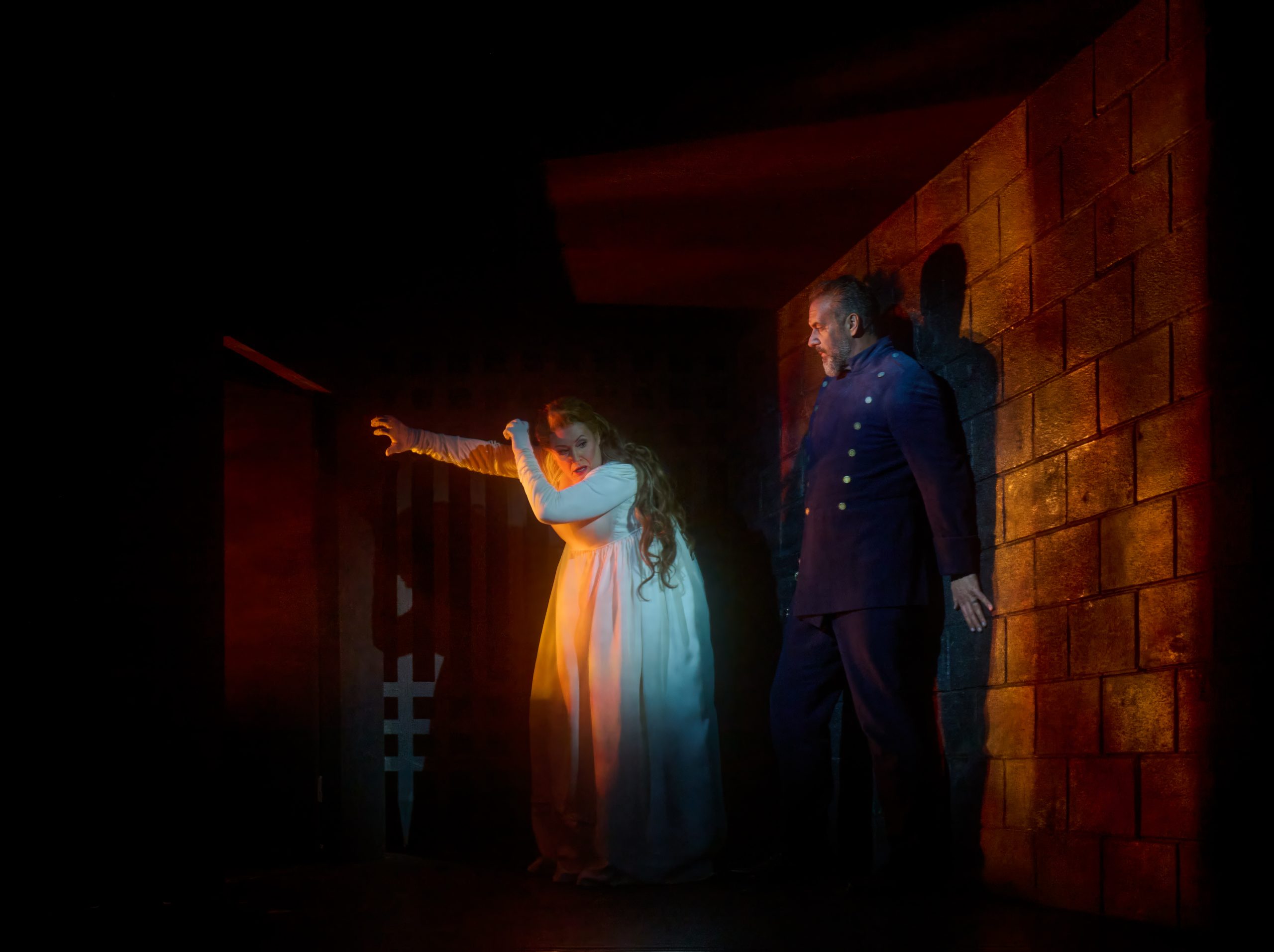
Bluebeard’s Castle
Photo by Michael Cooper
Canadian Opera Company/Bluebeard’s Castle, composed by Bela Bartok, libretto by Bela Balazs, and Erwartung, composed by Arnold Schoenberg, text by Marie Pappenheim, conducted .by Johannes Debus, directed by Robert Lepage, revival director François Racine, Four Seasons Centre, closes May 16.
Some opera-goers attending the Canadian Opera Company’s powerful double bill of Bluebeard’s Castle and Erwartung may not realize the historical significance of the evening but this is not just another revival.
When this pairing was first presented in 1993 — at what was then the O’Keefe Centre — it marked a turning point. Not only did it help propel the international career of what is now the legendary director Robert Lepage, it also showed a rare degree of foresight in recognizing and engaging a rising international talent. It further signalled a new artistic ambition for the Canadian Opera Company. This was risk-taking, visually daring opera-making — and it announced that the company had arrived on the international stage.
More than three decades later, the impact of this pairing has not diminished; if anything, it has deepened. What might once have seemed adventurous now feels inevitable, and the result is utterly compelling. It is like encountering the work for the first time: a searing, immersive experience that holds the audience in its grip from beginning to end. One sits, quite literally, pinned to the seat, as the evening unfolds with a cumulative intensity that is impossible to resist. The audience response is palpable — a collective stillness, a shared sense of being transfixed. The pairing is, quite simply, a stunning piece of music theatre.
The stars, of course, are the singers, the Canadian Opera Company Orchestra, and conductor Johannes Debus, along with the vision of original stage director Lepage. But there are others just as crucial. Lighting designer Robert Thomson and media effects designer Laurie-Shawn Borzovoy emerge as central collaborators in the success of the evening. In Bluebeard’s Castle especially, one becomes acutely aware of the visual language — the play of light and projected imagery that shapes the drama as powerfully as the music itself. Seen now, it is striking to recognize this as an early manifestation of Lepage’s fascination with technology. One cannot escape the impact of these elements; indeed, the production is inconceivable without them.

Bluebeard’s Castle
Photo by Michael Cooper
While on the subject of design, one must also acknowledge the work of Michael Levine, whose contribution is deceptively understated. His set is spare, almost austere, centred on a single diagonal wall that serves both operas but is used in strikingly different ways. A gilded frame encloses the stage, as though we are observing a living landscape — a subtle but telling visual conceit.
This is Levine at his most economical and most eloquent. By resisting excess, he allows the staging and, above all, the lighting and media effects to assume primacy. The set becomes a kind of canvas — a landscape onto which Lepage and his design collaborators can project their vision. It is a quietly astute piece of design, providing just enough structure while leaving room for the production’s visual imagination to take flight. Levine’s costumes evoke character in the strongest of terms, the dark lord of his castle, the bride with her long train that impedes her progress, and in Erwartung, what could be the evocation of a straitjacket.
One of the first striking images in Bluebeard’s Castle establishes the production’s visual language with remarkable economy. Light streams through the seven keyholes, and their shadows are cast onto Levine’s slanted wall, magnified many times over. What begins as something small and contained is transformed into something vast and inescapable. It is a simple effect, but a powerful one, and it sets the tone for the visual imagination that follows. As for the rest of the lighting each door reveals a distinct and increasingly astonishing visual world that consistently defies expectation.
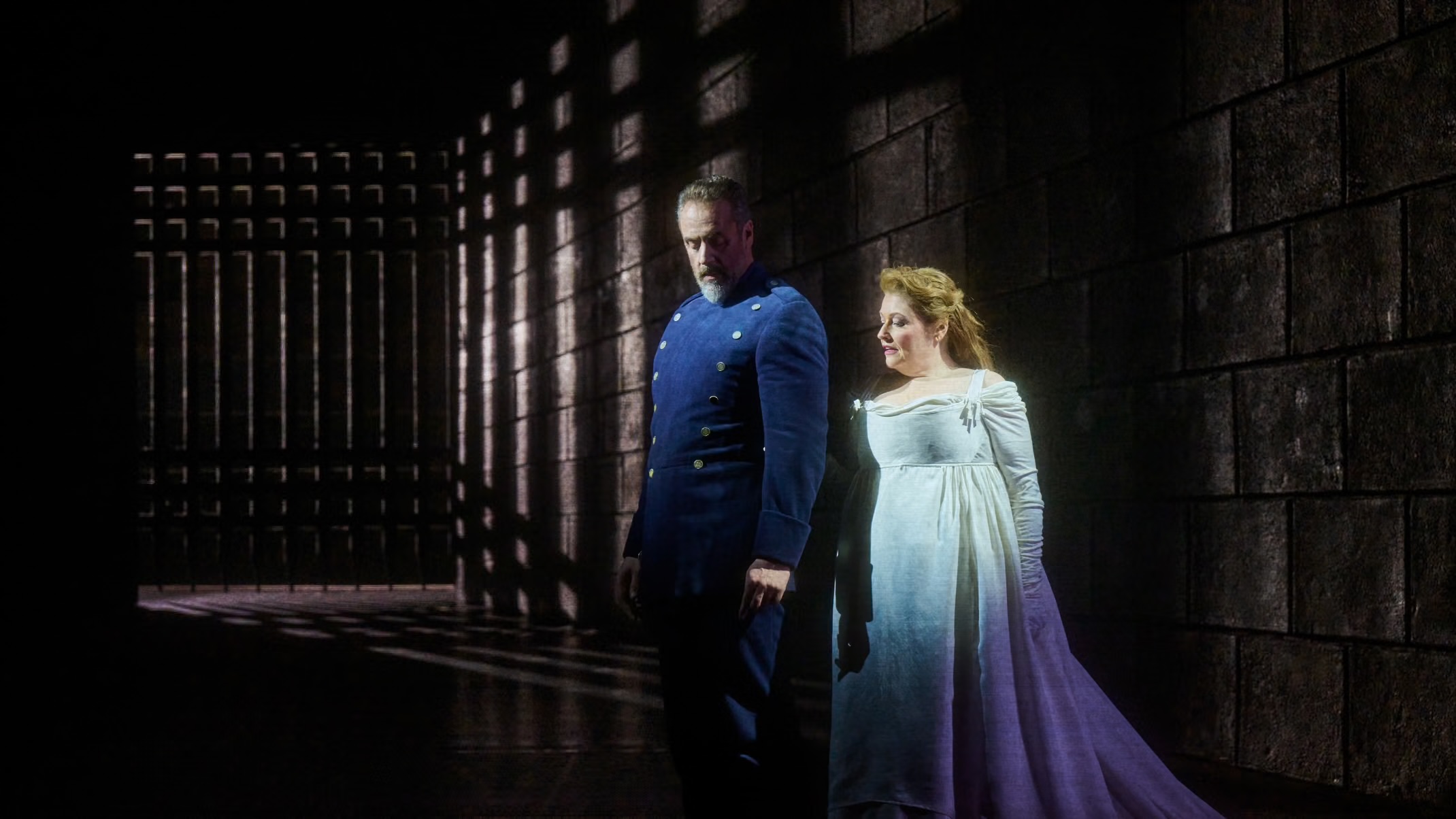
Bluebeard’s Castle
Photo by Michael Cooper
Musically, the evening is superb. Anyone who follows my opera reviews knows that I am something of a perennial admirer of MaestroJohannes Debus — almost to the point of embarrassment. But here, in Bluebeard’s Castle, he outdoes himself.
Of course, he has the extraordinary musical canvas of Bela Bartok to work with. The score is endlessly revealing, almost cinematic in its descriptive power. Each door opens onto a distinct musical world: the armoury resounds with the clangour of battle, the treasury glitters with the orchestral brilliance of gold and diamonds, but beneath it all runs a current of mounting tension. The music is, in many ways, a symphonic tone poem as much as an opera. Under its cinematic sweep, the score is also rooted in Bartok’s engagement with Hungarian folk idioms, whose modal inflections and raw edge give the music an unmistakable sense of place.
In Debus’ hands, the COC Orchestra responds with astonishing clarity and force. He draws from the players a vivid sense of narrative, shaping each episode with precision. When the vast landscape of the sixth door is revealed — the empire of fields, mountains, and deserts — the orchestra expands to full power, filling the space with a sound of overwhelming breadth. In the resonant acoustics of the hall, the effect is almost physical; one feels pushed back in one’s seat by the sheer magnitude of it. This is Debus, the orchestra, and Bartok at their most formidable — a fusion of musical imagination and execution that is nothing short of monumental.
The two singers, American bass-baritone Christian Van Horn and Scottish mezzo-soprano Karen Cargill, bring an intense presence to the stage. What is immediately striking is the contrast between them. Van Horn’s Bluebeard is markedly restrained, almost immobile, while Cargill’s Judith is restless, circling him, probing, driven by a mounting agitation. Both sing magnificently, their powerful voices essential in cutting through Bartok’s orchestral force. Revival director François Racine has wisely largely kept to Lepage’s original vision, allowing the integrity of the 1993 concept to remain intact.
This contrast of movement and stillness is not merely theatrical but embedded in the music itself. Judith’s insistence on uncovering what lies behind the final door — despite repeated warnings — drives the work toward its inevitable climax. The tension is psychological as much as dramatic, rooted in the myth of Bluebeard and the rumours of his past.
What is particularly compelling is the libretto by Bela Balazs, which reimagines the tale first popularized by French folklorist Charles Perrault. Here, Judith is no passive bride; she abandons her former life to pursue Bluebeard, introducing a powerful element of desire and agency. The relationship is charged with sexual and psychological symbolism — attraction intertwined with danger, curiosity with dread.
That symbolic undercurrent is fully realized in Lepage’s staging which reads the work as a study in interior states as much as narrative, and significantly, that psychological and sexual tension carries forward into Erwartung, creating a thematic bridge between the two operas.
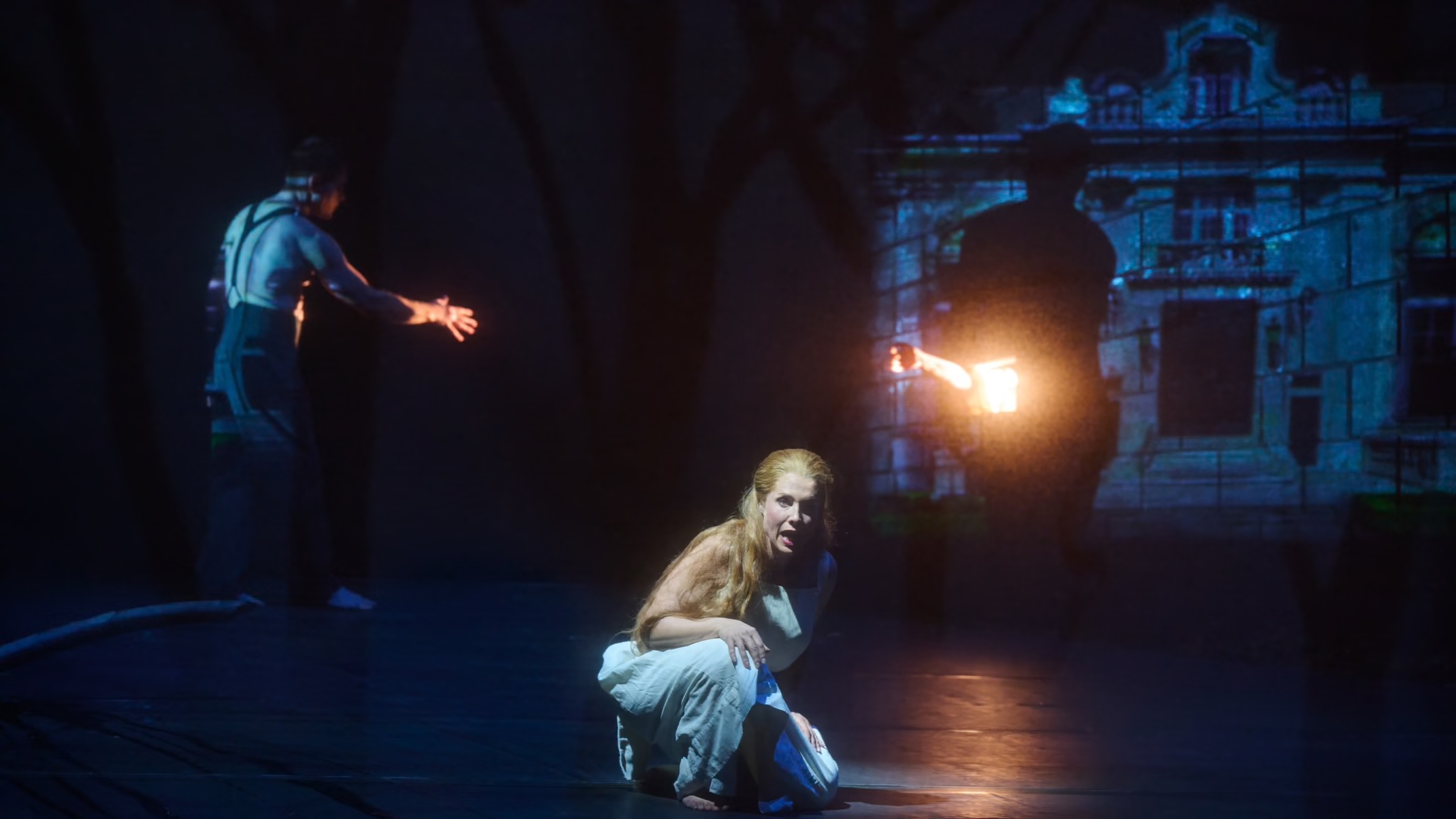
Erwartung
Photo by Michael Cooper
If Bluebeard’s Castle explores psychological tension within a relationship, Erwartung (Expectation) strips that dynamic down to a single consciousness. Here, the interior becomes the entire drama. Arnold Schoenberg’s monodrama, with text by Marie Pappenheim, abandons narrative logic in favour of a fractured, expressionistic landscape of the mind where memory, desire, fear, and hallucination collapse into one another. The title drips in irony.
The Woman— alone on stage — moves through a forest that is as much psychological terrain as physical space. What we are witnessing is not action in the conventional sense, but a relentless excavation of inner states. The sexual and emotional tensions that underlie Bluebeard’s Castle are here turned inward, intensified, and made unstable. Desire becomes anxiety; curiosity becomes dread; the search for the absent lover becomes a descent into psychic disintegration.
At the centre of Erwartung stands German soprano Anna Gabler, who carries the entire monodrama on her shoulders and was rewarded with a resounding ovation. Her achievement here is considerable. Lepage’s staging demands not only vocal stamina but a fully integrated physical and psychological performance: she must interact with the silent figures around her (three actors), suggest a mind in disarray, and inhabit both interior and exterior states simultaneously.
Gabler meets these demands with remarkable assurance. She conveys distraction, mystery, and mounting hysteria, particularly as the Woman’s thoughts turn to imagined betrayal and violence. The production strongly suggests that she may herself be implicated in the death she discovers, and Gabler sustains that ambiguity with compelling intensity.
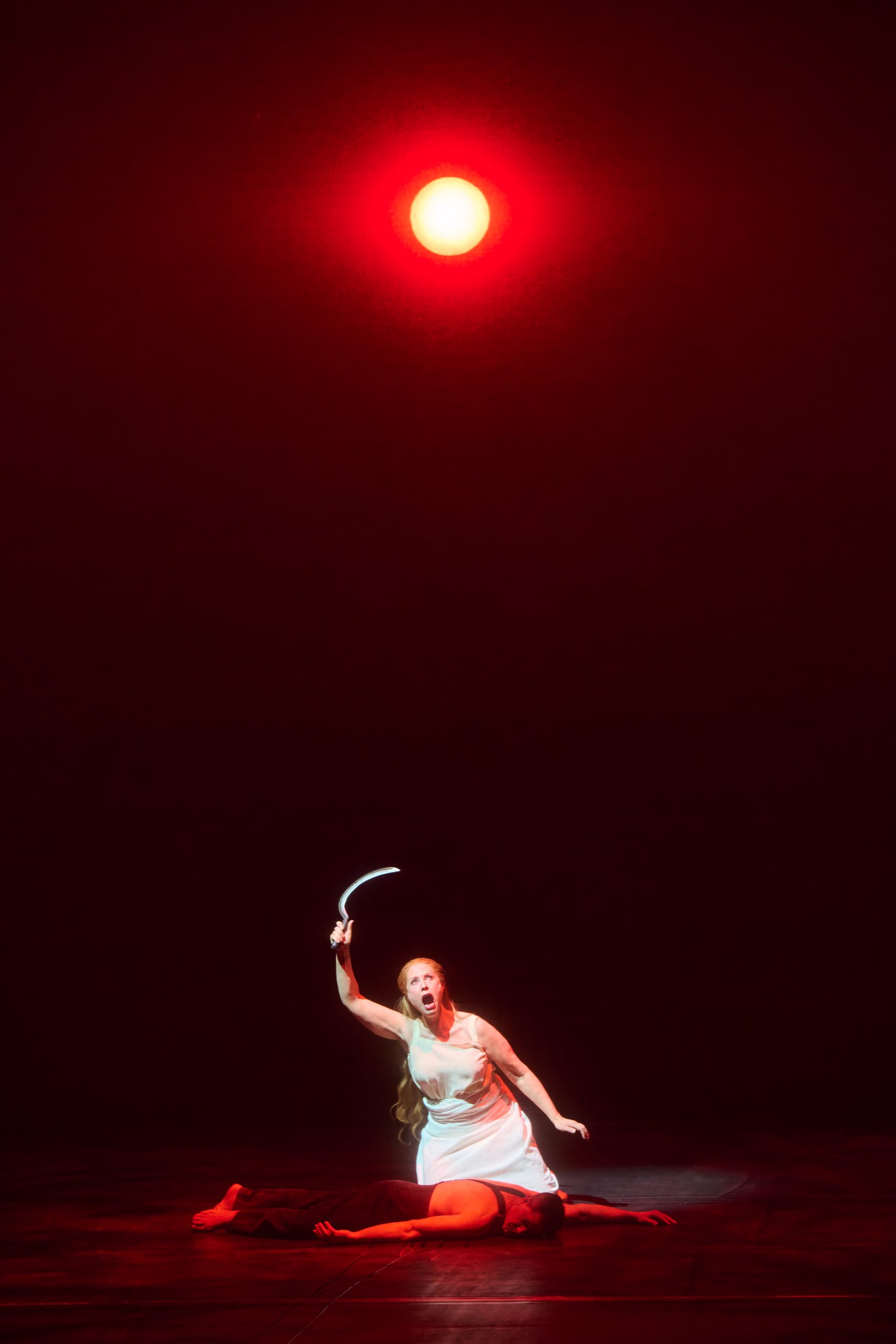
Erwartung
Photo by Michael Cooper
Vocally, she is equally impressive. This is a role that sits at the intersection of lyric and dramatic soprano, requiring both flexibility and power, and she brings a voice capable of cutting through Schoenberg’s dense orchestration with clarity and control. Her performance confirms her credentials in the heavier German repertoire — Richard Strauss and Wagner roles that demand precisely this combination of vocal strength and dramatic commitment.
In Erwartung, Lepage approaches the work as a study in mental fragmentation. The woman appears to be institutionalized, trapped within her own mind, reliving or reconstructing memories that surface in disjointed flashes. Different areas of the stage illuminate as moments of memory come into focus. At one point, a figure — unmistakably a doctor — sits above the action on the wall observing and taking notes, reinforcing the sense of clinical scrutiny. At other times, actors break through the wall like nightmare apparitions. The opera begins and ends with the image of a Woman seated, in a chair as if writing in a journal, framing the entire experience as an interior record.
The narrative itself remains ambiguous, but the implication is unsettling. The Woman searches for her lover, only to discover his body — yet there is a strong suggestion that she herself may be responsible for his death. The forest through which she wanders becomes a dense psychological landscape, a projection of her inner turmoil.
That psychological dimension is rooted in the text by Marie Pappenheim, who was connected to Bertha Pappenheim, one of Sigmund Freud’s early case studies. The work’s exploration of sexuality, repression, and hysteria is therefore no accident. As the Woman’s mind spirals, desire and jealousy surface in distorted form: she imagines infidelity, envisions lovers entwined, and contemplates violence against a rival. These images are rendered explicitly in Lepage’s staging, making visible the sexual and psychological tensions that simmer beneath the surface.
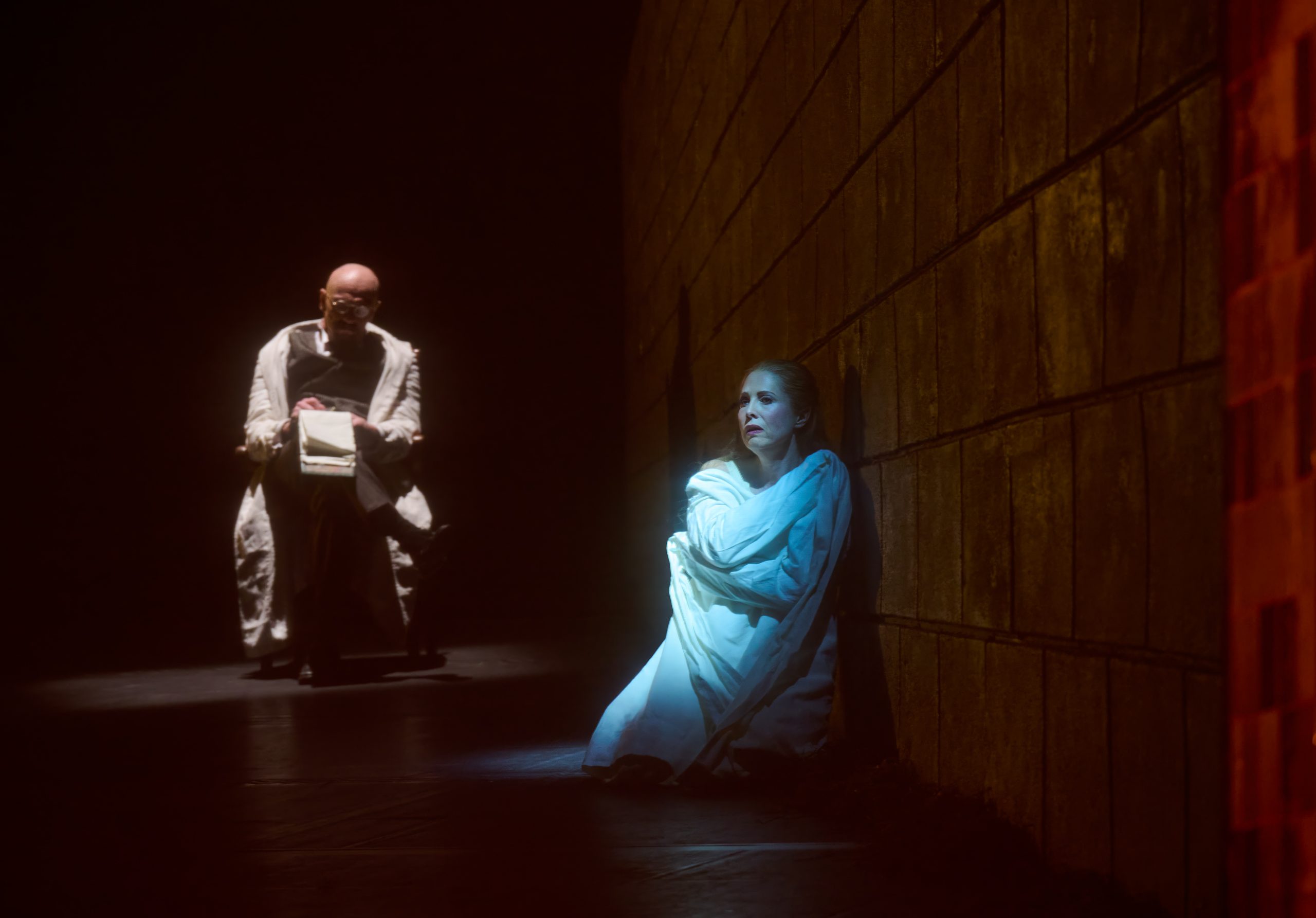
Erwartung
Photo by Michael Cooper
In this way, Erwartung intensifies the symbolic undercurrents already present in Bluebeard’s Castle. What is externalized in Bartok becomes internalized in Schoenberg — a continuation of the same psychological inquiry, but driven to the point of disintegration. It is also worth remembering that these works, though often paired, emerged separately: Bluebeard’s Castle premiered in 1918, while Erwartung, written in 1909, did not receive its first performance until 1924. It was not until the 1950s that the two operas began to be a couple, so to speak, a logical curatorial choice given the striking thematic and psychological affinities between them.
Musically, the contrast is striking but complementary. While Bartok offers a more overtly melodic, even cinematic language, Schoenberg’s score abandons traditional tonality in favour of a fluid, atonal expressivity Both are unmistakably products of the early twentieth century, and together they form a compelling, if demanding, musical landscape.
Under Debus, Erwartung’s score and its shifting emotional canvas emerges with striking coherence, revealing its nuanced musicality that can easily be overlooked in a work often dismissed as merely dissonant.
Before closing, I’d like to make one final observation. The evening is structured with Bluebeard’s Castle first and Erwartung second — a logical decision, given their respective lengths. One can understand the practical reasoning: it avoids opening with a half hour work followed by a half hour intermission and a longer hour long second half.
And yet, dramatically, the choice is open to question. Bluebeard’s Castle is such a monumental and overwhelming experience that it proves difficult to follow. Erwartung, for all its intensity, inevitably feels like the lesser work when placed after it. One cannot help but wonder whether the order should be reversed. Would an audience truly object to beginning with the shorter piece, followed by an interval and the larger, more powerful work? In the theatre, such structures are hardly uncommon
As it stands, the evening builds to its peak too soon. Reversing the order might well allow it to achieve an even greater cumulative impact.
Dan Tarlock says:
I traveled from Chicago to Toronto to see/hear this double bill. As the French say, worth the detour. I also very much enjoyed your Review which, unlike the snotty reviewers, actually deepns one’s understanding of the opera.
pcitron says:
Music to my ears, Dan.
P.