
Introduction
Both of these productions explore grief, though on very different scales — one intimate and personal, the other reflecting a collective grief shaped by decades of suffering and instability. Each also incorporates a distinct element of the fantastical. In one, the audience is asked to accept a horse on stage embodied by a human performer; in the other, to suspend disbelief and engage with the idea of reincarnation. In both cases, the playwrights establish their worlds with such assurance that the audience willingly accepts the terms presented.
12 Litres 8800 Steps
Photo by Jeremy Mimnagh
The Unbridled Theatre Collective and Aluna Theatre /12 Litres 8800 Steps, written by Anita La Selva, co-directed by Anita La Selva and Beatriz Pizano, Factory Theatre Mainspace, closes May 17.When Anita La Selva lost her partner to alcoholism in 2014, she turned to equine therapy as a way of coping with her grief. Working with a thoroughbred horse named Spirit Walker, she found the experience so profound that she resolved to transform it into a theatrical work. The pandemic intervened, and the project first emerged as a film, which went on to considerable success on the international festival circuit. The original intention, however — to bring it to the stage — remained, and after five years, that vision has now been realized at Factory Theatre.
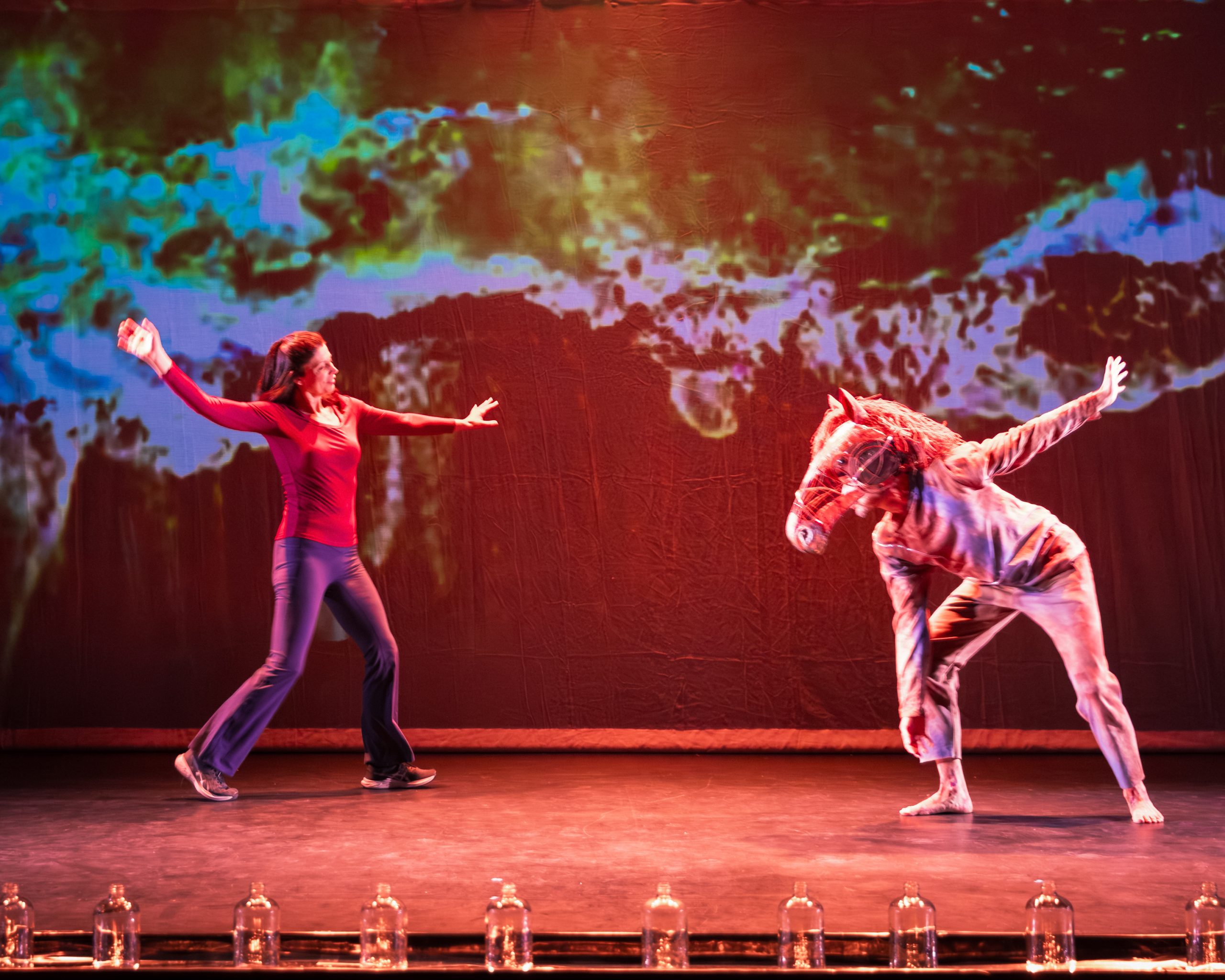
Yes, there is a horse, and yes, that horse is portrayed by movement specialist and actor Brad Cook in an extraordinary performance. Through a combination of physical precision, vocalization, and deeply attentive interaction, he creates a fully believable presence. The performance is supported by finely judged choreography by Victoria Mata Soledad, and striking design elements, including an evocative mask (Monica Viani) and costume (Teresa Pryzbylski) that complete the illusion without ever tipping into caricature.
La Selva herself appears as a version of her own past self, and the play unfolds in a non-linear structure, moving fluidly across time. Scenes shift between childhood memories, moments at the hospital bedside, and the granular details of daily life. What emerges is a portrait not simply of addiction, but of the emotional and psychological toll borne by the caregiver — the relentless strain of loving someone caught in its grip.
One of the most striking sequences visualizes the partner’s alcoholism through a simple but powerful device: empty bottles roll onto the stage from all directions, accumulating as La Selva recounts the moment of discovery — the realization of addiction, the mounting debt, the strain on daily life. The image is both literal and metaphorical, and it anchors the play’s shifting structure. From there, the work moves fluidly between hospital scenes, childhood memories, and her encounters with the horse, creating a layered, non-linear narrative that nonetheless builds a coherent emotional arc.
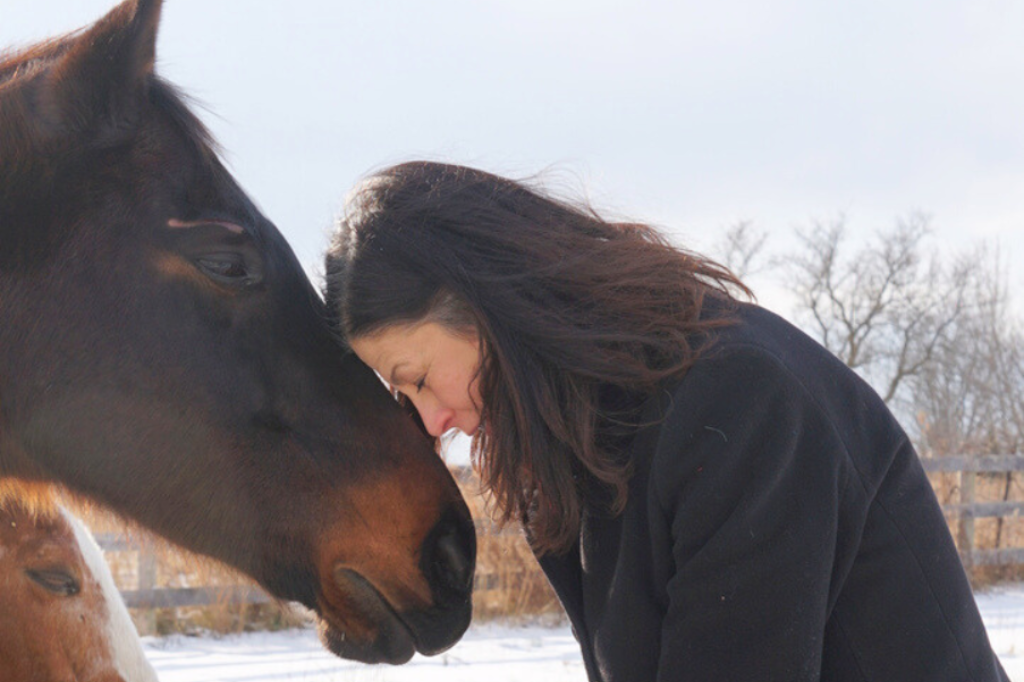
Anita La Selva and Spirit Walker
At the centre of this is the relationship with the horse, which becomes both companion and guide. There is a sense — never overstated — that the animal embodies a kind of imperative: to keep moving, to keep going. The act of walking, of taking those 8,800 steps from home to St. Michael’s Hospital, becomes a ritual of endurance, a way of navigating grief even as it threatens to overwhelm her.
The production is a finely integrated collaboration of text, movement, and design. Sound design by Thomas Ryder Payne and Daniel Tessy creates a rich auditory landscape, blending the live sounds produced by Cook with an evocative collage of city noise, hospital ambience, and memory details. Trevor Schwellnus’s production design utilizing live cam, video and still imagery, deepens the emotional texture — from pastoral images of the horse in open space to the stark immediacy of the hospital and La Selva’s own anguished presence.
The script itself is equally inventive. At one point, La Selva delivers a meticulously detailed account of her daily routine, minute by minute, a passage that underscores both the discipline required to cope and the exhaustion it entails. Even the title becomes resonant: the 8,800 steps marking a physical and emotional journey, while the twelve litres suggest the scale of the addiction that underlies the narrative.
What is most remarkable is the restraint. The play does not dwell on medical specifics or graphic detail; instead, it trusts the audience to fill in what is left unsaid. The result is a work that is deeply moving without ever becoming exploitative. Every element — visual, textual, and performative — aligns with clarity and purpose. It is a brave piece of theatre, and an entirely affecting one.
KARMA
Photo by Cylla von Tiedemann
Pleiades Theatre /KARMA, written by Aksam Alyousef, directed by Ash Knight, Theatre Passe Muraille Mainspace, closes May 17.
Pleiades Theatre continues its mandate of amplifying first- and second-generation voices — stories from the diaspora. In this case, the focus is on Syrian-born playwright Aksam Alyousef, now based in Edmonton. His play KARMA is dense and demanding, and one that expects the audience to piece together the narrative. When the story does come into focus, the result is a deeply powerful experience.
At the centre is Adeeb, played by Andrew Iles, a Canadian-born young man of Syrian descent. Since childhood, he has been haunted by the conviction that he lived a previous life in Syria. His mother, Karma (Christina Tannous), herself Syrian-born, attempts to dismiss these claims, but the pull of this imagined past proves too strong. As an adult, Adeeb travels to Syria in 2012, when the civil war is raging, determined to uncover the truth of what he believes to be his former existence.
Once there, he reconnects with family — his mother, an aunt (Zaynna Khalife) and uncle (Basel Daoud) — and begins to articulate, with unsettling precision, details of the life he insists was once his. Through connections made by his uncle, who is aligned with one of the armed factions operating in the region, Adeeb is able to travel to the town he has described with such unsettling precision.
There, he is brought to a farm and meets an older man, Muhammad (also Daoud) whom he believes to be his father in that earlier existence. What follows is a carefully constructed exchange. The man speaks of his children — four of them now living abroad, but when Adeeb asks about the fifth, Malek, the answer is uncertainty: Malek has disappeared, his fate unknown.
Adeeb then suggests that he knows exactly what became of him. The implication is unmistakable — that he himself is Malek. It is a moment that crystallizes the play’s central tension between memory, belief, and reality.
KARMA
Photo by Cylla von Tiedemann
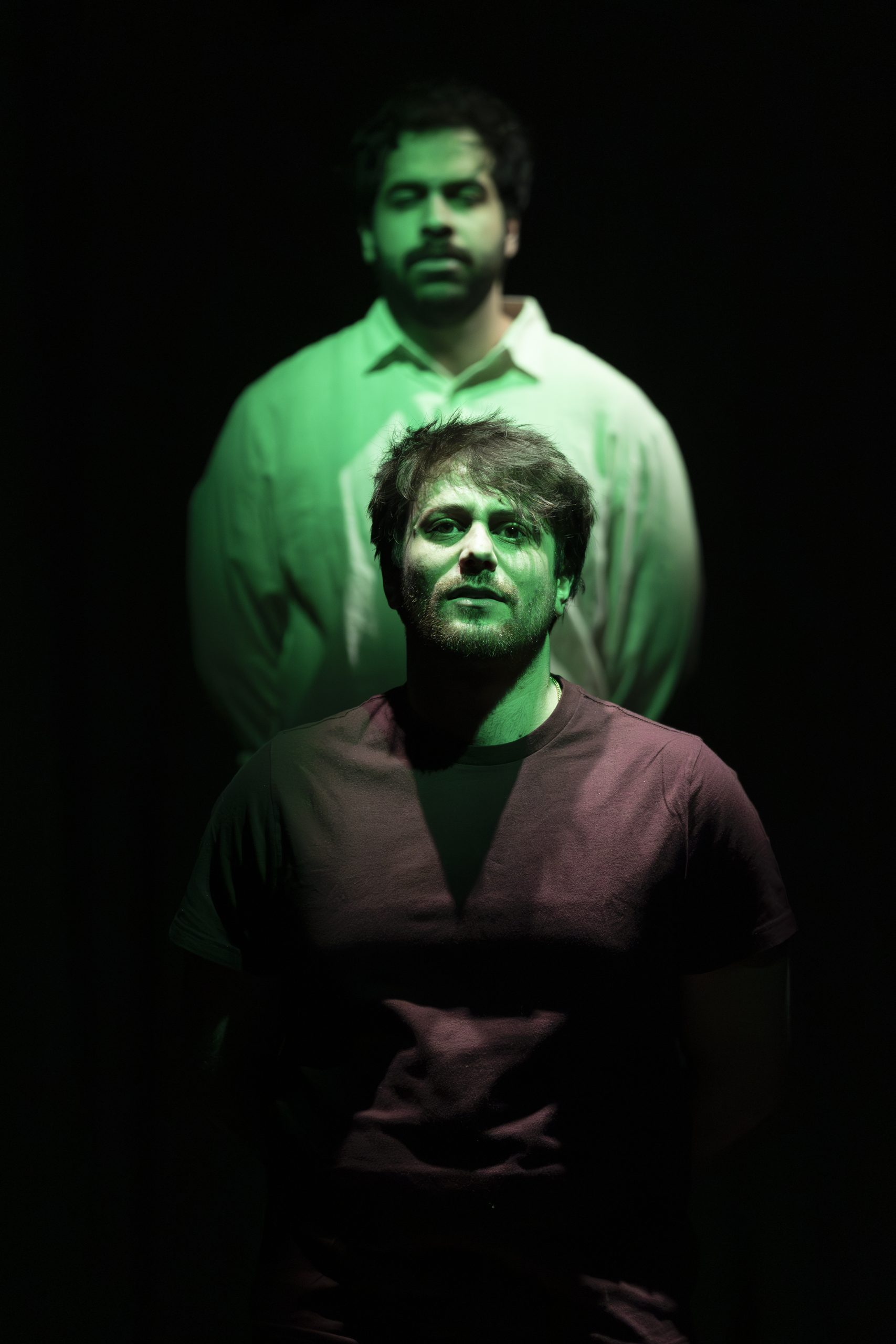
The tension intensifies with the arrival of Shaheen (Yusuf Zine), a nephew of the family and therefore Malek’s cousin. Initially, he is deeply suspicious of what he sees as an impostor, but Adeeb begins to recall details that only Malek could know. What follows is a powerful recognition scene as the two men accept one another within this extraordinary framework.
At the centre of the drama is a concealed object — a suitcase hidden in the sheepfold, something Malek himself had secreted away. When it is finally uncovered, it reveals the play’s deeper structure. During their time fighting in the civil war, Malek and Shaheen had adopted alternate identities, noms de guerre that allowed them to operate within the conflict. The contents of the suitcase include the name Malek chose for himself and connect directly to a horrifying incident within Adeeb’s own family.
With that revelation, it is enough to say that Alyousef brings the narrative full circle with remarkable precision. The device of reincarnation is not treated as a gimmick but as a means of exploring inherited guilt and unresolved trauma. As the playwright suggests in his notes, cruelty is a debt deferred — one that must eventually be paid. The intertwining of personal history, national conflict, and metaphysical possibility is handled with assurance, and the audience is led to accept what might otherwise seem implausible.
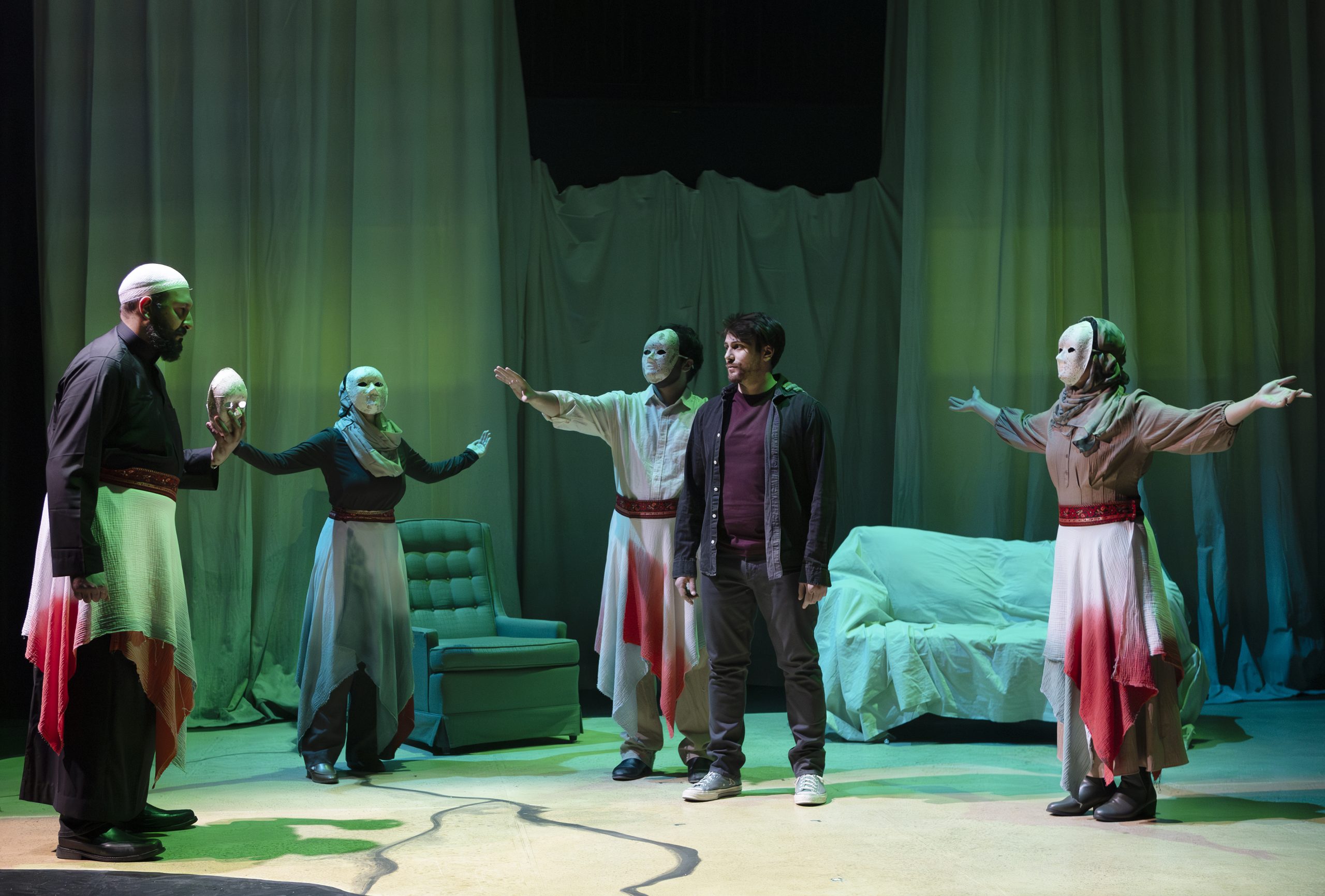
Director Ash Knight and his committed cast make effective use of the TPM theatre space, even incorporating the upper galleries to expand the playing area. Scenic designer Lucas Arab creates a strong sense of place through the use of draped curtains that evoke the textures of the Middle East, while costume designer Ariana Lilith Moodie situates the characters clearly within that world. Complementing this, Gurpreet Chana’s sound design draws on the musical traditions of the Levant. Against this backdrop, Adeeb’s Western clothing stands out sharply, heightening his sense of displacement.
When KARMA concludes, one is left with the sense — whether or not it is the playwright’s intention — that the work functions as a broader parable for the benighted people of Syria. The play’s exploration of debt, guilt, and retribution takes on a wider meaning, reflecting the precariousness of life in a country shaped by prolonged instability and conflict.