
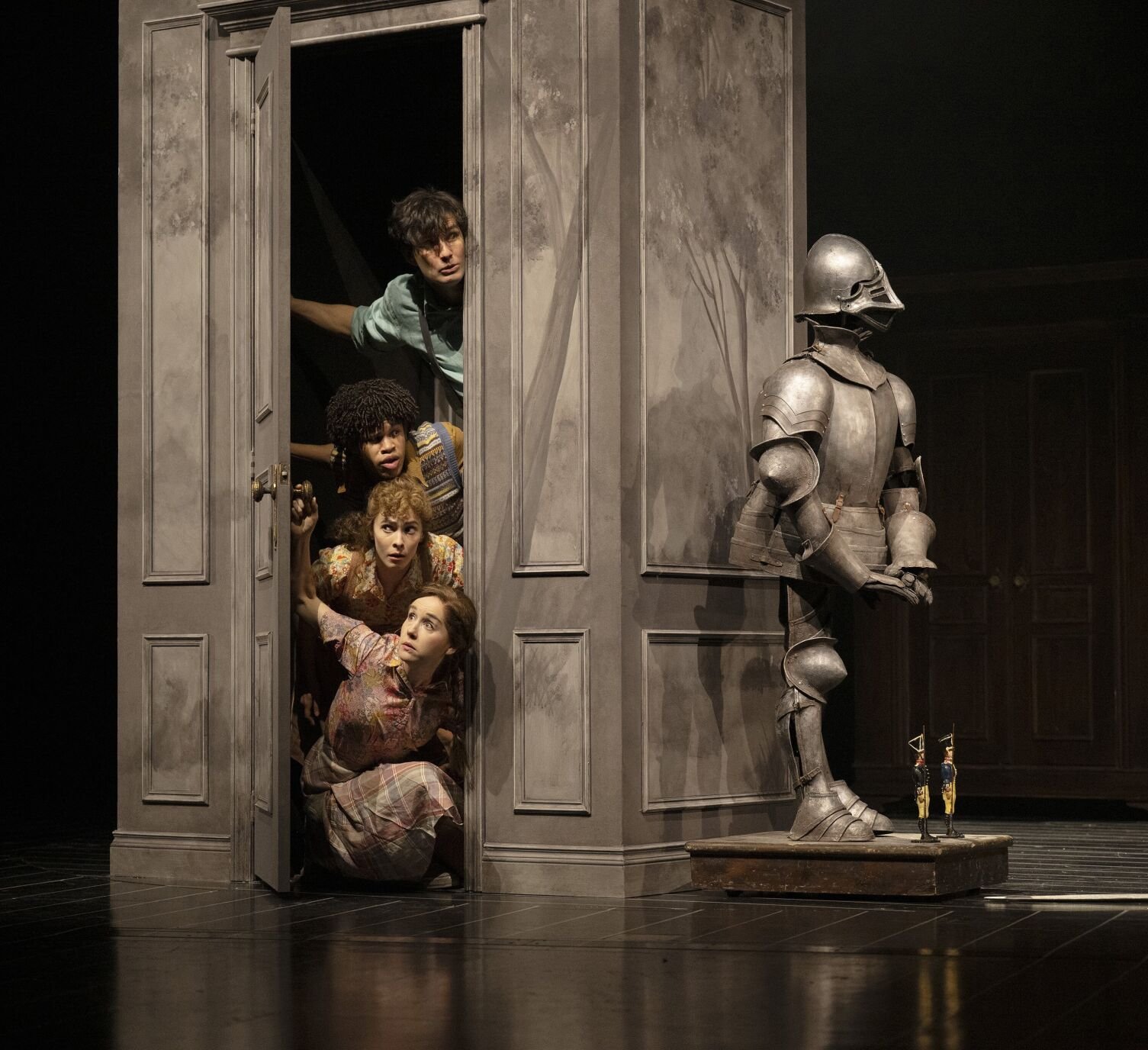
The Lion, The Witch and The Wardrobe
Shaw Festival 2025
Photo: David Cooper
Shaw Festival 2025/The Lion, the Witch and the Wardrobe, co-adapted for the stage by Selma Dimitrijevic and Tim Carroll, based on the novel by C.S. Lewis, directed by Selma Dimitrijevic, Festival Theater, closes October 4.
The production started spectacularly well, with a striking image of adults in raincoats with umbrellas sheltering the children upstage as the sounds of war boomed. The transition to sunshine as the children slipped out from under the umbrellas and came downstage was a powerful metaphor for leaving danger behind and entering the countryside. That moment was full of imagination and theatrical promise. Unfortunately, everything collapsed after that.
This adaptation of the beloved novel by Tim Carroll and Selma Dimitrijevic, directed by Dimitrijevic, deliberately avoided spectacle— but it cost them the magic. What followed was flat and uninspired. The staging lacked theatrical flair, and what could have been a fantastical journey into Narnia felt overly subdued. The decision to de-spectacularize the production in order to emphasize storytelling might have worked on paper, but in practice it drained the piece of wonder. The result was a production that left very little impression beyond its initial moment of promise.
For a show that should have been steeped in childhood imagination, the set design of The Lion, the Witch, and the Wardrobe offered a surprisingly sparse visual world. On essentially an empty stage was the famous wardrobe as the central device for every scene change. Narnia itself — that lush, snowy, mythical realm — was rendered as little more than tatters of white fabric suspended at the back of the stage to represent snow. Much of the show’s action took place semi-behind the white snowy fabric, robbing key moments of their theatrical impact.
Downstage right sat a lone lamppost. Aside from a few minimal set pieces that rolled in to stand for interiors or abodes, that was it. The wardrobe spun around every time the scene shifted between the professor’s house and Narnia — and while functional, its repetitive movement became monotonous and routine. What began as a promising theatrical gesture quickly lost all visual surprise.
Now here’s something for you to ponder. No set designer is listed, only scenic consultants, which can only mean that Dimitrijevic and Carroll were responsible for the set design. Big mistake guys.
The deeper issue, however, is that the production seemed unsure of its tone or audience. Take the White Witch, for example. Elodie Gillett played her in a skin-tight bodysuit and delivered her lines in a breezy, colloquial manner. The effect was jarring — she felt less like a mythical villain and more like a Broadway diva who had wandered into the wrong show. With her exaggerated stance, movement, and vocal choices, she came across more as a sexy babe than a figure of icy menace or dark magic. It was a perplexing interpretation, particularly for a story aimed at children.
Equally baffling was the addition of a “Spirit of Narnia,” a silent character played by Alana Bridgewater who moved solemnly through the action but contributed little beyond vague atmosphere. She crowned the children at the end, yes — but otherwise remained an ambiguous presence. One has to question what children familiar with the book might make of this insert. Was she meant to be a silent narrator? A guardian angel? A living metaphor? The production offered no clues.
There were also two musical numbers — one in the Beavers’ house and another at the conclusion — but these felt isolated and disconnected. If the creative team wanted to include music, why only two songs? The result was confusing: neither a proper musical nor a consistent dramatic tone piece.
Ironically, the play, as mentioned before, did begin with promise. The early transition from war-torn London to the professor’s home was handled with clarity and style. Lucy’s first encounter with Mr. Tumnus, played by Michael Therriault, was engaging and full of potential. But after that, the production quickly unravelled.
Judith Bowden’s costume design raised its own questions. Mr. and Mrs. Beaver (Shawn Wright and Jade Repeta) wore beaver bodysuits but held their beaver heads like muffs in their hands — a strange, halfway concept that felt neither fully anthropomorphic nor symbolically abstract, and very difficult to see from the back of the house. Aslan (Kelly Wong)— the most iconic character in the story — was represented not with a puppet or costume, but with a mere brooch on a performer’s shoulder. The only figures with full-costume commitment were the trolls.
Adults played the children, admittedly, but they did have a certain degree of charm.
Kristi Frank as Susan and Jeff Irving as Peter are established actors within the Shaw community, but they did exude childlike energy. They are the adults of the children after all, and Susan, in fact, does end up killing the White Witch in this production.
But I want to single out Alexandra Gratton as Lucy, who did try to capture the magic of Narnia, and Dieter Lische-Parkes as the rebellious, traitorous Edmund who brought verve to his role. The two younger children, Gratton and Lische-Parkes, really did do their best to inject excitement, and together with Frank and Irving, they did form a lively ensemble.
Given storytelling that wasn’t there, the children at least brought some sparkle, particularly the two younger ones.
By the time the show reached its climax, however, whatever sense of enchantment might have been present early on had vanished. The production seemed to get more lifeless as it went on, and worst of all, it lacked any sense of wonder. A story like The Lion, the Witch, and the Wardrobe should dazzle the imagination. It should be magical. This version wasn’t.
And yes, I have to use the B-word: it was boring.