
Dancer: A Musical in Ten Furlongs
Photo by Racheal McCaig
Oh What a Ride! Productions Inc. in association with Crow’s Theatre and The Toronto Stage Company/Dancer: A Musical in Ten Furlongs, book and lyrics by Jim Betts, music by Marek Norman, directed and choreographed by Stacey Tookey, Terminal Theatre, closes Nov. 1.
Dancer: A Musical in Ten Furlongs is guaranteed to put a smile on your face and make your Canadian heart swell with pride. And yes, it is about a horse, namely Northern Dancer, who became the first Canadian-bred horse to win the Kentucky Derby in 1964.
The eyes of an entire nation were fixed on Churchill Downs in Kentucky, and even Prime Minister Lester B. Pearson got caught up in the excitement, sending an extraordinarily long telegram to Northern Dancer’s owner, E. P. Taylor, declaring that Canadians were waiting with bated breath and that his horse was running for the honour of the country.
And did you know that Northern Dancer became the first non-human to be named Canadian Athlete of the Year? Or that he was presented with the keys to the City of Toronto in the form of a carved carrot, which, I might add, he promptly ate?
But did you also know that Northern Dancer was the runt of the litter? When Windfields Farm, where he was born in 1961, held its yearling sale, nobody wanted him. While his fellow colts went off to new owners, Northern Dancer was left behind. Small, stubborn, temperamental and seemingly untrainable, he was hardly anyone’s idea of a champion.
Yet everybody loves an underdog story, and therein lies much of the musical’s irresistible appeal. We watch this unlikely hero defy every expectation, transforming himself from an unwanted little colt into a racing legend, ultimately claiming the most coveted prize in North American horse racing, the blanket of roses awarded to the winner of the Kentucky Derby.
Of course, there is more to a successful musical than a good story. Enter what I affectionately call the old guard of Canadian musical theatre, book writer and lyricist Jim Betts and composer Marek Norman.
Dancer: A Musical in Ten Furlongs
Photo by Racheal McCaig
These two veterans have been such an integral part of the Canadian musical theatre landscape, and have given us so much pleasure over the years, that they seem almost inseparable from its history. We are certainly not dealing with a couple of young whippersnappers, but with two seasoned theatre artists whose decades of experience have given them an instinctive understanding of how to construct a musical. Surprisingly, Dancer marks their first collaboration. In short, the creative backbone of this musical is in the hands of the A-Team.
According to Betts and Norman, they have deliberately fashioned a score that captures the popular musical sounds of the early 1960s, the era in which Northern Dancer became a national hero. There are echoes of the Beatles and the British Invasion, the folk-inflected melodies of Gordon Lightfoot, and the lush orchestral sophistication of Henry Mancini. Yet the music never becomes a mere exercise in nostalgia. Instead, these diverse influences are woven into a rich and varied score, with the racing sequences given their own distinctive orchestral character. The result is music that not only evokes the period but also helps propel the story forward.
But you are probably wondering, what about the horse? And here is the catch. Dancer is a dance show, an honest-to-God dance show.
Enter Canadian-born Stacey Tookey, now based in New Jersey, whose career has unfolded largely in the United States, including three Emmy nominations.
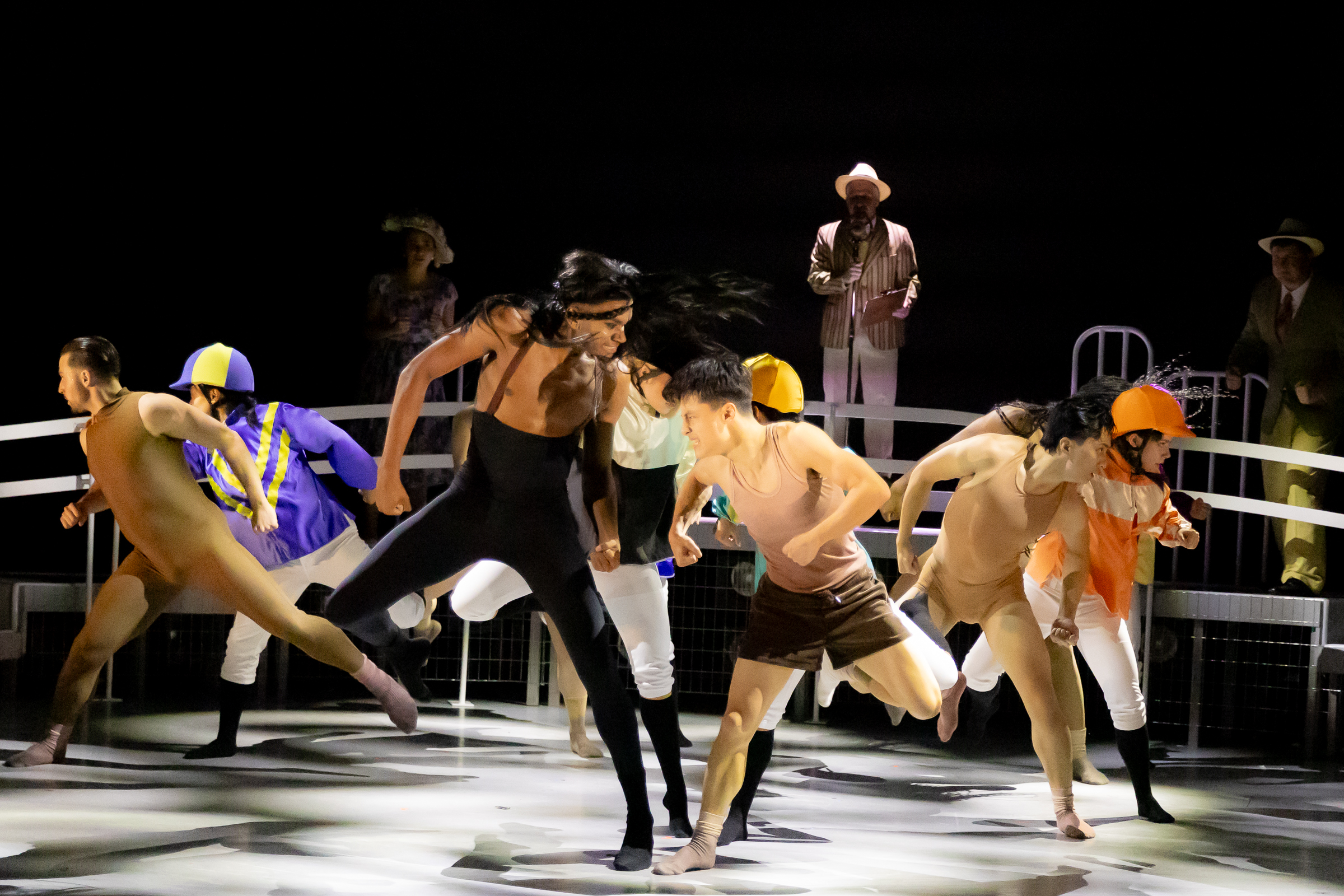
Boy, can this lady ever command a stage! Tookey, who is both director and choreographer, has ten dancers portraying the horses, and the show opens with an exhilarating explosion of movement. Gorgeous bodies sweep across the stage in breathtaking lines and extensions, gymnastic feats, tours en l’air and majestic leaps, creating a dazzling display of physical virtuosity.
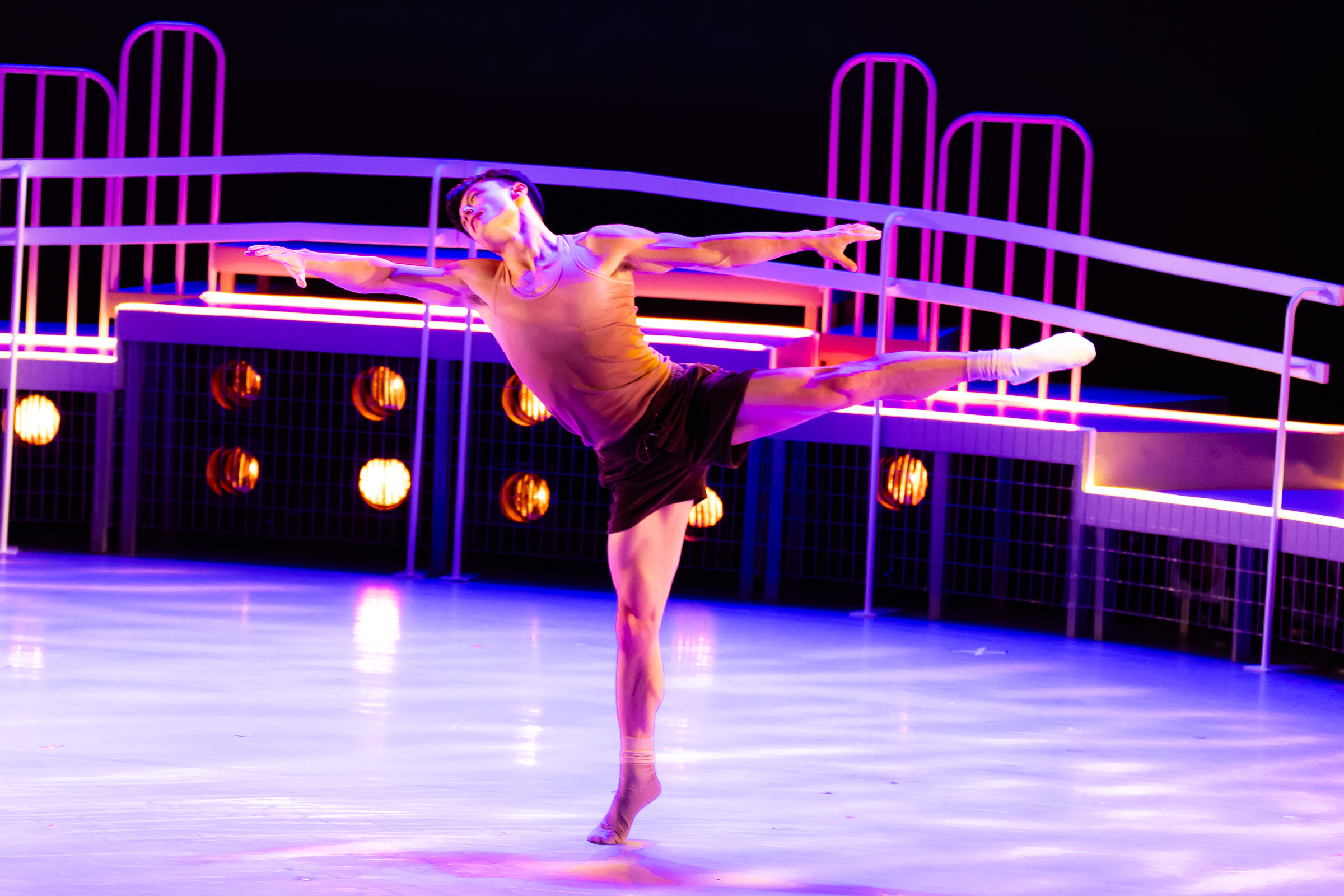
What is so remarkable is that the dancers are not literally imitating horses. Instead, through the grace, lyricism and sheer magnificence of their movements, they evoke the power, beauty and nobility of these extraordinary animals. It is not imitation but the very essence of the horse that Tookey captures through dance.
Everyone, that is, except Northern Dancer, portrayed by the diminutive Keanu Uchida, who transforms his body into that of a whiny little brat throwing a monumental temper tantrum. Stubborn, petulant, irritating, perpetually pouting and seemingly untrainable, this is one thoroughly exasperating little horse.
Uchida’s physical characterization is a marvel, his movements compressed and ungainly, in hilarious contrast to the majestic grace of the other dancers. Yet beneath all that obstinacy lies a champion. When Northern Dancer finally decides to run, there is simply no stopping him. This little runt can fly, or, as his devoted groom so aptly puts it, “put a hole in the wind.”
Dancer: A Musical in Ten Furlongs
Photo by Racheal McCaig
Betts and Norman first presented Dancer at the 2023 Toronto Fringe Festival, where it became an overnight sensation. By the second performance, the entire run had sold out, and the show went on to win the award for Best New Musical. Those fortunate enough to have seen it clamoured for a return engagement, while those who had missed out were desperate for another chance.
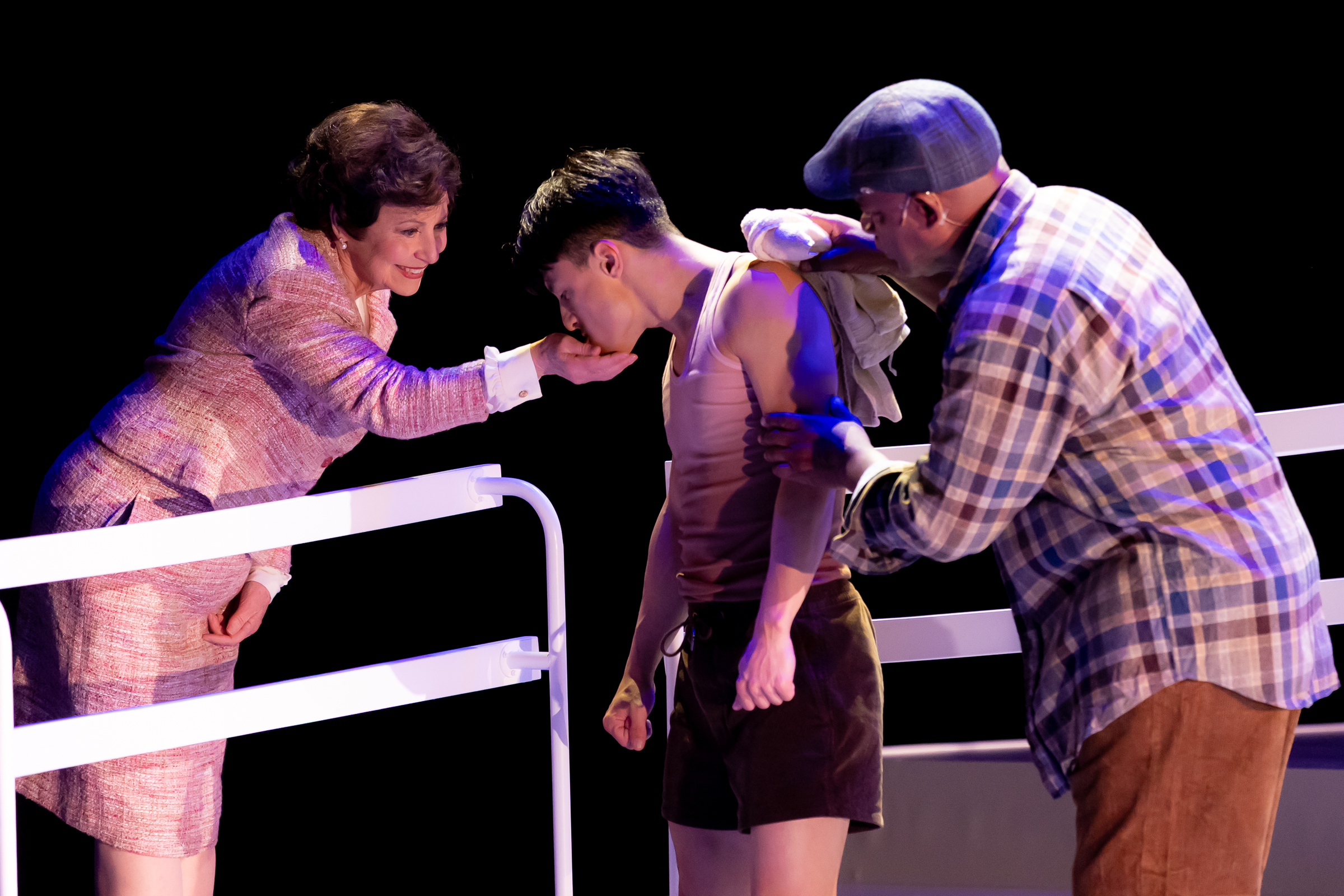
Now that wish has been granted. The original 90-minute production has been expanded to 100 minutes, still without an intermission, and among the most significant changes is the fuller development of the two people closest to Northern Dancer. There is his devoted groom, Bill Brevard (Sterling Jarvis), who recognizes the little horse’s potential when everyone else has given up on him, and Mrs. E. P. Taylor
“Winnie” (Barbara Barsky), who affectionately calls him her “little giant.” Together with Northern Dancer, they form an endearing trio whose mutual affection and unwavering loyalty provide the musical with its emotional heart.
There is a particularly charming scene in which Winnie and Bill set about finding a name for the little colt. Bill recalls that the legendary ballet dancer Vaslav Nijinsky once expressed a wish to be reincarnated as a horse. Winnie then points out that the colt’s sire was Native Dancer, and suddenly the name Northern Dancer is born. It is a delightful exchange, revealing the tenderness these two characters feel for their troublesome little charge, while forging an unexpected connection between the seemingly disparate worlds of ballet and horse racing. And Betts and Norman take that connection one imaginative step further, actually bringing Nijinsky and Northern Dancer together in a scene later in the musical.
Tyler Murree portrays E. P. Taylor, whose relationship with his wife, Winnie, is one of the musical’s quieter pleasures. Taylor is crusty, perpetually busy and occasionally snappish, yet beneath the gruff exterior lies a genuine sweetness and affection that makes their scenes together particularly endearing.
Book writer Betts even manages to slip a little feminism into the proceedings, with Winnie railing against the restrictions imposed on women in the 1960s, including her inability to open a bank account or obtain an Eaton’s credit card in her own name. It is a telling reminder of the era, delivered with a welcome touch of humour. Barsky is just lovely as Winnie. The part is extremely well-written – a wife of a powerful man who knows how to handle him, who seems to take an active part in the business, and yet is every inch a society matron.
Then there is Jarvis as Bill Brevard, a role he has inhabited since the musical’s early development. Jarvis brings enormous warmth and humanity to the devoted groom, whose unwavering faith in Northern Dancer makes him one of the most sympathetic figures in the show. Betts also touches on the anti-Black prejudice Brevard encounters in the American South, giving his character a social dimension beyond his relationship with the horse.
Dancer: A Musical in Ten Furlongs
Photo by Racheal McCaig
Another valuable presence in the musical is Sam Rosenthal as Daryl, the track announcer, who functions as a kind of semi-narrator, as well as calling the races and keeping the story moving at a lively clip. He also has some great one liners which he delivers with just the right ironic touch.
Of course, every good musical needs a villain of sorts, and that dubious distinction falls to Kent Sheridan as Horatio Luro, the Argentinian trainer, a role he plays with positively luscious glee. Referring to himself as le grand señor, Luro is oily, pompous, officious and insufferably self-important, lavishing upon Winnie Taylor an exaggerated, almost cloying display of Latin macho gallantry. A consummate know-it-all, he boasts of breakfasting with Bing Crosby and hobnobbing with the rich and famous of the horsey set.
Yet beneath all this swagger and self-proclaimed expertise lies a man who simply does not understand Northern Dancer. Worse still, he resorts to the whip, the one thing the little horse absolutely cannot abide. Their encounters erupt into fierce battles of will, with Northern Dancer expressing his fury and defiance through explosive, almost violent movement. Uchida attacks these confrontations with extraordinary ferocity, transforming the horse’s stubborn resistance into a thrilling display of physical theatre.
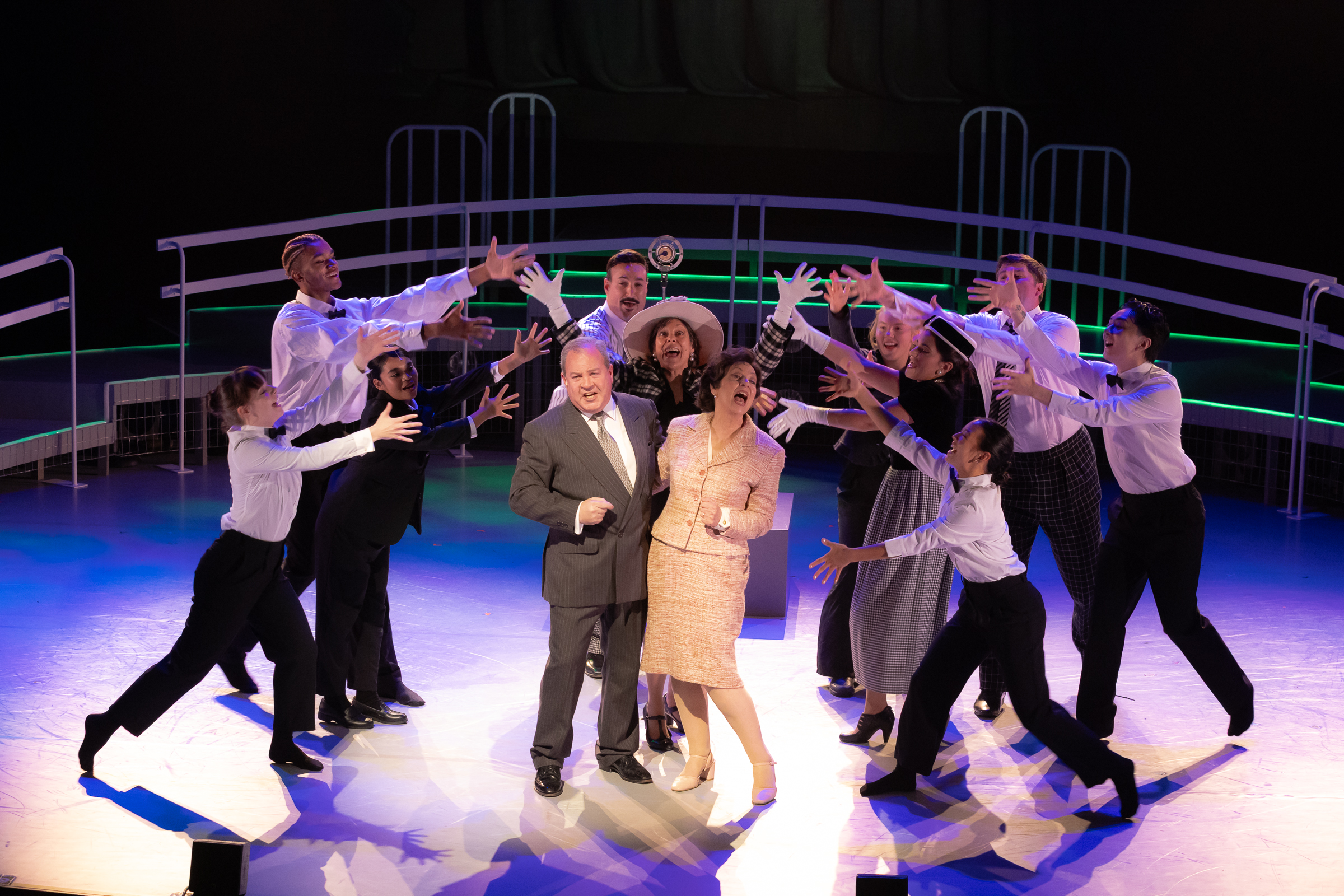
The chorus of singers is called the Hoofbeats, a rather peculiar name, to say the least. Yet these versatile performers do considerably more than provide vocal accompaniment. From their ranks emerges a colourful parade of supporting characters, including pushy auctioneer Harry Green (Danny Cannis), the “experimental” veterinarian Doc Bane (Daniel Williston), hilarious Prime Minister Lester B. Pearson (Lara Angela Roda), and the thoroughly narcissistic jockey Willie Shoemaker (JJ Gerber). These cameos, some of whom get their own song, inject an extra dose of humour into the proceedings, always a welcome diversion when they’re clever, which these for the most part are.
At the heart of Dancer, however, are the dance sequences, most of which unfold during the races, although there are several dream sequences as well. What is absolutely phenomenal is that no two races look alike. Norman has composed edgy orchestral music for the eight-piece band, and just as each race has its own musical identity, Tookey gives it a distinctive choreographic vocabulary. The balletic movement is breathtaking, with the other dancers never surrendering their grace and Uchida never quite acquiring his, although he keeps winning.
In the final two races, dancers also portray the jockeys, adding yet another dimension to an already intricate choreographic landscape. Sometimes they ride on the backs of their horses; at other times, they move beside or behind them, creating a fascinating double choreography in which jockey and mount must remain in constant physical dialogue. It is an extraordinary feat of imagination, using the language of ballet to conjure the excitement, speed and competitive fury of horse racing without resorting to literal imitation. And we believe absolutely in what we are seeing.
The Kentucky Derby sequence is particularly spectacular. Tookey has devised an utterly original movement vocabulary for Northern Dancer, whose physicality remains stunted, compressed and ungainly, yet who can unleash lightning-fast turns and jumps from within those very limitations. His chief rival is the favourite, Hill Rise, portrayed by Jude Richardson, a tall, stately and magnificent dancer whose effortless elegance provides a striking contrast to the diminutive Uchida.
As the race progresses, however, something fascinating happens. Richardson gradually loses his composure as Hill Rise falls behind, his once-majestic movement becoming increasingly strained and disjointed. By the time he loses by a nose, that glorious elegance has all but deserted him. It is a brilliant piece of choreographic storytelling, revealing the outcome of the race through the very bodies of the dancers. Quite simply, Tookey’s choreography is a triumph.
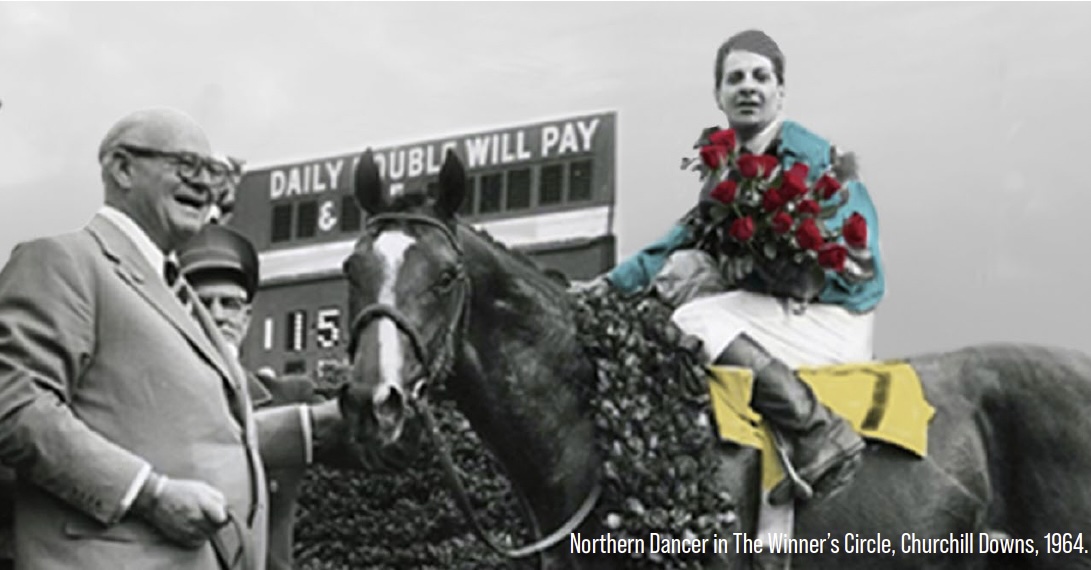
Winner’s Circle, Kentucky Derby 1964
Northern Dancer, owner E.P. Taylor, jockey Bill Hartack
Even the title, Dancer: A Musical in Ten Furlongs, contains a clever piece of theatrical ingenuity. The show unfolds in ten scenes, each designated a furlong, bookended by a prologue and an epilogue. For the uninitiated, a furlong is one-eighth of a mile, which means that ten furlongs equal a mile and a quarter, precisely the distance of the Kentucky Derby at Churchill Downs. Thus, the musical’s very structure becomes a metaphor for Northern Dancer’s greatest triumph, taking us furlong by furlong towards the finish line.
Set designer Julia Kim has provided the attractive back ramps, clever movable paddock fences and narrative videos, while Alessia Urbani has returned to the Sixties to costume the humans. The horses are in various shades of brown unitards (with Hill Rise in black and the jockeys in racing colours). Northern Dancer is in brown shorts and a tank top, setting his clunky look apart from the tight fit of the other horses. Chris Malkowki’s lighting follows the action, particularly zooming in on Northern Dancer in the races, thus directing the eye of the audience.
All is not perfect, however, and I have one serious complaint.
Mark Camilleri, the supervising music director and orchestrator, who also serves as conductor and keyboard player, is an enormously talented musician. However, Mark, I hope you’re listening, because your band is simply TOO LOUD.
At times, the eight musicians overwhelm the singers, particularly Sterling Jarvis, and that is unforgivable in a musical blessed with lyrics as clever as those Jim Betts has written. I wanted to hear every word, and I could not.
There are few things that make me angrier in musical theatre than having lyrics swallowed up by an overzealous orchestra. What is the point of such wonderful writing if the audience cannot hear it? I sincerely hope the balance between singers and musicians is corrected, because audiences will undoubtedly flock to Dancer, and they deserve to hear every word of this delightful score.
Dancer: A Musical in Ten Furlongs is an absolute delight. The wonderfully tuneful score and breathtaking choreography combine to transform a remarkable chapter of Canadian sporting history into a joyous theatrical celebration. It is a feast for the eyes, a pleasure for the ears, and a heartwarming tribute to a little horse who captured the imagination of an entire nation.
Quite simply, Dancer is a show not to be missed.