

Booty Candy
Photo by Roya DelSol
Buddies in Bad Times Theatre & Obsidian Theatre/Booty Candy, written by Robert O’Hara, directed by Jay Northcott, Buddies in Bad Times Theatre, closes Oct. 17.
Booty Candy is an extraordinary, must-see play.
The structure is absolutely breathtaking. It begins with a series of seemingly unrelated scenes in the first act, which are brought together at the end of the act in the most unexpected way. The second act continues these scenes at a later point in time, finding new ways to connect them. In other words, the intersectionality as a whole is most surprising and ingenious.
Booty Candy was written by American playwright and director Robert O’Hara, known for his provocative, often outrageous theatrical works that explore race, sexuality, identity and social hypocrisy through biting satire and dark comedy. Born in Cincinnati, Ohio, in 1970, O’Hara made his professional breakthrough with Insurrection: Holding History in 1996. His plays, including Booty Candy, are distinguished by their unconventional structures, audacious humour and willingness to confront uncomfortable truths.
At the heart of Booty Candy is the experience of growing up Black and gay in America. O’Hara examines the complicated relationships between family, religion and community, exposing the prejudices, hypocrisies and contradictions that shape individual lives. He is particularly interested in the tension between public morality and private behaviour, as well as the pressures of conforming to society’s expectations.
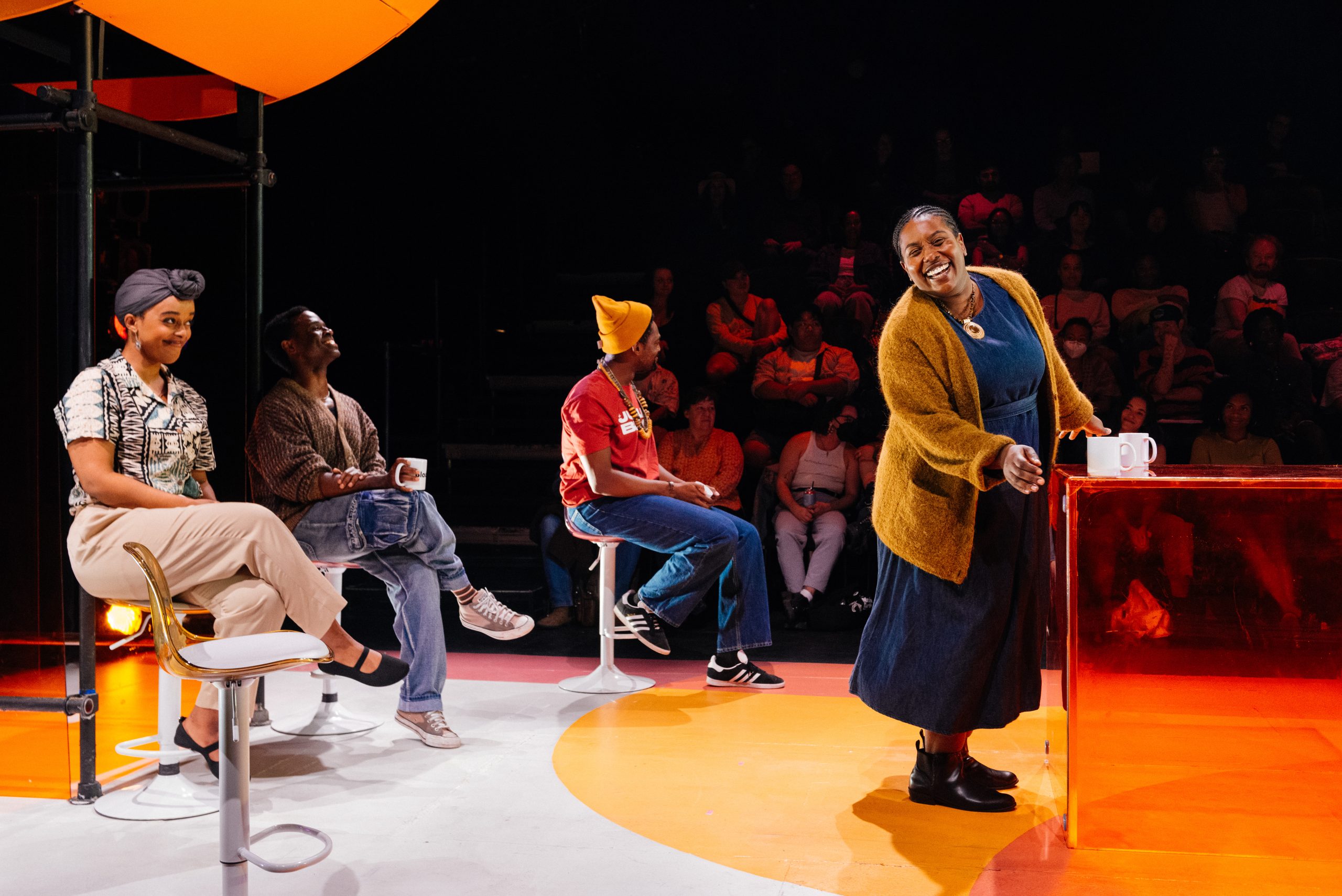
Booty Candy
Photo by Roya DelSol
O’Hara has said that Booty Candy is semi-autobiographical, and among the various scenes, one recurring character is Sutter (Kyle Brown), a young Black gay man whom we see as a child, an adolescent and finally an adult.
However, Booty Candy is not simply Sutter’s story. In fact, the five performers are listed in the program by number rather than by character, with Kyle Brown, who plays Sutter, designated as Actor Two. This is because the other actors, all of whom play multiple roles, are equally important to O’Hara’s examination of society.
For example, Christopher Allen (Actor 4) portrays a reverend who hilariously castigates members of his congregation for their disapproval of gay worshippers. Helen Belay (Actor 1) and Meghan Swaby (Actor 3) appear in an equally hilarious scene as a lesbian couple undergoing an “uncoupling,” the opposite of a marriage ceremony. Then there is Dan Mousseau (Actor 5), who portrays a series of troubled white men. All five performers are given equal weight as O’Hara spreads his broad canvas, examining the many contradictions, prejudices and complexities of contemporary society.
One moment in Booty Candy, you are absolutely convulsed with laughter, as in the scene with the reverend, or the hilarious telephone conversation between Belay and Swaby, who play four different women complaining about a relative and the name she has chosen for her unborn baby. The two actresses keep disappearing for lightning-fast costume changes. Then, in the very next scene, O’Hara can turn to something deeply poignant, such as the agonizing encounter between Sutter (Brown) and Clint (Mousseau), the latter who claims to be straight but is struggling with his attraction to Sutter.

Booty Candy
Photo by Roya DelSol
Thus, O’Hara takes us through an extraordinary range of emotions, moving from the satiric to the poignant, from the ironic to the downright funny, and even to the pathetic. He is a playwright of many moods, and the sheer unpredictability of his writing is one of the great strengths of Booty Candy, making for a thoroughly compelling evening of theatre.
The acting in Booty Candy is absolutely phenomenal, with all five performers delivering brilliant performances in their multiple roles. The direction is particularly tight, with Jay Northcott finding the perfect pacing, never allowing the action to lag for a moment, while striking just the right balance between scenes of satiric humour and genuine poignancy.
Nick Blais’ set design, however, is something of a mystery. A large wooden structure dominates the stage, with a long central piece that serves as a table or counter, but also as a walkway on which the actors can stand. Beside it is a plastic table for sitting inside or on top. Above it, to the side, is a raised platform, with various pieces suspended in the air. Is the large piece supposed to suggest a phallus? What is certain is that the oversized central structure tends to dwarf the actors, and I am not convinced of what Blais is trying to achieve.

Booty Candy
Photo by Roya DelSol
On the other hand, costume designer Arianna Moodie has struck gold. Her costumes are absolutely brilliant, and given the constant shifts in scenes and characters, this is no small achievement. Whether it is the four gossipy women played by the two actresses, the young gay men out on the town for a drink, the mother and father at home, or Sutter at various stages of his life, from childhood through adolescence to adulthood, every character looks exactly as they should. The costumes are a triumph.
Darren Shaen’s lighting design and David Ariza’s original music and sound design also contribute to the production’s striking theatricality, helping to define the constantly shifting moods and scenes.
Before concluding, a word about the title. Booty Candy was apparently the expression O’Hara’s grandmother used to refer to his penis when he was a child, a euphemism that he found amusing and later recognized as having theatrical possibilities. In fact, the play opens with young Sutter questioning his mother about his “booty candy,” sending her through hoops as she struggles to explain what it means. Given the many scenes involving sex and sexuality throughout the play, the title becomes an apt umbrella for the entire work.
If I had to find one word to describe Booty Candy, which premiered in Washington, D.C., in 2011 and made its Off-Broadway debut in 2014, it would be – extraordinary. Extraordinary for its vision, its many themes, but most of all for its brilliant structure and sheer overall inventiveness. It is not just what O’Hara has to say, but how he says it that makes this play so remarkable.
Robert O’Hara, I am a fan.