

Diana After Her Suicide Attempt
Next to Normal
Photo by Valentina Caballero
Bowtie Productions/Next to Normal, music by Tom Kitt, book and lyrics by Brian Yorkey, music direction by Michael Ippolito, choreographed by Meredith Shedden, directed by Anthony Goncharov, Aki Studio, closes June 6.
This is the first of two reviews dealing with Pulitzer Prize-winning Drama winners currently on Toronto stages.
The first is Tom Kitt and Brian Yorkey’s groundbreaking musical Next to Normal, presented by the enterprising Bowtie Productions, a company devoted to producing thought-provoking shows that are rarely seen in town.
When the Pulitzer Board awarded Next to Normal the 2010 Prize for Drama, it described the work as “a powerful rock musical that grapples with mental illness in a suburban family and expands the scope of subject matter for musicals.”
The citation was significant. Next to Normal became only the eighth musical ever to receive the Drama Prize. Before its arrival, no musical had dared tackle bipolar disorder and family trauma as serious dramatic subjects. Whether or not one agrees with the Pulitzer’s description of the score as a “rock musical” (it’s not), there is no question that Next to Normal changed the landscape of musical theatre by expanding what a musical could be about.
While the six-member musical ensemble includes electric and bass guitars, it also incorporates cello and violin, creating a sound world far richer and more varied than that of a conventional rock band. Tom Kitt’s score strikes closer to contemporary adult-pop than rock, filled with melodic, emotionally accessible music. With very little spoken dialogue, Next to Normal unfolds almost entirely as through composed, functioning less like a traditional Broadway musical than a compact modern opera in which character, emotion, and story are carried primarily through song.
This is my third encounter with Next to Normal. I first saw the show at Broadway’s Booth Theatre in 2009, curious to discover what all the excitement was about. The Booth, with its roughly 800 seats, is one of Broadway’s more intimate houses. A decade later I saw The Musical Stage Company’s acclaimed Toronto production at the 700-seat CAA Theatre. Yet, despite the show’s reputation and its Pulitzer Prize pedigree, I remained unconvinced. I admired its ambition and acknowledged its groundbreaking subject matter, but I found it self-conscious in its determination to break new ground. Rather than feeling the emotional impact of the story, I found myself admiring the mechanics of the writing.
It was not until this Bowtie Productions’ revival in the 120-seat Aki Studio that the musical finally revealed itself to me. In this extraordinarily intimate setting, the protective distance that had existed in the larger theatres simply disappeared. For the first time, I understood what Tom Kitt and Brian Yorkey were trying to accomplish and why the Pulitzer Prize committee responded so strongly to the work. This production strips away any sense of theatrical grandstanding and pretentiousness and focuses instead on the emotional reality of a family struggling to cope with mental illness, grief, and loss. Suddenly the show ceased to be about its reputation and became about its people.
Brian Yorkey has said that the genesis of Next to Normal came from a television program about electroconvulsive therapy, or shock treatment, which plays an important role in the musical.
The Family
Next to Normal
Photo by Valentina Caballero
On the surface, the story concerns Diana Goodman (April Rebecca), a suburban wife and mother whose bipolar disorder has dominated family life for sixteen years. Her husband Dan, an architect (Taylor Long) and 16-year-old daughter Natalie (Aveleigh Keller) have learned to live with behaviour that can swing from eccentric to alarming. In one memorable scene, Diana scatters bread and meat across the kitchen floor before assembling sandwiches from the mess.
Crisis follows crisis. Natalie, a gifted musician, finds her achievements overshadowed by her mother’s illness and, more to the point, her obsessive devotion to older bother, 18-year-old Gabe (Christopher Lyon). Promises are made and broken as Diana’s latest emergency takes precedence over everything else. No one comes to Natalie’s all-important piano recital and she has a breakdown on stage as a result.
The genius of Yorkey’s book is that it examines the effect of that illness on everyone around Diana. Dan spends his life trying to hold the family together. Natalie struggles to emerge from her brother’s shadow and establish an identity of her own. The family’s relationships are shaped by Diana’s condition. The musical’s true subject is not one woman’s illness, but the emotional cost borne by an entire family as they attempt to live with it. Happily, Natalie does have a warm relationship with Henry (Samel Sunil), a boy from school, and we see that delightful relationship growing, although it does have a troubling drug aspect.
And then there is Diana’s relationship with her two doctors, both played with excellent differentiation by actor Mich Anger. The first, the cold and distant Dr. Fine, can only give medication, but he’s macabrely humorous with colour-coded don’t mix up this pill with that pill. Her second doctor, the uber warm and comforting Dr. Madden, is the one who suggests electroconvulsive therapy, ECT. If the first seems to be totally uncaring, the other is almost like a snake oil salesmen in trying to convince Diana to do ECT.
The first act sets the stage for the audience to meet the totally dysfunctional family, while the second act is Diana’s reaction to undergoing ECT and what it has done to her brain and her memory loss. What ultimately makes Next to Normal so effective is that it is not really about Diana’s bipolar disorder. We know from the beginning that Diana is ill. To repeat the obvious – the more interesting question is how everyone around her copes with that reality. It is not always an easy watch, but it is often a deeply moving one.

Diana in a Crisis
Next to Normal
Photo by Valentina Caballero
One concern at the outset is that Diana and Dan Goodman are played by performers who appear scarcely older than the actors portraying their children. Yet any reservations quickly disappear because the performances are so compelling. Indeed, director Anthony Goncharov draws richly detailed characterizations from the entire cast.
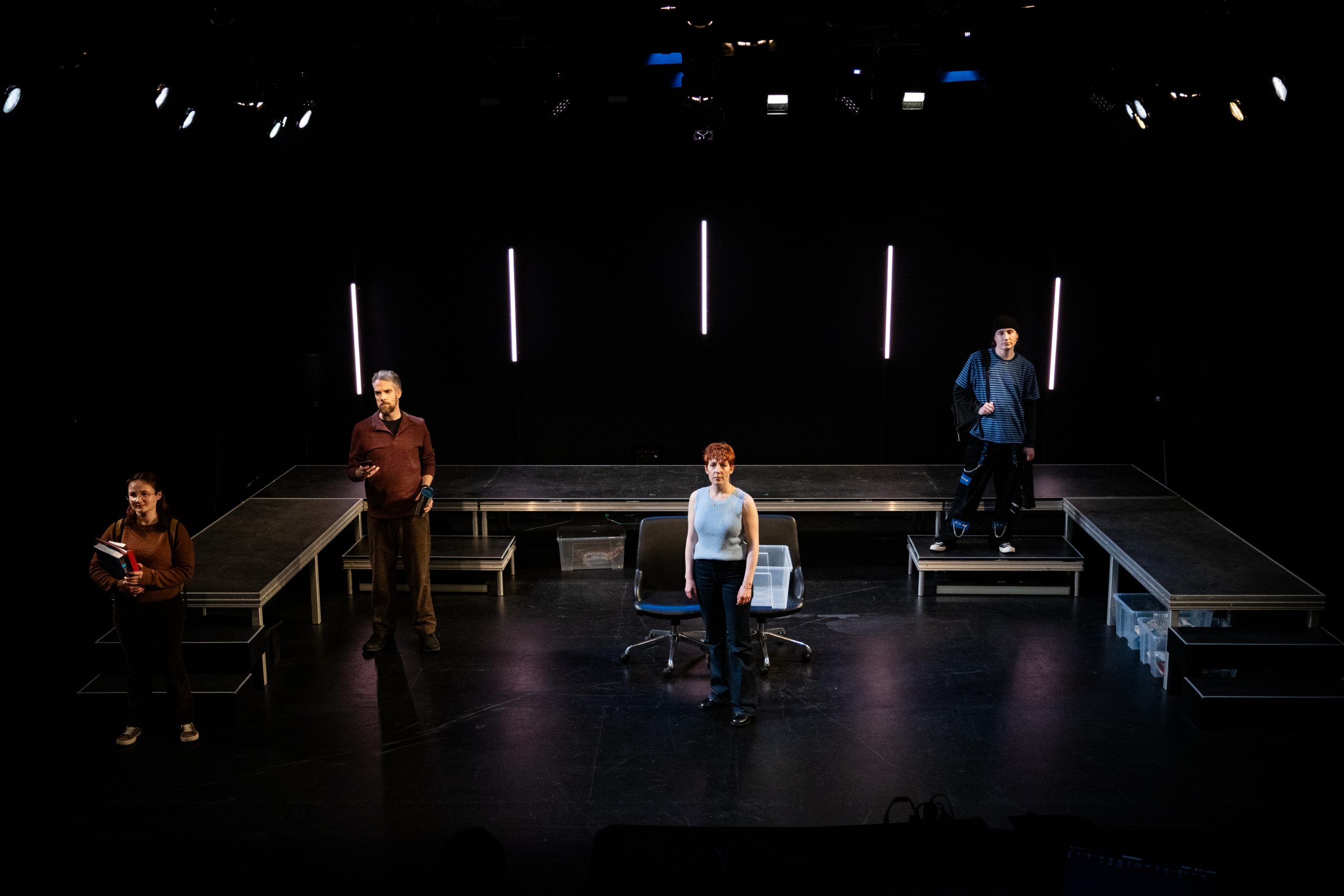
One of the production’s greatest strengths is its simplicity. Goncharov’s set demonstrates how little is actually required when the storytelling is strong. A handful of risers and a collection of plastic storage bins provide virtually everything needed for the performance. The bins, tucked beneath the platforms, hold the props, courtesy props designer Emily Anne Corcoran, that emerge as required. It is an economical solution, but an effective one, proving that imagination can accomplish more than elaborate scenery.
Niall Durcan’s lighting is equally impressive. Working within the intimate confines of the Aki Studio, he illuminates precisely the areas that require focus, guiding the audience’s attention with clarity, while Goncharov marshal’s his cast through a myriad of exists and entrances with clever military precision..
My one significant reservation concerns the sound balance. The excellent six-member ensemble under Michael Ippolito (piano) performs behind a wall, which may explain the decision to amplify the music so heavily. Unfortunately, there are moments when the band overwhelms the singers. In a through-sung work where every lyric carries dramatic information, that is a problem. The audience needs to hear every word, and more often than it should, the score drowns them out.
Still, if excessive volume is my principal complaint, that speaks volumes about the production’s overall success. These young performers sing from the heart, and several are still completing their training. Bowtie Productions has taken on a demanding musical, a difficult subject, and a largely sung-through score, and makes it work through conviction, talent, and intelligent staging. Judging by the ecstatic response from the sold-out audience, I was not alone in my admiration.
Bowtie has already announced Pippin for the fall, a musical every bit as challenging in its own way. After seeing what the company has achieved here, I look forward to discovering what they do with that legendary show.