
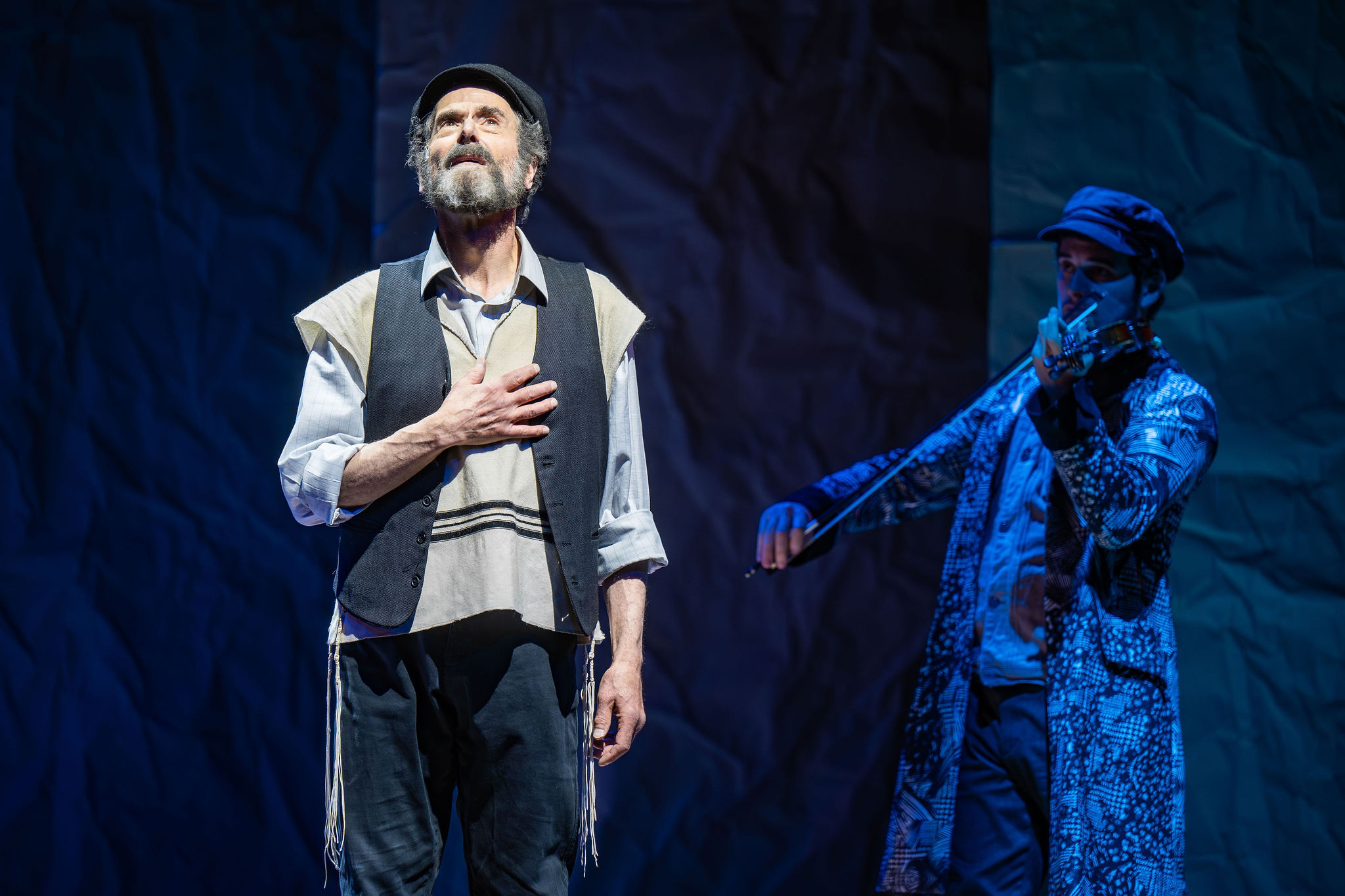
Tevye and Fiddler
Fiddler on the Roof in Yiddish
Photo by Dahlia Katz
Harold Green Jewish Theatre Company Presents The National Yiddish Theatre Folksbiene Production/Fiddler on the Roof in Yiddish, based on Sholem Aleichem Stories, book by Joseph Stein, music by Jerry Bock, lyrics by Sheldon Harnick, Yiddish translation by Shraga Friedman, music direction by Mark Camilleri, Toronto production choreographed and staged by Stas Kmiec, original production directed by Joel Grey, Elgin Theatre, closes June 7.
Sometimes you see a show that is so wonderful, so moving, and so perfect an evening of theatre that you want everyone to experience it. Such a one is Fiddler on the Roof in Yiddish currently playing at the Elgin Theatre.
The musical is the celebrated production that took New York by storm in 2018 directed by Tony and Oscar winner Joel Grey. Originally scheduled for a limited run of just six weeks, the National Yiddish Theatre Folksbiene production proved such a sensation that it remained in New York for 18 months. We owe a considerable debt to Harold Green Jewish Theatre Company for bringing this remarkable production to Toronto.
Not only have the original sets, and costumes arrived here intact, but so has Steven Skybell, who reprises the role of Tevye that won him off-Broadway Lucille Lortel Award.
Surrounding him is a Canadian cast that has undertaken the formidable challenge of performing in Yiddish. Only 13 of the 24-member company are Jewish, and only a couple of them knew Yiddish. Yet one would never know it from the confidence and authenticity of the performances. It’s absolutely remarkable when you think about it – that 20 people had to master Yiddish to get this acting gig.
For those concerned about not understanding the show, there is absolutely no need to worry. We’ve all watched foreign-language films and are used to reading subtitles. Well this production works in much the same way. Large, easily readable English supertitles are positioned on either side of the stage at eye level, allowing the audience to follow the dialogue effortlessly without losing sight of the action. Within minutes, reading them becomes second nature. The language never becomes a barrier. Not understanding Yiddish is no reason to miss this production.
The original Fiddler on the Roof opened on Broadway in 1964 and was initially considered too Jewish to appeal to mainstream audiences. History, of course, had other ideas. The musical ran for nine years, became the longest-running show in Broadway history at the time, and eventually spread across the globe. It has been translated into 16 languages and performed in 32 countries. Clearly, the musical has found enthusiastic audiences wherever it has travelled.
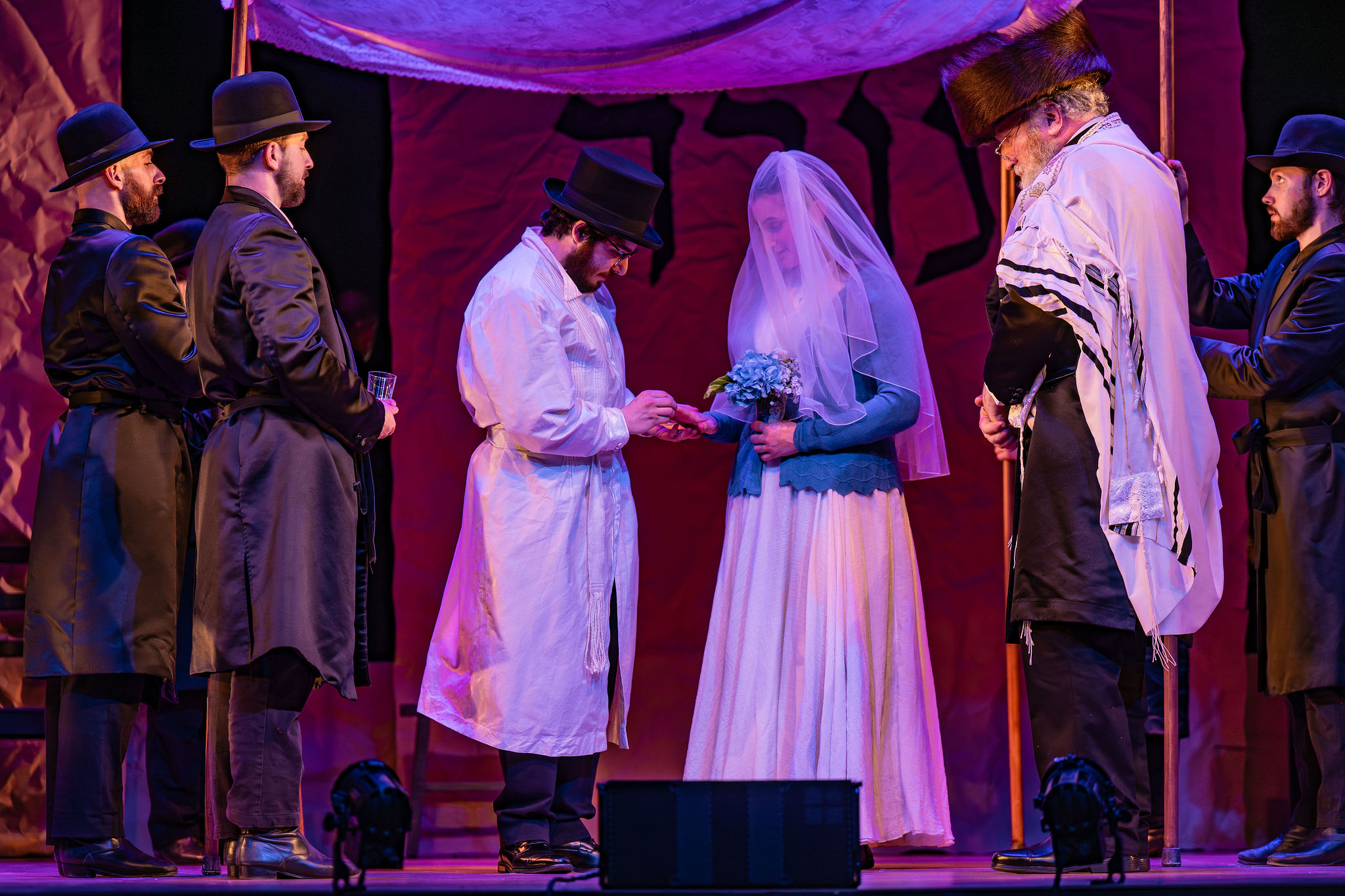
Tsaytl and Motl’s Wedding
Fiddler on the Roof in Yiddish
Photo by Dahlia Katz
The obvious question is why?
Beneath its specifically Jewish setting, Fiddler on the Roof is a celebration of family, resilience, love, and survival. Set in the poor shtetl of Anatevka in the Ukraine in 1905, then part of the Russian Empire, it tells the story of ordinary people trying to preserve their traditions and their humanity while confronting poverty, prejudice, and the arbitrary power of the state. The details may be Jewish, but the emotions are universal.
Most people, wherever they live, can recognize something of their own family history in Tevye’s story. For many of us, our ancestors came from difficult circumstances. They endured hardship, discrimination, economic struggle, and uncertainty in the hope that their children might enjoy a better life. That journey from vulnerability toward security is a story that transcends language, religion, and nationality. It is why audiences around the world continue to respond so strongly to Fiddler on the Roof.
What is astonishing is that after all those translations and all those international productions, the show has finally arrived in the language that seems the most obvious of all. The inhabitants of Anatevka would have actually spoken Yiddish. More to the point, Sholem Aleichem wrote his Tevye the Milkman stories in Yiddish. In that sense, this celebrated Yiddish production feels less like a translation and more of a homecoming.
A few words should be said about The National Yiddish Theatre Folksbiene itself. Founded in New York in 1915, it is today the longest-running Yiddish theatre company in the world. For more than a century it has preserved and celebrated a theatrical tradition that once flourished throughout Eastern and Central Europe. Its productions are performed in Yiddish when appropriate, although it also stages works in English that draw upon Jewish history, culture, and experience. It is also a poignant reminder of a theatrical tradition destroyed by the Holocaust. The Folksbiene survives not only as a theatre company but as a living link to a vanished world that might otherwise have totally disappeared.
The staging was a minimalist approach and therein lies its genius. Rather than attempting to reinvent the musical or overwhelm it with spectacle, designer Beowolf Boritt strips it down to its essentials. The result is revelatory.
There is virtually no set. The stage is framed by gold parchment-like side dividers, while a large gold parchment curtain hides the orchestra at the back with the Hebrew letters for “Torah” written on it. Tevye tells us that it is the Torah that gives Jews their faith, their laws, their traditions. During the pogrom scene, this curtain is torn down and the letters ripped in half, an absolutely horrifying sight to Tevye and his neighbours.
Other than these curtains there is little more than a handful of props and set pieces brought on as needed. That is all. There are no elaborate village streets, no sprawling rooftops, no attempt to create a realistic Anatevka. Instead, Grey places the focus squarely where it belongs: on the characters, the relationships, and one of the greatest scores ever written for the musical theatre. Wearing Ann Hould-Ward’s authentic costume design, the actors fill the empty space which brings Anatevka alive.
Without visual clutter, every moment lands with greater force. Songs such as “Tradition,” “Sunrise, Sunset,” and “If I Were A Rich Man” emerge with renewed clarity, while Tevye’s famous conversations with God take on an almost intimate immediacy. We know these songs so well that it is easy to take them for granted. Here, stripped of distraction, they reveal their enduring power all over again.

The Bottle Dance
Fiddler on the Roof in Yiddish
Photo by Dahlia Katz
What is particularly gratifying is that choreographer Stas Kmiec does not abandon the show’s history. There are numerous affectionate nods to the original 1964 production directed and choreographed by Jerome Robbins. The iconic bottle dance at Tsaytl’s wedding remains one of the evening’s highlights. Likewise, the exhilarating tavern sequence, in which the local Ukrainians challenge the Jewish villagers through displays of increasingly athletic folk dancing, retain the excitement audiences remember from the original production.
Most importantly, the minimalist staging allows the audience to concentrate on the emotional heart of the musical, namely, Tevye and his family. and a community attempting to preserve its identity in a world that is becoming increasingly hostile.
Tevye (Steven Skybell), a poor milkman, has five daughters which means no real dowry for the girls. Tradition dictates that the matchmaker Yente (Theresa Tova) will arrange the marriages and maybe by a miracle, find wealthy husbands. Tevye’s three oldest daughters, however, have ideas of their own. One by one, they challenge the conventions that have governed village life for generations by choosing love over custom.
Tsaytl (Isidora Kecman) wants the poor tailor Motl Kamzoyl (Joshua Kilimnik), Hodl falls in love with the Communist agitator Pertshik (Sayer Roberts), while Khave (Alice Malakhov) chooses the non-Jewish Fyedke (Nick Boegel). This forces their father to wrestle with his entire belief system, and if he does decide to give his blessing, how does he tell his wife Golde (Tracy Michailidis). Much of the musical’s emotional power comes from watching Tevye navigate these challenges. How he copes with the tension between these two impulses – his belief in tradition versus his love for his daughters – drives the entire story.

Tevye’s Dream
Fiddler on the Roof in Yiddish
Photo by Dahlia Katz
One of the musical’s great comic set pieces, devised entirely by Kmiec, arrives when Tevye must persuade Golde to accept Tsaytl’s marriage to the impoverished tailor Motl rather than the wealthy butcher Leyzer-Volf (George Masswohl) who has made an offer. Tevye’s solution is the famous dream sequence, an elaborate nightmare that unfolds spectacularly before our eyes featuring Golde’s grandmother Bobe-Tsaytl (Michelle Heisler) and Leyser-Volf’s first wife Frume -Sore (Gabi Epstein), who have both risen from the dead. The scene is brilliantly staged to evoke maximum laugh-out-loud absurdity.
Holding the centre is Skybell’s magnificent Tevye. His portrayal is richly human, funny, warm, stubborn, yet vulnerable at its core. With the production’s minimalist approach placing every word and every note under a microscope, there is nowhere to hide and Skybell rises brilliantly to the challenge. The Broadway star leads an impressive Canadian cast of singing actors who certainly meet Skybell on his own level and lest we forget, four outstanding dancers who can pull off both a Ukrainian Hopak and a Yiddish Bottle Dance in dazzling fashion.
And no discussion of Fiddler on the Roof in Yiddish would be complete without mentioning the Fiddler himself (Connor J. Lucas), a figure who follows Tevye throughout the action and serves as the musical’s central metaphor. As Tevye explains, living as a Jew in Imperial Russia was like being a fiddler on a roof, trying to maintain a precarious balance, holding on to dignity and tradition while knowing that one misstep could send everything crashing down. It is a powerful image of a people living in a state of perpetual uncertainty, vulnerable to the whims of an oppressive regime and the ever-present threat of violence.
More than sixty years after the musical first appeared on Broadway, that metaphor retains an unsettling relevance. Watching this production, I found it difficult not to think about the rise in antisemitism that has become increasingly visible around the world today. The underlying anxiety of a community wondering whether it truly belongs, whether it is safe, gives the musical an added emotional weight. Fiddler on the Roof remains a glorious celebration of family, resilience, faith, and love, but this remarkable Yiddish production also reminds us why stories of cultural survival continue to matter.
One of the musical’s most beloved songs is “L’Chaim” — “To Life.” It is difficult to imagine a phrase that better captures the spirit of this production. It brims with life. It overflows with humour, warmth, heartbreak, love, and humanity. Every scene, every song, and every relationship feels fully alive.
I found myself unexpectedly moved throughout much of the performance, and judging by the reaction around me on opening night, I was not alone. The audience responded with extraordinary warmth and enthusiasm, culminating in a spontaneous ovation that reflected just how deeply the production had affected them.
Fiddler on the Roof in Yiddish is not to be missed.
Judith John says:
Paula, thank you for this beautiful and meaningful review of a beautiful and meaningful show. Timeless in its poigancy, and never more relevant, sadly….