
(Due to a calamitous computer meltdown, these mini reviews are the missing posts.)
b.current, CROW’S & studio 180 theatre, The Christmas Market, by Kanika Ambrose, directed by Philip Akin, Studio Theatre, Streetcar Crowsnest, closes Dec. 14.
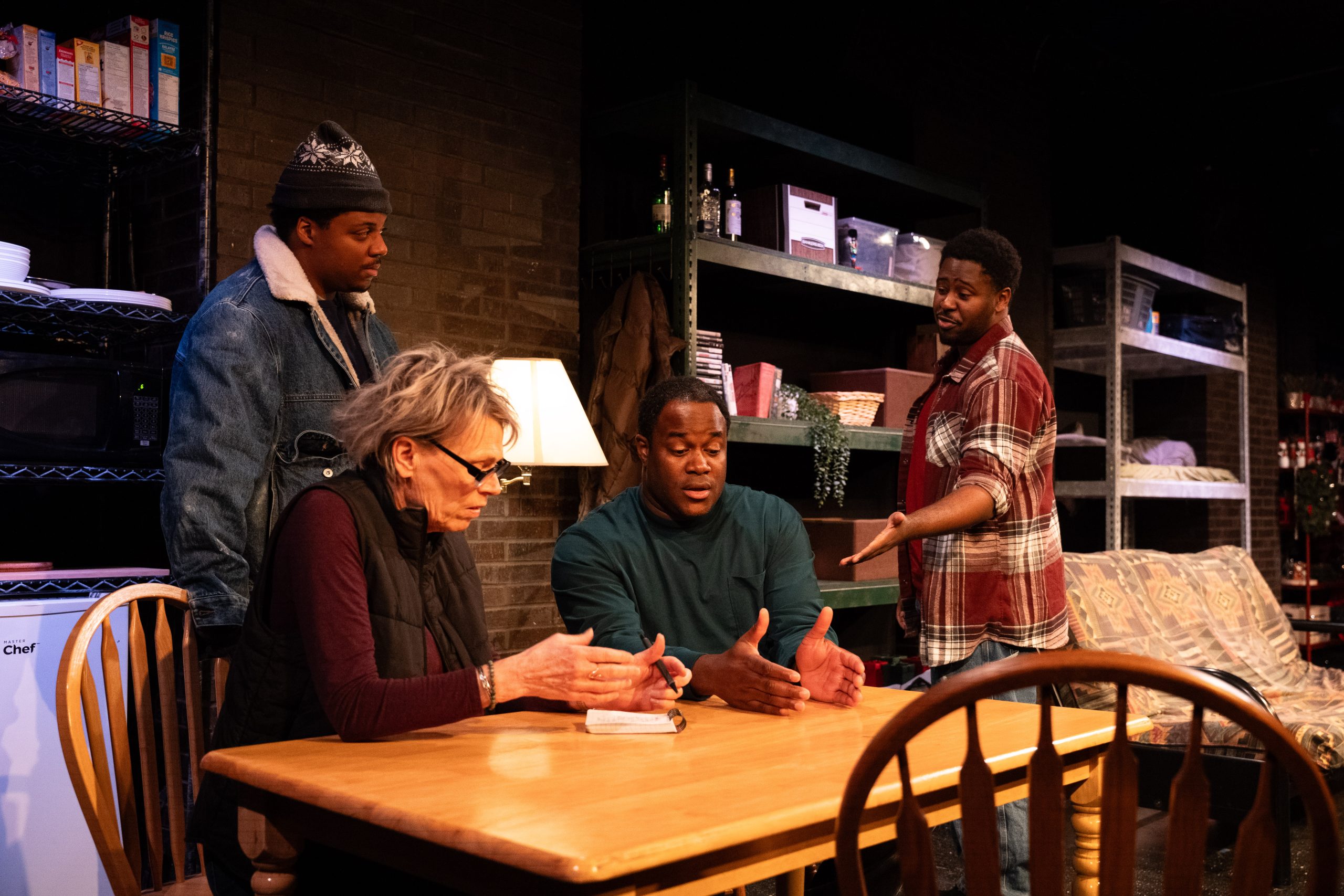
The Christmas Market
Photo: Kenya Parsa
The Christmas Market is an important play because it shines a clear and uncompromising light on the seasonal Caribbean workers who come to Canada and the conditions they are expected to endure.
In this case the men have been brought to a farm to work through the busy Christmas season, living in a cramped trailer where even the gloves they are issued are so inadequate that they must spend their own money at Canadian Tire to buy usable ones.
There are three men: Joe (Matthew G. Brown) keeps his head down and has returned for years to build a better life for his family back home; Roy (Savion Roach) comes back hoping to reconnect with the white woman who will not let him see his child; and Lionel (Danté Prince) who is fiercely committed to fighting for workers’ rights and refuses to stay silent in the face of injustice.
Their differing philosophies clash and intersect, especially as Ryan (Brenda Robins) a white co‑worker forms a relationship with Joe, and is permitted into the trailer when the other girlfriends are barred to a car port.
The play is an honest portrayal of the lives, hopes and compromises of Caribbean migrant workers, and for Canadian‑born audiences it is uncomfortable because it forces us to confront how easily these men can be taken advantage of.
As you watch the play, you also have to wonder whose side are you on—the man who survives by keeping his head down but who has made a good life for his family back home, or the man who insists the system must be challenged? It’s a difficult choice. Kanika Ambrose, one of the country’s most important Black playwrights, has written a work we cannot ignore.
My only quibble is the staging: presented in the long Studio Theatre at Crow’s, the action is directed lengthwise down the room, which means that if you are seated at one end and something is happening at the other, you often have to crane your neck and risk missing moments.
Otherwise, The Christmas Market is a compelling and essential play. In fact, you could say it is a perfect play, beautifully focused on character and theme.
Necessary Angel Theatre Company, CanadianStage & Tarragon/Moonlight Schooner written by Kanika Ambrose, directed by Sabryn Rock, closes Dec. 14.
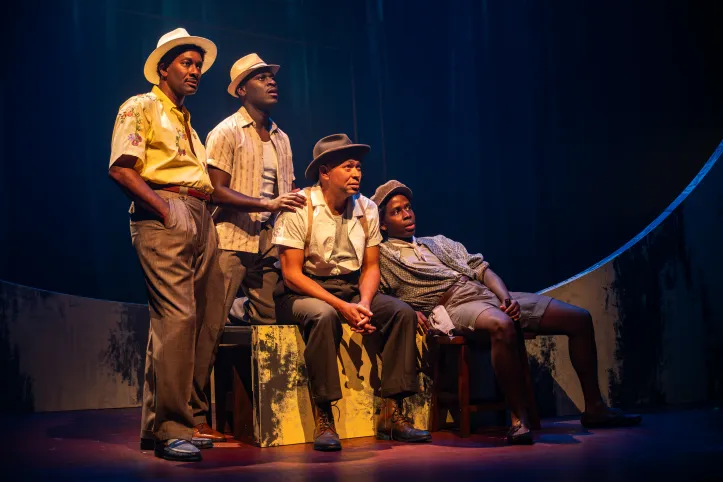
Moonlight Schooner
Photo: Dahlia Katz
The world premiere of Kanika Ambrose’s Moonlight Schooner presents a genuine dilemma.
If an audience member arrived without reading Ambrose’s program note, they would encounter what appears to be a loose, episodic night in the lives of three sailors stranded on St. Kitts after a storm damages their ship. Luke (Tony Ofori), the young local who takes them in, longs for adventure and dreams of joining their crew, even as he remains tethered to his mother (Nehassaiu deGannes) and the comfortable life paid for by remittances from his father, one of the Windrush generation working in England.
Seen from that angle, the sailors seem merely directionless: Vincy (danjelani ellis) sent to sea to “find himself,” Timothy (Darren A. Herbert) a trouble‑maker who delights in provocation, and Sabine (Jamie Robinson)—part‑white and resented for it—scribbling poetry in his diary while forever pulled back by a wife who is always pregnant or nursing.
Their obstacles appear personal rather than systemic, and the story drifts along on May Day, 1958, a holiday that frees them from their duties and sends them off in Luke’s car for drinking, role‑playing, and even a willing encounter with a young woman who joins them for group sex. Over the course of the night, they behave badly, laugh easily, and live impulsively. There is nothing here of imperial oppression.
Yet one cannot ignore Ambrose’s statement: that Moonlight Schooner is an “evocative tale about the systemic and deliberate breaking of Black men by colonial forces during the Windrush generation and the casualties left behind.”
Yet none of that is visible in the play as presented. There are no colonial authorities, no machinery of empire, no explicit structures exerting force upon these men. If there are casualties, they are existential rather than political, the aimlessness of men who must make their way in an economy that exists regardless of absent fathers or distant histories. Luke’s father, the Windrush figure, is not broken—he is sending money home that enables a prosperous life. The expected thematic frame simply is not onstage.
The result is an enigma. Moonlight Schooner is written by a playwright of immense skill—her Christmas Market elsewhere in the season is a marvel—but here the stated intention and the play itself feel disconnected. I am left genuinely uncertain about what I am meant to glean from the May Day 1958 night’s events, and how they align with the monumental themes Ambrose invokes.
The gap between what I watched and what I was told I was watching remains unresolved.
King Black Box in partnership with Blkabong Theatre Projects/BUG by Tracy Letts, directed by Andrew Cameron, King Black Box, closes Dec. 14.

Actor Tracy Letts wrote Bug in 1996, at the height of America’s anti-government conspiracy era, and the play has hardly been off the stage since.
It is one of the most deeply compelling psychological horror works in the modern repertoire, because it understands how easily delusion can take hold and how terrifyingly real it becomes when shared.
Agnes (L.A. Sweeney) is a lonely woman living in a run-down motel and working a dead-end job, and when her friend R.C. (Alexandra Floras-Matic) introduces her to the quiet, damaged Peter (Nicholas Eddie), she takes him in out of kindness and curiosity.
What begins as companionship slowly becomes engulfing, as Peter reveals that he is on the run from government medical experiments. Bit by bit, Agnes is pulled into his fear, into the conspiracies, into the belief that he has been implanted with “bugs,” and that these insects have now begun to infest the motel room. Even the attempted intervention of Agnes’ ex-boyfriend Jerry (Bongani Musa) and the army doctor (Jeff Still) only increases their paranoia.
Letts was writing in the explosive atmosphere of the 1990s—Timothy McVeigh, the Oklahoma City bombing, Ruby Ridge, the Waco siege—and those shadows hang over the play. When Peter connects his imagined persecution to real historical extremism, it feels unnervingly plausible.
The descent into folie à deux is masterfully structured. Agnes and Peter prove the “bugs” to each other with absolute conviction, and the audience is drawn into their shared madness. They bring in a microscope to search for them; they scratch and slap at imagined bites; their reasoning, though deranged, has an internal logic that becomes frighteningly persuasive. The writing is astonishing in the way it fuses personal delusion with national hysteria.
The King Black Box production makes the experience even more claustrophobic. In that tiny third-floor room—never meant to be a theatre—two searing performances – Sweeney and Eddie – unfold almost within arm’s reach. The acting is phenomenal, the direction taut and exacting, and the intimacy of the space heightens the terror to the point where you feel as if you too might start scratching at invisible insects.
This Bug is a first-class production in every respect.