
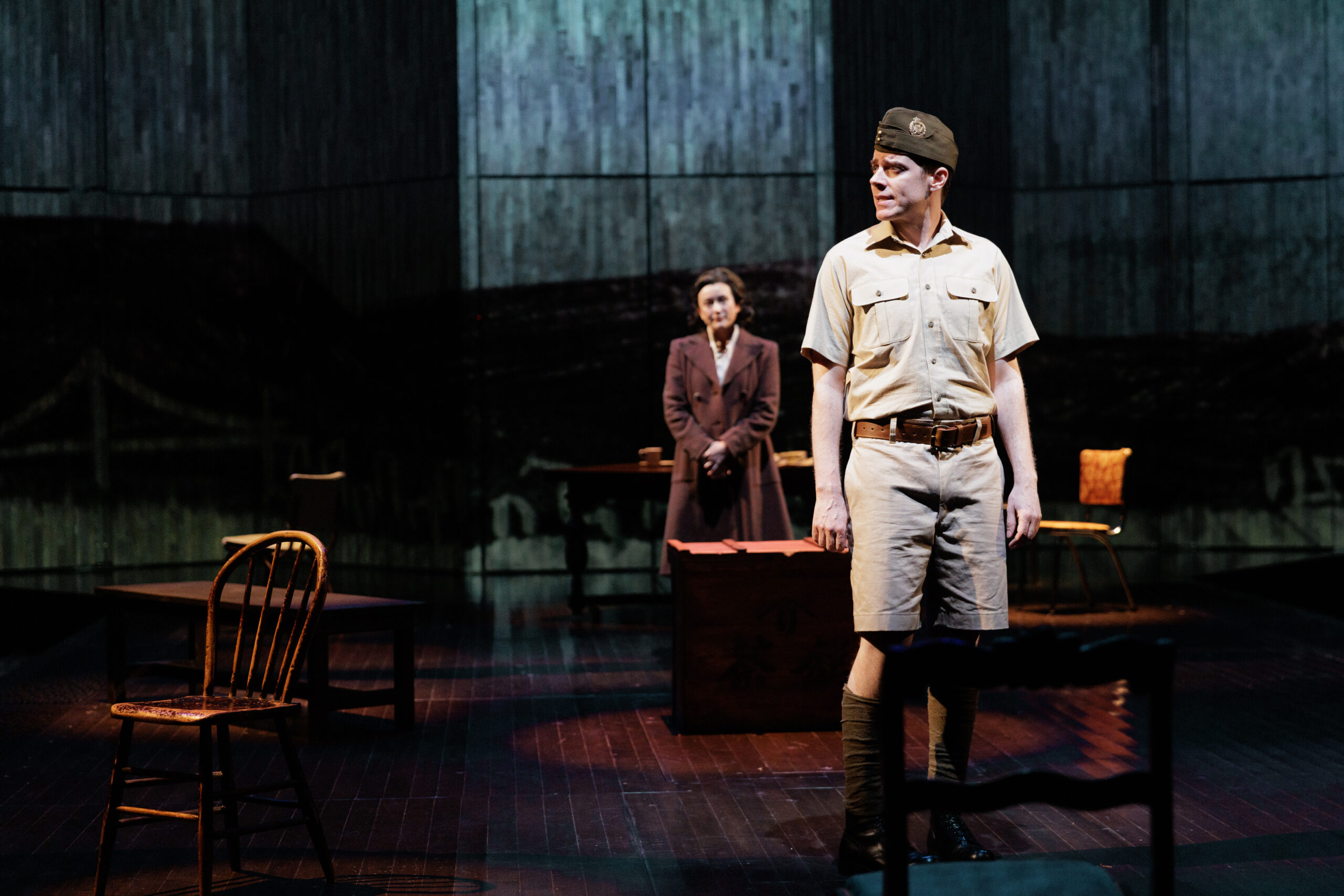
Stratford Festival 2025/Forgiveness by Hiro Kanagawa, adapted from the book Forgiveness: A Gift From My Grandparents by Mark Sakamoto, directed by Stafford Arima, Tom Patterson Theatre, closes September 27.
Jeff Lillico as Ralph with Yoshie Bancroft as Mitsue in Forgiveness.
Photo: David Hou.
The original Canadian play, Forgiveness, catches you up in a whirlwind because the structure is a series of rapid-fire scenes, so it takes you a few minutes to get adjusted to the pace. Once you do figure out what’s going on, and who the characters are, and what the shifting timeline is, the play holds you in its mighty grip and doesn’t let go until the end.
Forgiveness is based on a true story. It is Mark Sakamoto’s memoir and the subtitle A Gift from My Grandparents is the key. It looks at the parallel lives of his Japanese grandparents and his Canadian grandparents during World War II. Both of them endured traumatic experiences.
In short, Forgiveness is an utterly compelling play because what happened to these people was absolutely cataclysmic.
On the Canadian side, Ralph McLean (Jeff Lillico) is a Newfoundlander who, at just 17, enlisted in the Canadian Army in World War II. He ended up in the Canadian regiment sent to Hong Kong, which was captured by the Japanese, and spent the war in a Japanese prisoner of war camp suffering under horrific conditions.

Jeff Lillico as Ralph, Forgiveness.
Photo: Ted Belton.
On the other side of the fence is Mitsue Sakamoto (Yoshie Bancroft). Her prosperous family in British Columbia was swept up in the horrors of the anti-Japanese fervor that overtook Canada in World War II, where Japanese Canadians were rounded up, their property confiscated, followed by the final indignity of being sent into the interior, and the appalling conditions of internment camps.
We follow Ralph as a servant to the crazed, drunken, brutal, mercurial Japanese commandant Kato (Hiro Kanagawa) where he is at risk of being killed any minute. For her part, Mitsue tries to make a life in the interior for her husband Hideo (Michael Mann) and their children but also faces absolutely horrific experiences including racism and near starvation scratching out a living on dirt farms in Alberta.
The play cuts back and forth between Mitsue and Ralph during and after the war but also cuts to the present—to an all-important dinner party. The Sakamoto son, Stan (Douglas Oyama), has a girlfriend, Diane MacLean (Allyson Lynch). That relationship is bringing these two families together.
You’d think they’d both be filled with rage—the Sakamoto family at Canadians, and the MacLean family at the Japanese. And that’s why the title, Forgiveness, is so important. For the sake of their children, and for the important step of moving forward, they are able to lay aside the heartbreaking struggles Mitsue faced just to keep her family alive and Ralph’s harrowing experiences as a prisoner which makes the final scenes of the play so moving.
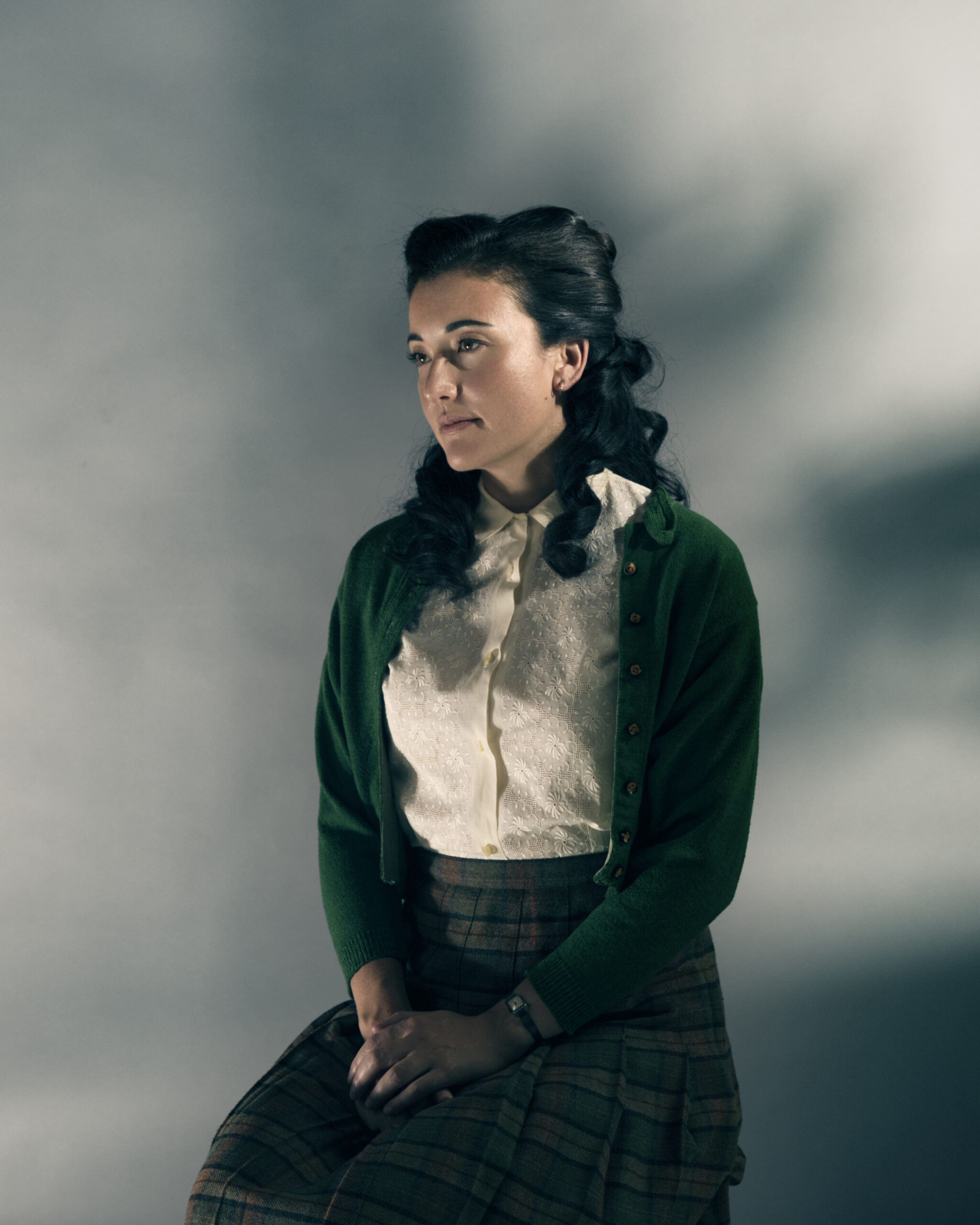
Yoshie Bancroft as Mitsue, Forgiveness.
Photo: Ted Belton.
Some superb acting should be noted.
Kato, played with terrifying unpredictability by Hiro Kanagawa (who also adapted the book) gives a performance that’s absolutely unforgettable. His drunken commandant keeps the audience in dread—one moment of whim could end Ralph’s life.
Jeff Lillico, as Ralph MacLean, beautifully captures the transformation from an innocent 17-year-old to battle-scarred survivor. Yoshie Bancroft brings strength and grace to Mitsue Sakamoto. Both actors show immense fortitude through their many travails.
Michael Man’s Hideo, Mitsue’s husband, who eventually gives up, earns sympathy, while Gabriel Antonacci is heartbreaking as Coop, Ralph’s best friend who dies in the POW camp.
There are a ton of characters in this play, with actors taking on three or four roles, which adds to the initial confusion. Director Stafford Arima deserves immense credit for keeping the narrative under control and the storytelling in a tight grip. Once you realize you’re going to be assaulted by scene after scene and a parade of characters, the rhythm becomes clear.
The great Lorenzo Savoini provides the set and costume design—always tasteful, always evocative. The small scenic elements help you locate where you are, and his period costumes feel exact.
Under ordinary circumstances, this play could have been unwieldy but somehow, the twin narratives— and a shame on the Canadian government and a shame on the Japanese—balance. They don’t cancel each other out. They coexist. And that’s what makes the play so moving.
Overall, Forgiveness is soul-destroying to watch because of the terrible things that people do to each other. Nonetheless, unwieldy though it seems at first, the play sorts itself out and becomes an incredibly powerful theatrical experience.