
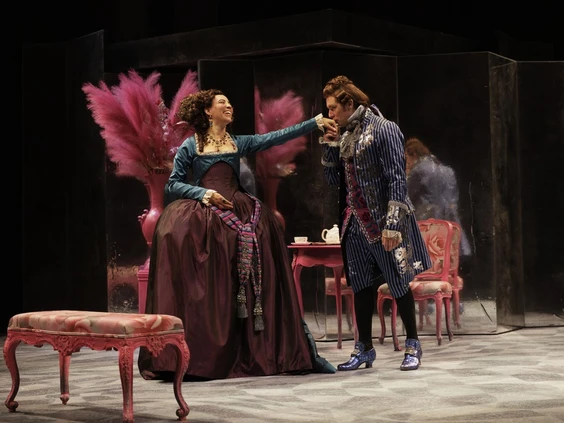
Stratford Festival 2025/Dangerous Liaisons written by Christopher Hampton from the novel Les Liaisons Dangereuses by Choderlos de Laclos, Festival Theatre, directed by Esther Jun, closes Oct. 25.
Dangerous Liaisons
Photo: David Hou
Pierre Choderlos de Laclos published his novel Les Liaisons dangereuses in 1782 in the form of letters, which British playwright Christopher Hampton brilliantly transformed into a play in 1985. I have now seen several versions of this play, and I am utterly fascinated by the evil, nasty characters at its core. Every time I come away thinking: if you are rich enough, you feel you can get away with anything.
I point to the Epstein case that still dominates headlines south of the border and internationally—the sexually harrowing Epstein case. These two morally bankrupt people at the centre of Les Liaisons dangereuseshave no moral compass. There is nothing too wicked, corrupt, or decadent they will not do. They are the Marquise de Merteuil, played by Jessica B. Hill, and the Vicomte de Valmont, played by Jesse Gervais.
The play begins with a challenge: these two former lovers are not above ruining reputations and, centrally, ruining lives. Merteuil seeks revenge against Le Comte de Gercourt, who hurt them both—he dumped Merteuil, who was his mistress, for another woman, and that woman had been Valmont’s mistress. So, Valmont lost his mistress, and Merteuil was discarded. Their revenge? Valmont is to seduce Gercourt’s young fiancée, Cécile de Volanges, fresh from the convent and barely sixteen, played by Ashley Dingwell. If he succeeds, Merteuil promises to reward him with her body once again.
As the play unfolds, Valmont succeeds in corrupting Cécile, and Merteuil sets him another challenge: the seduction of Madame de Tourvel, played by Celia Aloma, the most virtuous, religious woman in France. Married, devout, incorruptible. If Valmont can seduce her, Merteuil swears she will give herself to him. Only the unexpected happens—Valmont falls in love with Tourvel. For people who equate love with weakness, this is a catastrophe.
Around them swirl the other figures of this decadent world: Madame de Volanges (Nadine Willison), Cécile’s mother; Madame de Rosemonde (Seana McKenna), Valmont’s devoted aunt; Azolan (Thomas Duplessie), Valmont’s morally flexible servant; Émilie (Sarah Farb), a courtesan who knows her role and performs it without illusion; and the Chevalier Danceny, (Leon Qin) Cécile’s innocent music tutor, who loves her dearly and becomes corrupted by both Valmont and Merteuil until, in fury, he challenges Valmont to a duel. These young innocents are destroyed by their elders’ moral decay.
Visually, the production is stunning. Costumes by A.W. Nadine Grant are exquisite—18th-century perfection. Teresa Przybylski’s spare but elegant set evokes period grace without excess: a single Louis XV chair, perfectly placed, carries the weight of opulence. Yet despite the beauty, the tone left me cold. The usually reliable Richard Ferren’s modernist music irritated from the first note, and the emotional temperature of the production never rose above freezing.
Jessica Hill’s Merteuil was brittle to the touch—if I brushed against her, she might shatter. Everyone felt trapped in a single dimension: Cécile too girlish, Tourvel too agonized, the aunt too fretful. Only Jesse Gervais broke free of the ice. His Valmont was a marvel—an alluring serpent, sin made seductive. He was the snake in Eden. I would have eaten the apple. Gervais owned every inch of his world, every couch he reclined on, every gesture he offered He understood the attraction of evil and gave it dangerous charm.
Director Esther Jun’s vision, according to her notes, aimed for something cold, sharp, and dangerous. But she went too far—creating not menace but detachment. The production, though visually resplendent, was emotionally distant, a mirror of beautiful surfaces without the pulse beneath.
I’ve seen Les Liaisons dangereuses in the 1980s, the 1990s, and the 2000s, and it always mirrors the society in which it is staged. There are always people who believe that if they are rich enough, clever enough, and sly enough, they can escape consequence. This play endures because it exposes them. But this production, for all its polish, was too cold, too dispassionate. Most of the characters were trapped within their one dimension—except Jesse Gervais, who transcended it. He broadened his horizons, made Valmont human, and became the saving grace of a production otherwise limited in scope.