
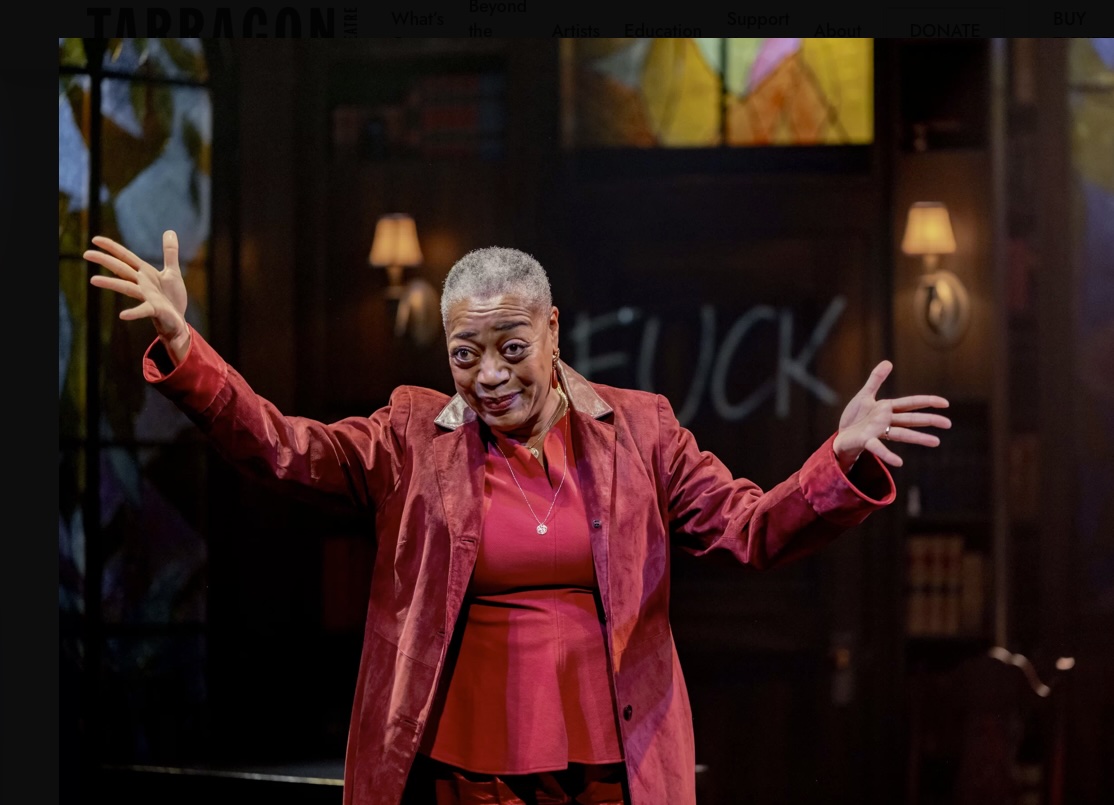
Karen Robinson as Prof. Margaret Anjou
Prophetess
Photo by Jae Yang
Tarragon Theatre/Prophetess, written by Ho Ka Kei (Jeff Ho), directed by Mike Payette, Mainspace, Tarragon Theatre, closes Nov. 1.
I have a cousin who was a tenured professor in the language department of a university out west, who used to describe the place as the court of the Borgias. Thus, I am not surprised that playwright Ho Ka Kei (Jeff Ho) could see a connection between Shakespeare’s history plays, depicting the Wars of the Roses that consumed England for decades, and the power struggles that go on in academia.
While ordinary Britons struggled to earn their daily crust of bread, the royal houses of York and Lancaster, fought over who would occupy the throne in the 15th century. Ho has taken these dynastic power struggles and transplanted them into modern-day academia, setting his play at a university called York.
This is not the sprawling modern campus we know in the north of Toronto, but rather a Gothic hall of learning, magnificently realized by set designer Jawon Kang. With its gorgeous stained-glass windows, enhanced by lighting designer Logan Raju Cracknell and projection designer Laura Warren, the setting truly evokes the grandeur of medieval England. It is an utterly breathtaking set. The rather whimsical yet pointed costumes by Ting-Huan Christine Urquhart just gild the lily.
My own degree is in history, so I was particularly fascinated by the way Ho has drawn upon historical figures from the Wars of the Roses and reinvented them in the world of academia.
The central figure is Margaret of Anjou, the French-born wife of England’s King Henry VI. What is less well known about Margaret is that both her mother and grandmother exercised considerable authority over their family estates in Lorraine. Thus, she came from a lineage of strong women, and when her husband proved to be one of England’s weakest kings, Margaret took control in an effort to preserve the Lancastrian throne for her son, Edward, Prince of Wales, making her an unusual figure among England’s royal consorts.
Karen Robinson has a unique voice and an equally unique presence. She is unforgettable in virtually every role she plays, and she is certainly unforgettable as Margaret Anjou, a professor of etymology where this academic war is taking place. Her immediate superiors want her out. They are Elizabeth (Christine Horne), head of Human Resources, and Dicky (Rick Roberts), Elizabeth’s husband, who occupies a senior position in the university hierarchy.
So who are these people in Shakespeare’s history plays?
Elizabeth is Elizabeth Woodville, wife of Edward IV of the House of York, while Dicky is none other than Richard III. Good old evil Dicky! Interestingly, Ho has made them husband and wife, whereas historically they were sister-in-law and brother-in-law.
What is particularly fascinating is how Ho has mirrored their historical personalities (according to Shakespeare) in his contemporary characters.
Margaret of Anjou was a formidable warrior queen, raising armies and leading the Lancastrian cause with an almost ferocious determination. Elizabeth Woodville, wife of Yorkist Edward IV, on the other hand, was more of a backroom operator. Coming from a family of relatively modest standing, she became a skilled political schemer, arranging advantageous marriages for her numerous relatives and consolidating her family’s influence at court.
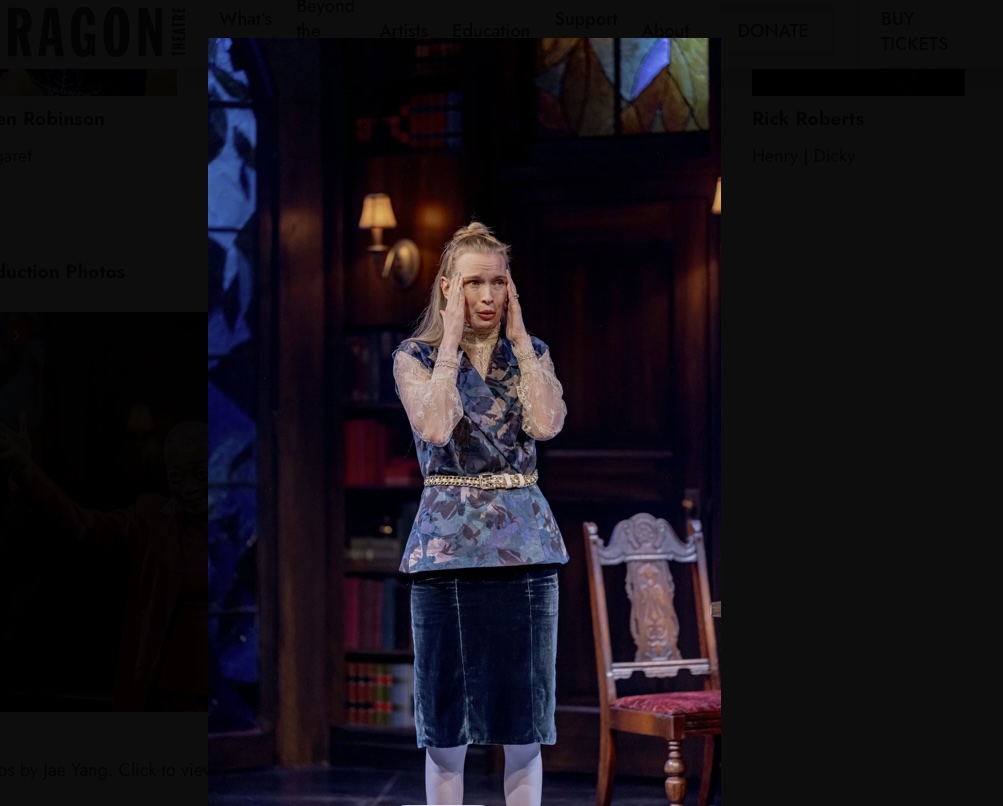
Christine Horne as Elizabeth
Prophetess
Photo by Jae Yang
And so it is thus in Prophetess. Margaret, the professor, is front and centre, while Elizabeth, working through Human Resources, is the behind-the-scenes planner. Their respective positions in the academic power struggle reflect their historical roles in the Wars of the Roses.
As for Dicky, Shakespeare’s Richard III, is practically evil incarnate. For example, he has traditionally been suspected of arranging the deaths of the two young princes in the Tower of London, his nephews, to secure the English throne, although modern historians have done much to challenge that portrayal. In Ho’s play, Dicky is content to let his wife in Human Resources do the dirty work, while he manoeuvres to oust Margaret and take control of her department. Once again, the historical parallels are unmistakable.
And who is the pawn in all of this?
That would be Anne (Natasha Mumba), inspired by the unfortunate Anne Neville. Historically, she was married twice, first to Edward, Prince of Wales, and then to Richard III, making her a pawn in the dynastic struggles of the Wars of the Roses, with little apparent control over her own destiny.
In Prophetess, Anne is once again a pawn, this time manipulated by Human Resources as a means of removing Professor Margaret Anjou from her department. The catalyst is an unfortunate encounter between Margaret and Anne. Suffice it to say that, just as she was centuries ago, Anne finds herself caught in a power struggle not of her own making.
Historical parallels are all well and good, but there is a play to consider, and at its centre is etymology. Why has Ho made the study of the origins of words so important?
Margaret is forever tracing words back to their roots, explaining their original meanings and how they have evolved. After all, knowing the roots, prefixes and suffixes of words can help us decipher unfamiliar vocabulary. It is one of the reasons Latin was once considered such an important part of education. Perhaps Ho is suggesting that just as we look back to discover the origins of words, we should also look back to discover our own origins, to understand where we came from and what our place in the world might be. There is certainly a deeper meaning to his fascination with etymology.
And then there is the matter of curses. Shakespeare’s Margaret of Anjou is virtually the queen of curses, forever railing against those who have defeated and dispossessed her. In Richard III, she seems to curse almost everyone she encounters, and her words take on a prophetic quality as her enemies meet their downfall. Ho mentions in his program notes that swearing actually has a psychological effect, providing a sense of relief or release. He is clearly fascinated by the power of curses, and by extension, the power of language itself.
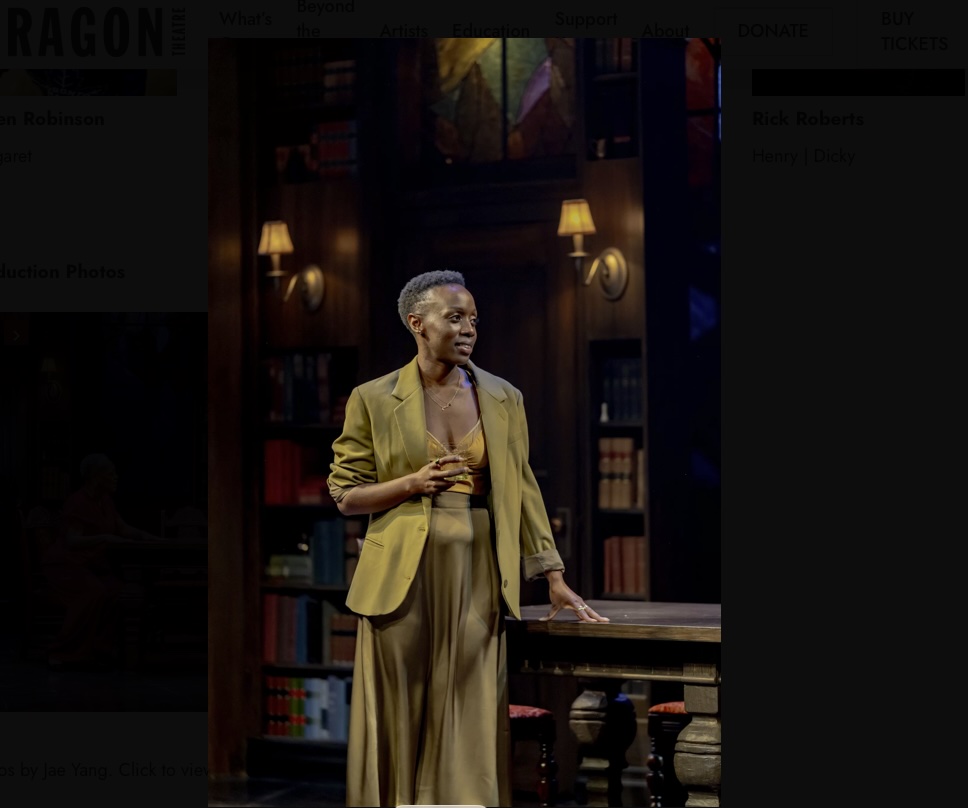
Natasha Mumba as Anne
Prophetess
Photo by Jae Yang
Which brings us to the title, Prophetess.
Can Margaret, armed with her formidable command of language, prevail against Elizabeth, Dicky and the university hierarchy determined to remove her? Can the power of words, and her knowledge of their origins and meanings, help her win a battle that the historical Margaret ultimately lost? Or is she, like her Shakespearean counterpart, destined to be defeated by forces beyond her control?
As well, can words shelter Margaret from forces within herself – from great grief, for example, from the almost unbearable burden of personal trauma, from inner upheavals too terrible to think about?
Ultimately, Prophetess is a play about power, but it is also about grief and loss, ambition, hierarchy and the struggle to find and preserve our place in the world. Do we fight openly, as Margaret does, or quietly manipulate events from behind the scenes, as Elizabeth does? Do we cling to the positions we have fought to achieve, struggle to move beyond them, or finally resign ourselves to staying put, or even losing them? Ho has woven together the power of language, academic politics, prophecy and grief into a complex exploration of human ambition and vulnerability.
And then, of course, there are the spiders.
The play opens with Margaret experiencing a dreadful nightmare about spiders, and the image continues to plague her throughout the single day in which the action takes place.
Shakespeare himself used spider imagery, particularly in Richard III, where Richard is associated with the poisonous spider. And then, of course, there is the notion of weaving webs, drawing people into them and ultimately entrapping them.
In Prophetess, the biggest villain is arguably the Human Resources department, headed by Elizabeth, played marvellously well by Christine Horne, who is working on behalf of her husband, Dicky. (And every time Robinson says the word “Dicky!”is a moment to be cherished.) HR is weaving an elaborate web around Margaret, using the unfortunate Anne as a pawn in its efforts to bring her down. Thus, the recurring spider imagery becomes a sinister reminder of the entrapment taking place before our eyes.
Lest this sound like a deadly dull history play, let me hasten to add that Prophetess contains a great deal of humour. Rick Roberts is wonderful in the contrasting roles of the scheming Dicky and Margaret’s sweet-natured husband, Henry. His portrayal of the slimy Dicky is absolutely hilarious, while his Henry is a gentle, sympathetic presence.
And I would like to say a word in defence of the historical Henry VI, who founded Eton College and King’s College, Cambridge, and was a generous patron of religion, learning and the arts. He was a man better suited to the contemplative life of a monk than the brutal politics of kingship. Roberts captures something of that essential gentleness in his portrayal of Margaret’s husband.
Horne manages to be both officious and unctuous at the same time which is no mean feat, while Mumba does put up a good fight, I’m glad to say, and is not a complete pushover. Both of these characters are beautifully drawn and are quite complex when they could be two-dimensional.
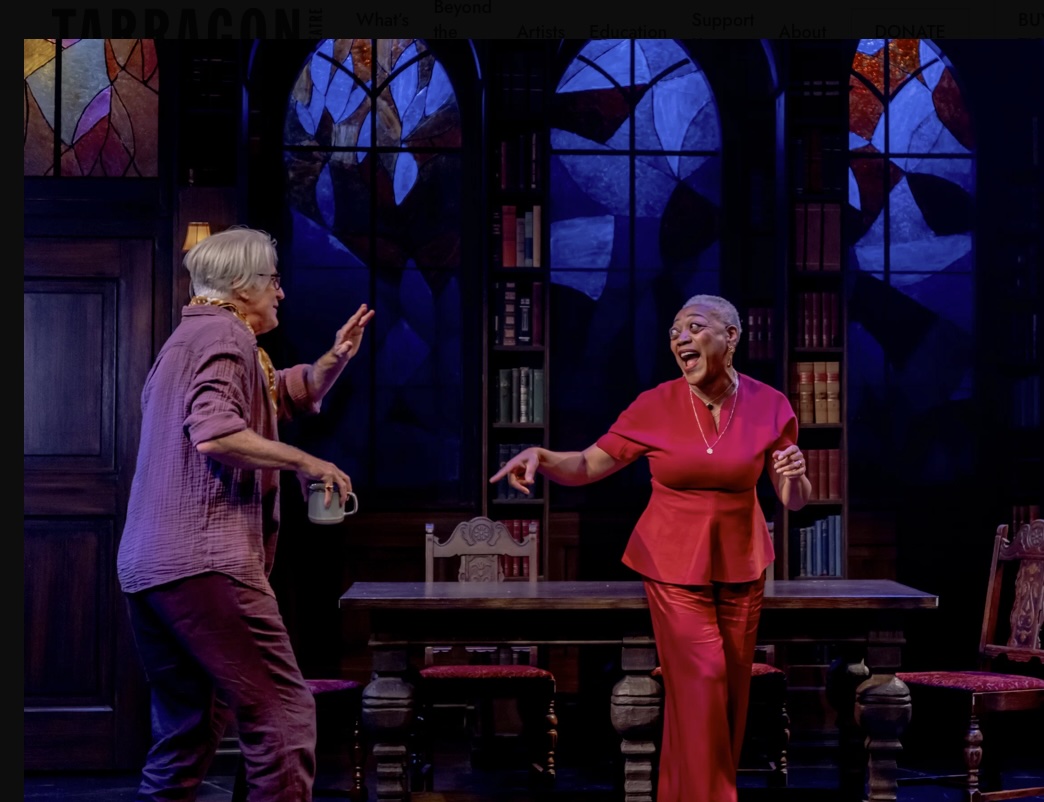
Rick Roberts as Henry and Karen Robinson as Margaret
Prophetess
Photo by Jae Yang
Director Mike Payette, who also worked closely with Ho as dramaturge, clearly has a firm grasp of the playwright’s intentions. His sharply defined characterizations bring the historical parallels into focus, while his deft handling of the humour prevents the play’s weightier themes from becoming overwhelming.
And then there is Karen Robinson, who is simply extraordinary when Margaret launches into one of her verbal flights. Whenever another character utters a word that catches her attention, she seizes upon it, traces it back to its origins and hurls its meaning back at the speaker. These etymological excursions are both fascinating and frequently very funny. I found myself learning a great deal about the origins of words, and I was deeply impressed by both the extent of Ho’s research and the ingenuity with which he incorporates it into the dialogue.
The result is a whirlwind of Shakespearean references, etymological explorations, academic intrigue and wonderfully pointed humour, all unfolding against that splendid Gothic setting. At its centre is a woman fighting desperately to preserve her position, her department and her sense of self against an institution determined to remove her while, at the same time, fighting demons from within. Shakespeare would have loved Ho’s Prof. Margaret Anjou.
It is, to return to my cousin’s memorable description of university politics, nothing less than the court of the Borgias.