
Dissonant Species
Photo: Michael Cooper
Theatre Gargantua/Dissonant Species, written by Heather Marie Annis and Michael Gordon Spence, directed by Jacquie P.A. Thomas, Factory Theatre Mainspace, closes Nov. 23.
Theatre Gargantua is a company that finds a substantive idea, develops it over several years, and then proceeds to dazzle the audience with their latest original multidisciplinary theatre creation.
The wellspring of this new show, Dissonant Species as their program tells us is that everything is sound.
We are surrounded by vibrations, disturbances, and sound waves – dissonances, as it were, that both in reality and metaphorically can connect us and divide us, and that is what this ambitious piece sets out to explore in all its many facets. A further question is, how do we find the harmony in the dissonance around us – the symphony of human discord? The framework of the piece rests on both music theory and sound science.
No small undertaking, but then this Is Theatre Gargantua.
The company, under the visionary leadership of Jacquie P.A. Thomas and Michael Gordon Spence has always thrived in that space where theatre, movement, music, installation, media and sound meet, but Dissonant Speciesfeels like an expansion of their core philosophy — a meditation on how human beings vibrate against one another, for better or worse.
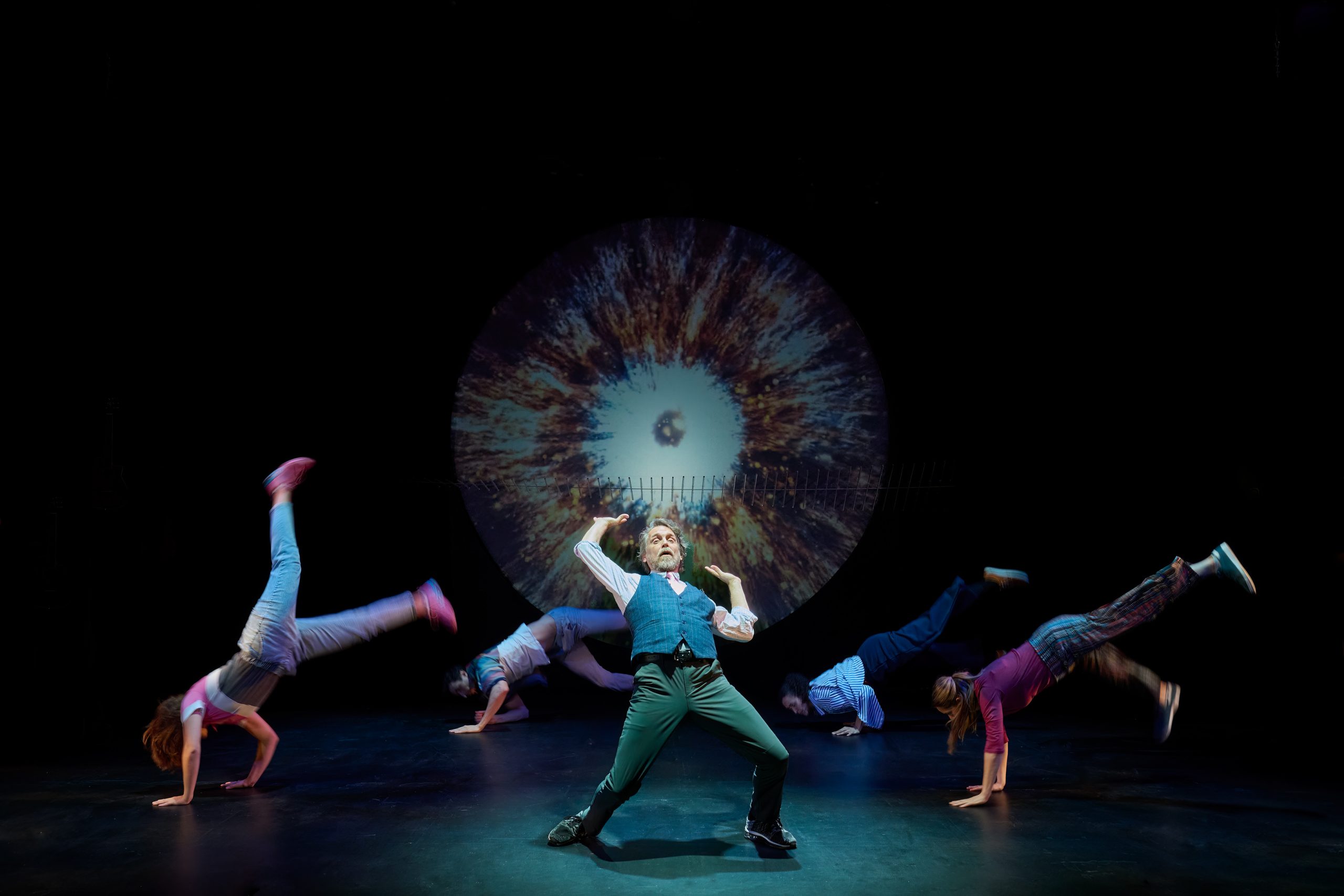
The production begins with the literal Big Bang, a spectacular wash of light, sound, and projection that only this company can marshal. It is an enormous gesture, the universe cracking open before our eyes.
And then, with a beautifully Gargantuan sense of proportion, the show drops to something almost comically small: a man clicking his pen while the woman across from him tries desperately not to lose her mind at the sound. She has just returned from parental leave and he accuses her of being hypersensitive, but that little sound of a clicking pen, after the cosmic explosion we have just witnessed, lands like a razor across a chalkboard. The juxtaposition is elegant: the birth of the universe collapsing into the petty irritations that govern everyday life.
Part of what makes a Gargantua work so distinctive is the way you never know when text will slip into movement or movement into song. The choreography is not dance in the formal sense, but expressive movement — gestures, weight shifts, bursts of physicality that sit alongside the spoken text like a parallel language. As someone who writes about both theatre and dance, I have always admired the way this company uses movement as a kind of emotional subtext.
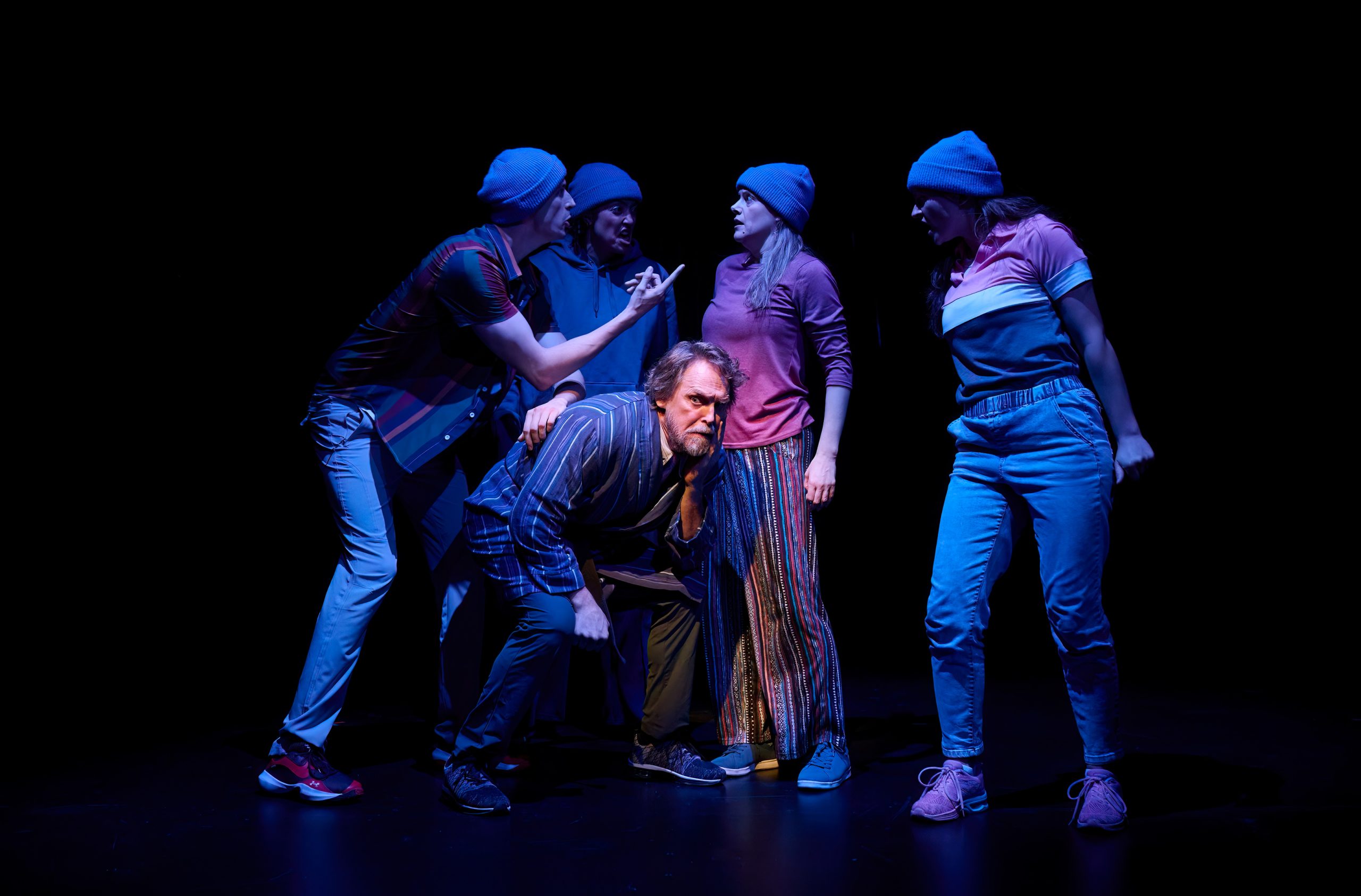
In Dissonant Species, that physical vocabulary runs through the various stories threaded across the piece: the woman maddened by the clicking pen; the professor who cannot recover from being slammed into by a passerby, his rage becoming so outsized that his colleagues simply call it ‘the bump’; and the tensions among a group of students, one of whom is continually out of phase with the others. These small frictions accumulate into a larger portrait of human discord. This is a piece about dissonance in all its forms — the emotional static that surrounds us, the collisions we cause, the misunderstandings we carry, the ways we fail to harmonize even with the people closest to us.
A highlight for me in Dissonant Species is the use of vocal sound by the ensemble.
One of the most striking scenes involves a professor explaining the rules of counterpoint to his four students. As he outlines each of Bach’s principles, the students demonstrate the rule vocally, creating harmonies that bloom and shift as if the classroom itself were alive. It is a music lesson and a theatrical coup, precise and inventive, and it feels unmistakably like something only Gargantua would attempt — and accomplish.
Dissonant Species
Photo: Michael Cooper
The multi-talented ensemble — Heather Marie Annis, Nicholas Eddie, Malia Rogers, Hannah Sunley-Paisley and Spence— navigates these tonal shifts with remarkable cohesion. Thomas directs with the clarity of someone who has spent decades refining this hybrid form. At times the staging resembles contemporary dance; at others it has the delicacy of chamber music.
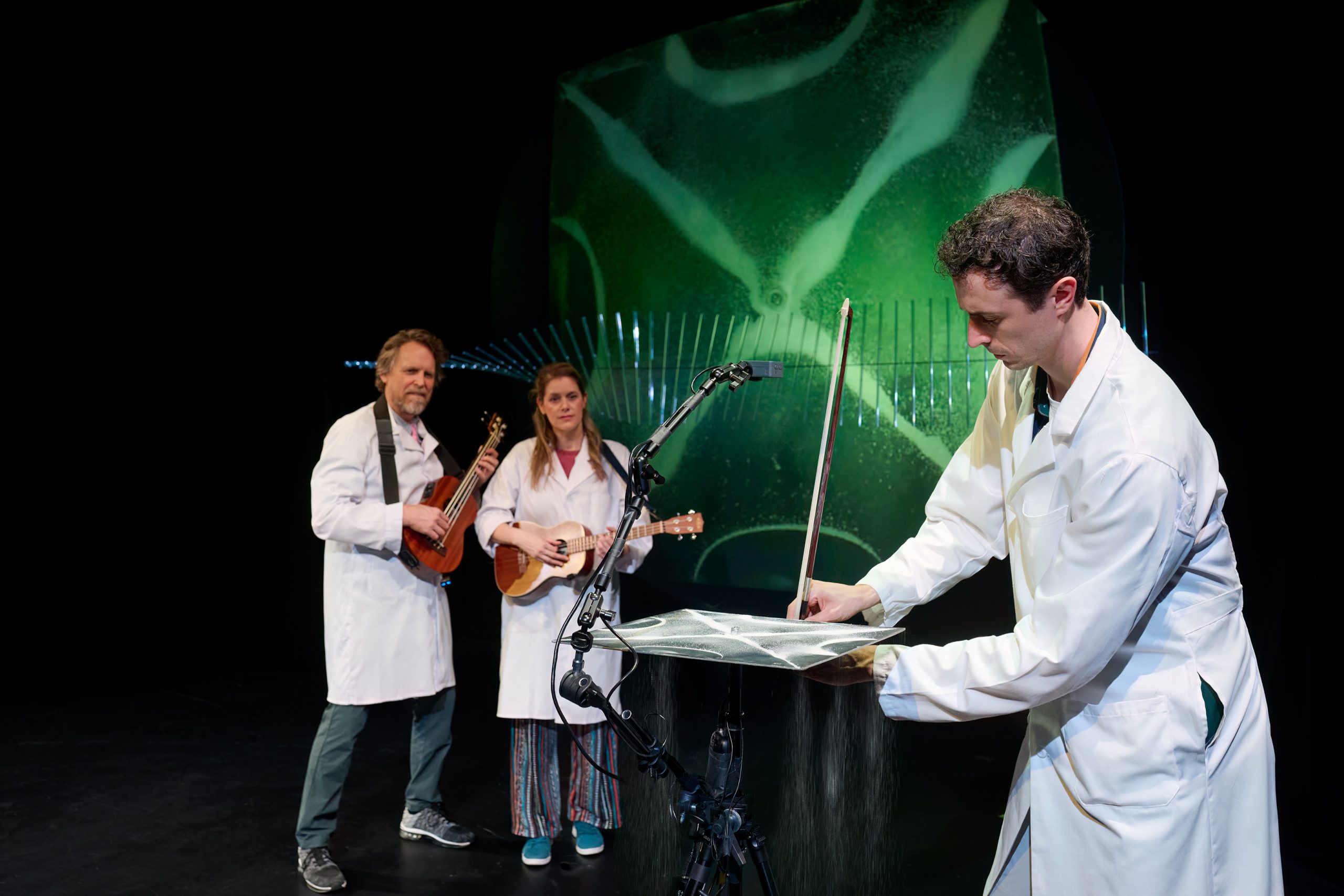
Spence’s set design uses Laird MacDonald’s magnificent projections of sound waves as the back drop while sliding screens carve the stage into shifting little words maneuvered by the cast – a void where anything might happen. Instruments sit on either side of the stage, not for traditional music-making but as tools for generating sound when a scene needs a particular texture. Macdonald’s projections and lighting wash the stage in saturated colour or isolate the performers in stark whites, while Christopher-Elizabeth and Richard lamb’s sound design creates a low hum beneath the action, a kind of emotional weather that shapes each moment. Even when the structure loosens and the piece becomes more impressionistic, that hum keeps the threads connected.
The text by Annis and Spence moves between observation, anecdote, abstraction and storytelling— never linear, but evocative enough to hold the room. Gargantua has never been a narrative company. They build atmosphere, not plot, and they ask the audience to settle into the texture of the world they have created. In Dissonant Species, that texture is built from pure human discord: the irritations we cannot let go of, the misunderstandings that escalate, the emotional noise that sits between us even when we are trying to connect.
At the end of a Theatre Gargantua show, you have to admire this company who for 30 years has never faltered in providing theatre that is stimulating, intelligent, thought-provoking, and entertaining not to mention being visually arresting.
And then there’s always a take away.
Late in the piece, there is a line that caught my attention and I want to believe that it’s true.
After dissonance, we hope there is something better.
Dissonant Species
Photo: Michael Cooper