
An Orchid and other such Lilies and Lies
Photo: Seamus Easton
Dandelion Theatre/An Orchid and other such Lilies and Lies, written by D. Halpern, directed by Max Ackerman, Red Sandcastle Theatre, closest Nov. 23.
D. Halpern and Max Ackerman have known each other since high school, and this production is the realization of a long-held dream.
Halpern first wrote An Orchid and other such Lilies and Lies when they were seventeen and mourning the coming death of a friend. Strangely, they channelled that grief into the story of two eighty-year-old men on a death pact, which became the seed of a Toronto Fringe production years later.
Now, under Ackerman’s direction, the play receives its full mainstage premiere, with no less than Stratford icons Scott Wentworth and Walter Borden performing up close and personal in the intimate Red Sandcastle Theatre. Seeing these two elder statesmen at such close range is a privilege in itself.
The production begins before the actors even appear. White sheets encircling the playing space act as projection surfaces. On them we see grainy images of young people on a beach—two of them clearly the younger versions of the men we are about to meet, one Black and one White, along with their friends. They cavort, dance, embrace, and drift through what seems like youth in all its possibility. This opening sequence lasts long enough to create an atmosphere of remembered freedom.
After these images comes an important Georgia O’Keeffe quotation: “Still—in a way—nobody sees a flower—really—it is so small we haven’t time—and to see takes time, like to have a friend takes time.” Friendship is the core of this play, and that quote echoes through the action.

Walter Borden
An Orchid and other such Lilies and Lies
Photo: Seamus Easton
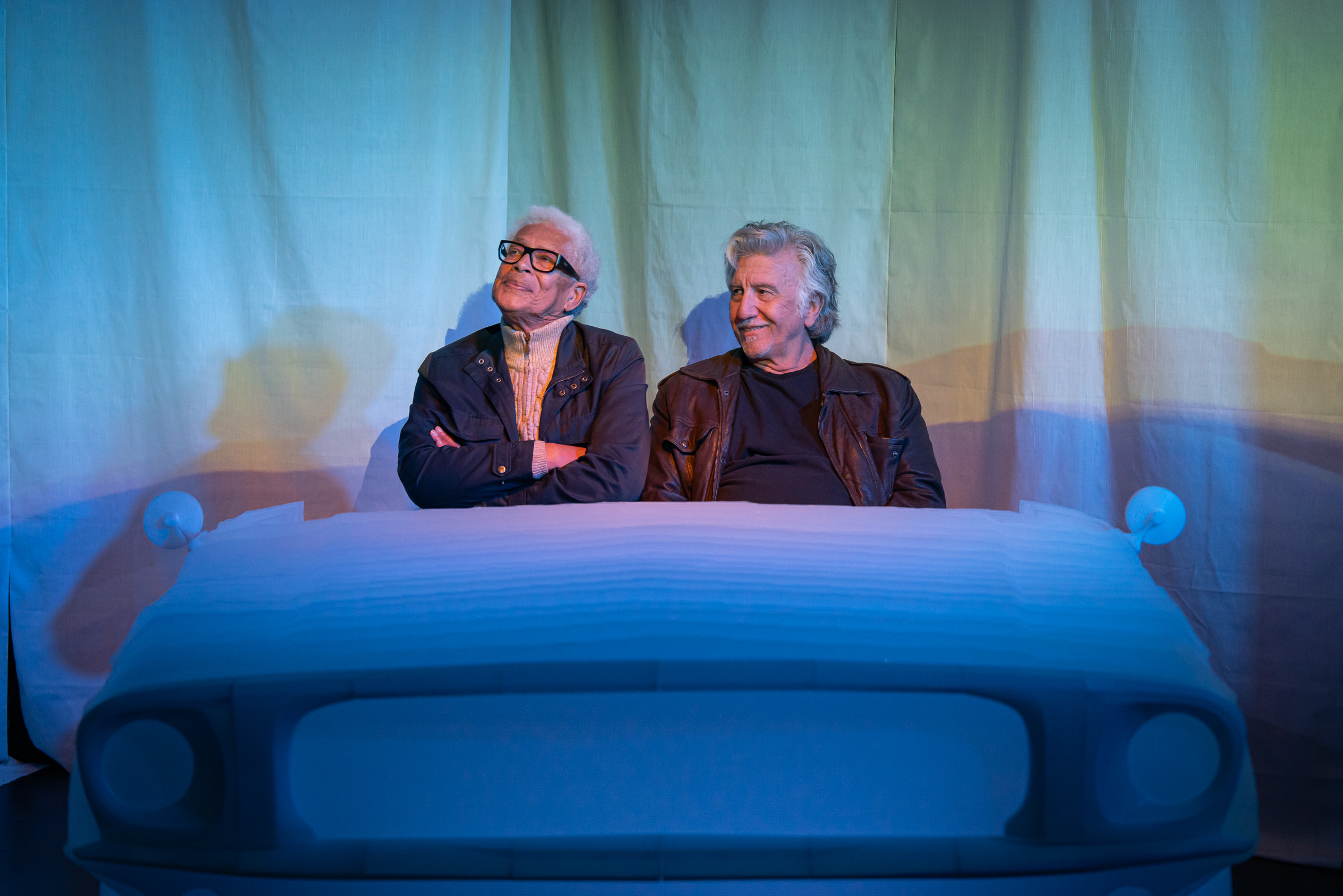
When the two elderly men finally appear, they are seated in one of the most astonishing stage pictures imaginable. The “car” in which they ride through the desert looks as though it has been generated by a 3D printer: white plastic tubing forming the hood and frame, with Lucite chairs serving as seats. It takes up most of the small stage, with the surrounding sheets carrying the shifting projections of desert landscapes.
The play begins with humour.
Wentworth’s character jokes that he has so many nose hairs he could donate them for wigs to chemotherapy patients. Borden counters with having enough earwax to make candles. The audience laughs heartily. But almost immediately we learn they are on a death pact, driving into the desert to end their lives together. One of the funniest moments comes when Wentworth shakes a box filled with the drugs and pills, they intend to use, listing them gleefully and saving “the good stuff” for last.
They also carry their high-school yearbooks. They begin naming their former classmates: who died, who married, who had children, who succeeded, who failed. Wentworth explains that if they do not remember these people, no one will. It is an unexpectedly moving moment—two anonymous old men with no names and no occupations given, holding the memories of a vanished cohort. They recognise that no one will remember them either.
As the drive continues, the conversation shifts. Humour gives way to revelations. We hear of Rose, the great love of the Borden character’s life, who died young, and whose name he gave to his daughter. We learn that both men married, that their lives were shaped by loss, duty, and missteps. We also learn there were moments when they needed each other profoundly and failed to show up. These grievances surface and recede.
There is a remarkable scene in which both men speak simultaneously about past experiences, neither listening to the other, each locked in his private history. Ackerman’s direction handles these tonal shifts gracefully, guiding the men from levity to irritation to confession.
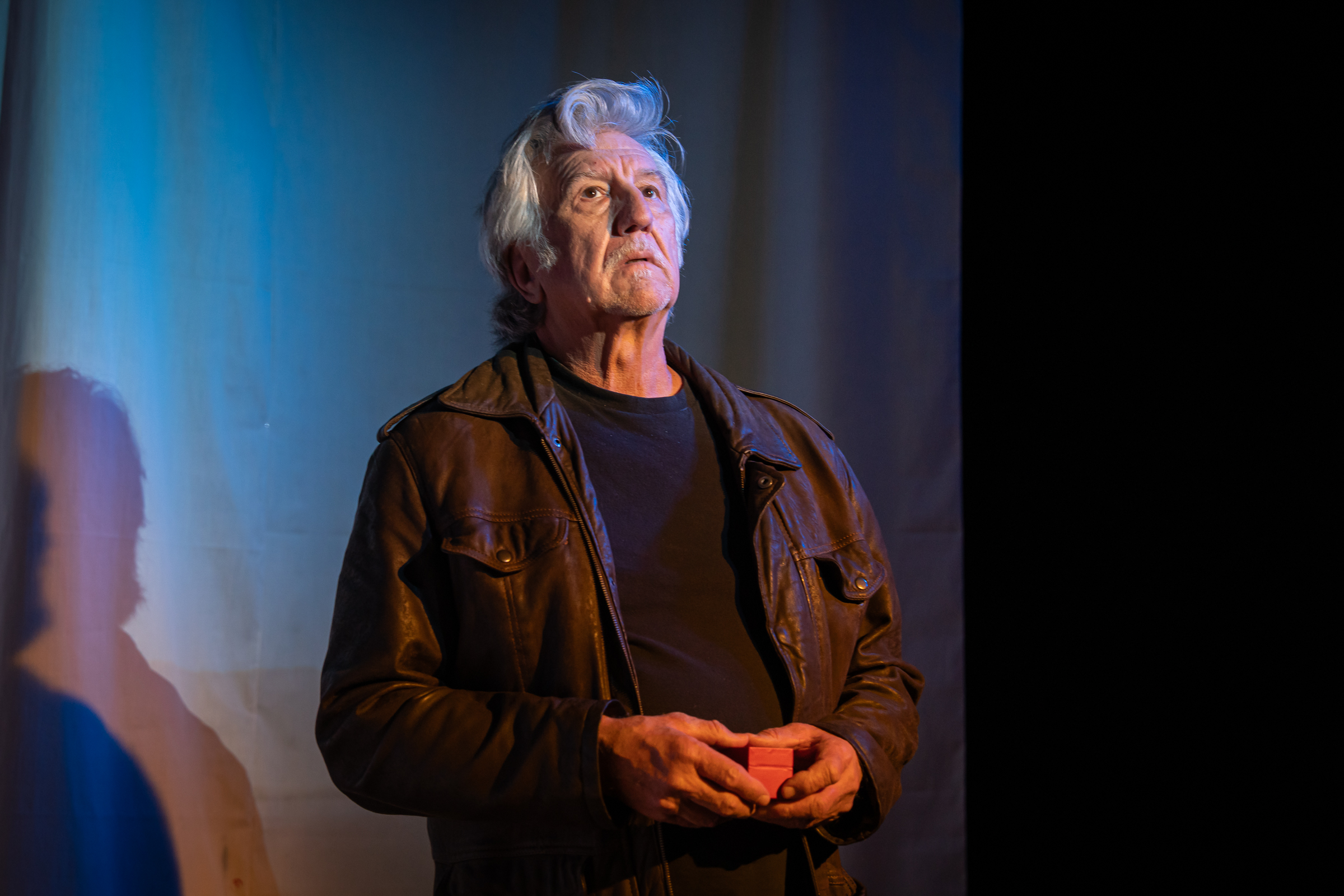
Scott Wentworth
An Orchid and other such Lilies and Lies
Photo: Seamus Easton
Late in the play, the stakes rise sharply. Borden’s character prepares to reveal a long‑kept secret but never does. In a moment alone, he speaks to God, giving Him a mission, though the nature of that mission remains unknown.
Wentworth carries a devastating intention of his own, which he attempts to express in a direct appeal to Borden. But Borden misses it entirely because he has brought his phone—against Wentworth’s wishes—and is texting his daughter as the appeal is made. It is a crushing moment.
The play concludes with Borden’s extraordinary monologue to his daughter—a mixture of imagined memory, longing, regret, and fragile hope. Before this speech are events between the men that cannot be described without spoiling the play’s impact, but they are both shocking and deeply human. The final ten minutes are delicate, brutal, surprising, and emotionally shattering.
Georgia O’Keeffe’s presence threads through the work. The Borden character claims to have proposed to his wife at an O’Keeffe exhibit, though Wentworth disputes the truth of it. Wentworth says he genuinely went to see O’Keeffe’s paintings and even imagines himself as the cow in one of them. In fact, he wants to be a cow. The imagery of seeing and being seen, of taking the time to understand another person, becomes central.
The set is unforgettable: that strange, white, 3D‑printed‑looking hood of a car surrounded by shifting desert projections.
Set design is credited to Sahana Dharmaraj and Kevan Cress, with projection design by Cress and lighting by Cress and Lidia Foote. The sound design by Ashley Naomi Skye includes the repeated sputtering and starting of the car engine. Seamus Easton’s initial cinematography provides the youth-film sequences.
In the end, the play is about the endurance of friendship—its failures, its recoveries, its absences, and its salvations. It is about the lives we live and the truths we hide.
An Orchid and other such Lilies and Lies is sensitive and brutal by turns, and it is a worthy staging of a young playwright whose talent is unmistakable.
Wentworth and Borden give monumental performances, and Ackerman shapes the emotional journey with precision.
The chance to see two great actors in such an intimate setting is an experience worth treasuring.